The Gift Perch earns a commission when you buy through our links, at no extra cost to you. We are an Amazon Associate. We accept no free products, no sponsored placements and no paid inclusion, and the commission rate plays no part in what we recommend. Full disclosure.
Buy for spacing, not for pattern. The American Bird Conservancy publishes the rule: markers with vertical, horizontal or diagonal gaps of two inches or less will prevent most collisions, stripes should be at least one-eighth of an inch wide, dots at least a quarter-inch across, and everything goes on the outside of the glass. That rule is what decides the purchase, because a four-decal pack on a picture window meets none of it. WindowAlert's UV Liquid is the only product here whose coverage is not capped by a sheet count; its Modern Dots sheet is the densest sticker format; and if a bird is deliberately attacking one pane, no collision product will help at all.
The American Bird Conservancy states that more than one billion birds die each year in the United States following window collisions. That is the reason this category exists, and it is also why it is worth being blunt about what a packet of stickers can and cannot do. This page does the arithmetic the listings leave out. Every rule below is ABC's own, and every product figure is the maker's own, both read on the dates in the sources.
What we judged on
Whether it can meet ABC's spacing rule at all. Two inches or less, in any direction. This is the criterion; everything else is secondary to it.
How much glass one purchase covers at the maker's own spacing. A sheet count is not coverage. Thirty decals at 4 in x 2 in is about 1.7 square feet, and a normal window is several times that.
Whether the maker publishes a spacing grid. Two of these four do. A product that tells you how to lay it out is doing something the rest of the category does not.
Inside or outside. ABC says outside, plainly, and says putting products on the inside should be avoided whenever possible. All four here are specified for the exterior.
The replacement interval. UV coatings fade. WindowAlert's own guidance is four months on the Performance Series and six on the Classic, which turns this from a purchase into a subscription.
Whether anyone claims proof. ABC lists products but publishes no comparative test results for them. We are not going to invent a ranking that the science does not support, so these are ranked on coverage and published detail, not on tested effectiveness.
The picks
Ranked picks with what each is best for, our score out of ten, the budget band it falls in, and a link to check its current price on Amazon.
#
Pick
Best for
Score
Price
01
WindowAlert UV Liquid Marker (1 oz)A sponge-tipped bottle you dot the glass with yourself — the only product here whose coverage is not capped by how many stickers are in the packet.Under $25
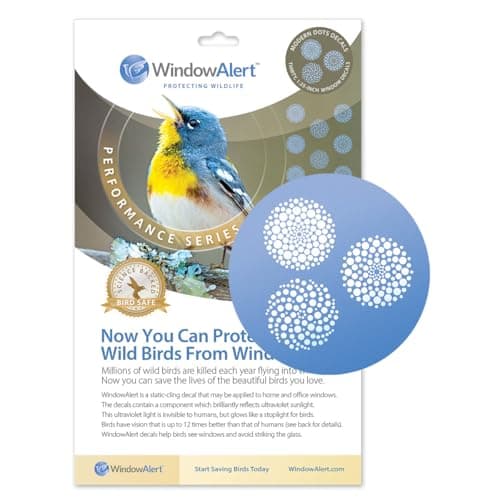
WindowAlert Modern Dots UV Window Decals (Performance Series)Thirty small decals on one sheet with a printed grid spacing — the only format here that gets anywhere near the coverage the science actually calls for.Under $25
The most decals per sheet, at the tightest published spacing
WindowAlert Stop Bird Attack Spray (9 oz)For the bird that keeps flying at the same pane on purpose — a territorial display against its own reflection, which decals do not solve.Under $25
The other window problem, which is not a collision at all
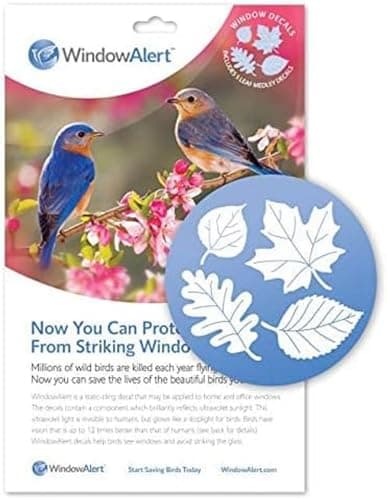
WindowAlert Leaf Medley UV Window Decals (Classic Series)Large leaf-shaped decals that look like something you would willingly put on a window — and that is most of what you are buying.Under $25
The decorative version, and the honest limits of one
Ranked by how much glass each one can actually treat at the published spacing, not by how they look on the window. If the bird is attacking the same pane on purpose rather than hitting it by accident, skip to the third pick — that is a different problem.
Pick 01
Treating a whole window at your own spacing
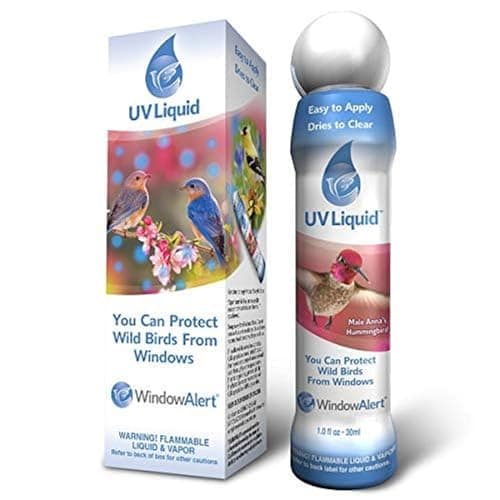
WindowAlert UV Liquid Marker (1 oz)
A sponge-tipped bottle you dot the glass with yourself — the only product here whose coverage is not capped by how many stickers are in the packet.
The American Bird Conservancy states that patterns with vertical, horizontal or diagonal spaces of two inches or less will prevent most collisionsSource: American Bird Conservancy, Solutions for Homes (glass-collision guidance for home windows), abcbirds.org, read 2026-09-20
Format
1 oz bottle with a sponge-tip applicator for dotting the glassSource: WindowAlert, UV Liquid product page, windowalert.com, read 2026-09-20
Spacing the maker specifies
Dots 4 in apart horizontally and 2 in apart verticallySource: WindowAlert, UV Liquid product page, windowalert.com, read 2026-09-20
Where it goes
Must be applied to the outside of the glass for full effectiveness, per the makerSource: WindowAlert, UV Liquid product page, windowalert.com, read 2026-09-20
Replacement interval
Every 4 months, or when the glow fadesSource: WindowAlert, UV Liquid product page, windowalert.com, read 2026-09-20
Shipping limits the maker states
Cannot be shipped to Alaska, Hawaii, or international destinations including CanadaSource: WindowAlert, UV Liquid product page, windowalert.com, read 2026-09-20
Coverage per bottle
Not published by the manufacturer in a form we could verify in square feet on the maker's product page
Minimum dot size
ABC states dots should be at least one quarter of an inch across; the maker does not specify a dot size for the applicatorSource: American Bird Conservancy, Solutions for Homes (glass-collision guidance for home windows), abcbirds.org, read 2026-09-20
Maker's list price
$19.45 on 2026-09-20
What it gets right
Coverage is limited by the bottle rather than by a sheet count, which is the only way a large window gets treated affordably
You choose the spacing, so you can work to ABC's two-inch rule rather than the maker's looser grid
Nearly invisible to people in most light, which is why it survives on a window people actually look through
The same four-month replacement cycle as the dense decals, at a fraction of the per-square-foot cost
What it does not
Invisible to you as well as to visitors, so you cannot tell by eye when it has faded without the maker's UV flashlight
No published coverage figure, so how many windows one bottle does is unknown before you buy
The maker will not ship it to Alaska, Hawaii or outside the continental US
Applying an even grid of dots by hand across a large pane is genuinely tedious work
Who it is for
Anyone treating a large window properly rather than symbolically, and willing to spend an hour with a bottle and a tape measure.
Skip this if
You want to see that the treatment is there. A liquid you cannot see is hard to maintain, and a visible decal grid is the honest choice for anyone who will not buy a UV torch to check it.
Pick 02
The most decals per sheet, at the tightest published spacing
WindowAlert Modern Dots UV Window Decals (Performance Series)
Thirty small decals on one sheet with a printed grid spacing — the only format here that gets anywhere near the coverage the science actually calls for.
The American Bird Conservancy states that patterns with vertical, horizontal or diagonal spaces of two inches or less will prevent most collisionsSource: American Bird Conservancy, Solutions for Homes (glass-collision guidance for home windows), abcbirds.org, read 2026-09-20
Decals per sheet
30Source: WindowAlert, Modern Dots UV Window Decals - Performance Series product page, windowalert.com, read 2026-09-20
Decal size
Approximately 1.25 in x 1.25 in eachSource: WindowAlert, Modern Dots UV Window Decals - Performance Series product page, windowalert.com, read 2026-09-20
Spacing the maker specifies
A 4 in horizontal x 2 in vertical grid, which WindowAlert describes as the spacing standard recommended by the American Bird ConservancySource: WindowAlert, Modern Dots UV Window Decals - Performance Series product page, windowalert.com, read 2026-09-20
Glass one sheet covers at that spacing
About 240 square inches — roughly 1.7 square feet, computed from 30 decals at 4 in x 2 in each
Where it goes
The outside of the glass; the maker states this is required for full effectivenessSource: WindowAlert, Modern Dots UV Window Decals - Performance Series product page, windowalert.com, read 2026-09-20
Coating
High-concentration UV coating, which the maker says reflects more UV light than its standard decalsSource: WindowAlert, Modern Dots UV Window Decals - Performance Series product page, windowalert.com, read 2026-09-20
Replacement interval
Every 4 months, or when the glow fades — the maker states UV performance depends on sun exposure and elevationSource: WindowAlert, Modern Dots UV Window Decals - Performance Series product page, windowalert.com, read 2026-09-20
Maker's list price
$9.95 per sheet, $36.95 for four, on 2026-09-20Source: WindowAlert, Modern Dots UV Window Decals - Performance Series product page, windowalert.com, read 2026-09-20
What it gets right
Thirty decals per sheet is by far the highest density here, and density is the entire mechanism
The maker publishes a spacing grid rather than leaving you to guess, which almost no decal listing does
At 1.25 in square these are small enough to sit at tight spacing without covering the view
Correctly specified for the outside of the glass, which is where ABC says markers belong
What it does not
One sheet covers about 1.7 sq ft. A single 3 ft x 5 ft window needs roughly nine sheets to be treated properly
The maker's 4 in horizontal spacing is looser than the two inches ABC currently publishes in every direction
UV coating fades: the maker's own advice is to replace every four months, so this is a running cost rather than a purchase
ABC lists products but publishes no comparative test results, so no decal here can be called the proven best
Who it is for
Someone treating a specific problem pane where birds have actually hit, who is willing to buy enough sheets to do that pane properly.
Skip this if
You are treating a large picture window and expect one pack to do it. The arithmetic does not work — price the job in sheets per square foot before you decide this is the answer.
Pick 03
The other window problem, which is not a collision at all
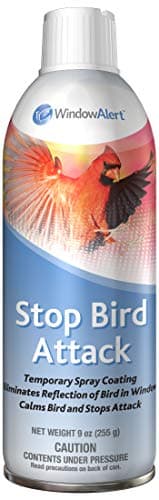
WindowAlert Stop Bird Attack Spray (9 oz)
For the bird that keeps flying at the same pane on purpose — a territorial display against its own reflection, which decals do not solve.
Songbirds establishing and defending a territory attack their own reflection; the maker states this happens most often in spring, with malesSource: WindowAlert, Stop Bird Attack product page, windowalert.com, read 2026-09-20
Why it matters
The maker states repeated attacks deplete the bird's energy and put its health and that of its nesting young at riskSource: WindowAlert, Stop Bird Attack product page, windowalert.com, read 2026-09-20
Format
9 oz removable spray coating for window glass
Shipping limits the maker states
Ships FedEx Ground to the continental US only, no PO boxes, and not to Alaska, Hawaii or international destinations including CanadaSource: WindowAlert, Stop Bird Attack product page, windowalert.com, read 2026-09-20
Coverage and durability
Not published by the manufacturer in a form we could verify on the maker's product page
Is this a collision product?
No. Collisions are birds failing to see the glass; this is a bird seeing a rival in it. Different problem, different fix.Source: American Bird Conservancy, Solutions for Homes (glass-collision guidance for home windows), abcbirds.org, read 2026-09-20
Maker's list price
$13.45 on 2026-09-20
What it gets right
Addresses the single most commonly misdiagnosed window problem, where buyers reach for collision decals that cannot help
The maker explains the behavior and the season it happens in rather than just selling the bottle
Removable, so it is a seasonal treatment rather than a permanent change to the glass
Cheap relative to repeatedly buying decals that were never going to work on this problem
What it does not
No published coverage figure and no published durability
Does nothing at all about collisions — it is not a substitute for spacing-rule markers
Continental US shipping only, and no PO boxes
Territorial attacks often stop on their own once the breeding season ends, so the value depends on timing
Who it is for
Anyone watching one cardinal or robin hammer the same pane every morning through spring. That bird is not confused about the glass; it is fighting.
Skip this if
Birds are hitting the window and stunning themselves. That is a collision, and this product is for the opposite situation — a bird deliberately attacking a reflection it recognizes as a rival.
Pick 04
The decorative version, and the honest limits of one
The American Bird Conservancy states that patterns with vertical, horizontal or diagonal spaces of two inches or less will prevent most collisionsSource: American Bird Conservancy, Solutions for Homes (glass-collision guidance for home windows), abcbirds.org, read 2026-09-20
Approximately 2 in x 2.25 in up to 4 in x 4.24 inSource: WindowAlert, Leaf Medley UV Window Decals - Classic Series product page, windowalert.com, read 2026-09-20
Spacing the maker specifies
Not published by the manufacturer in a form we could verify — unlike the Performance Series, this product page gives no grid
Where it goes
The outside of the glassSource: WindowAlert, Leaf Medley UV Window Decals - Classic Series product page, windowalert.com, read 2026-09-20
Coating
UV-reflective coating that the maker says reflects ultraviolet sunlight into a frequency only birds can seeSource: WindowAlert, Leaf Medley UV Window Decals - Classic Series product page, windowalert.com, read 2026-09-20
Replacement interval
Every 6 months, or when the glow fades — the maker states decals fade with exposure and elevationSource: WindowAlert, Leaf Medley UV Window Decals - Classic Series product page, windowalert.com, read 2026-09-20
Maker's list price
$7.95 per sheet, $29.95 for four, on 2026-09-20Source: WindowAlert, Leaf Medley UV Window Decals - Classic Series product page, windowalert.com, read 2026-09-20
What it gets right
Big enough to be a deliberate decoration rather than a grid of dots, which is why people actually leave them up
Cheapest entry point to a brand that publishes decal size and replacement interval at all
Six-month replacement rather than four, so the running cost is lower than the Performance Series
Correctly specified for the exterior of the glass
What it does not
Twelve large decals cannot be spaced anywhere near two inches apart on a normal window — this format is decorative first
The product page publishes no spacing guidance at all, where the Performance Series does
Larger decals obscure more of the view per unit of protection than small ones
Same fading problem as every UV product here, and the same absence of comparative testing
Who it is for
Someone who wants to do something visible about a window that worries them, and would rather have leaves on the glass than a grid of dots.
Skip this if
Birds are actually hitting the window. This is the decorative tier; the dense small-decal format or the liquid marker is what the spacing rule calls for.
The arithmetic nobody prints on the packet
Take WindowAlert's own recommended grid of 4 in horizontally by 2 in vertically. Each decal is therefore responsible for 8 square inches of glass. A sheet of thirty covers 240 square inches, which is about 1.7 square feet.
Now take an ordinary 3 ft by 5 ft window. That is 15 square feet, or 2,160 square inches, which at 8 square inches per decal needs about 270 decals — nine sheets. At the maker's list price of $9.95 a sheet, treating one window properly is roughly $90, and it has to be redone when the coating fades.
Hold it to ABC's stricter published rule of two inches in every direction and each decal covers 4 square inches instead of 8, so the same window needs about 540 decals. That is the number the category does not advertise, and it is the single strongest argument for the liquid marker, which is priced by the bottle rather than by the sticker.
What one purchase actually treats
What one purchase actually treats
Product
Units per pack
Spacing the maker gives
Glass covered per pack
Packs for a 3 ft x 5 ft window
Modern Dots
30 decals
4 in x 2 in
About 1.7 sq ft
About 9
Leaf Medley
12 decals
None published
Not calculable
Not a coverage product
UV Liquid
1 oz bottle
4 in x 2 in
Not published
Unknown, but not capped by a sheet count
Stop Bird Attack
9 oz spray
n/a
Not published
n/a — different problem
Coverage figures are computed on this page from each maker's own published decal count and spacing, on 2026-09-20. They are arithmetic, not a manufacturer claim.
Where the maker and the conservancy disagree
This is worth stating carefully, because both sources are quoted accurately on this page. The American Bird Conservancy's current published guidance is that patterns should have vertical, horizontal or diagonal spaces of two inches or less. WindowAlert's Performance Series pages specify a 4 in horizontal by 2 in vertical grid, and describe that as the spacing standard recommended by the American Bird Conservancy.
A 4 in x 2 in grid is twice as loose horizontally as the two-inch rule ABC publishes today. We are not in a position to say which spacing is correct in practice — we do not test, and ABC itself publishes no comparative results for individual products. What we can say is that if you want to meet the rule as ABC currently writes it, you need roughly double the decals the maker's grid implies, and the liquid marker is the only format on this page where you can simply choose your own spacing.
Collisions and attacks are different problems
The most common mistake in this category is buying collision decals for a bird that is not colliding. A collision is a bird that cannot see the glass, usually flying fast, often leaving a mark and a stunned or dead bird. An attack is a bird that lands, looks at its reflection, and goes at it deliberately — the same pane, the same time of day, day after day.
Fast impact, a dull thud, sometimes a feather smudge. A collision. Spacing-rule markers on the outside are the fix.
The same bird, the same window, every morning through spring. A territorial attack on its own reflection. WindowAlert states this happens most often in spring and usually with males.
Why it matters. The maker notes that repeated attacks drain the bird's energy and put it and any nestlings at risk, so it is not merely an annoyance.
Why decals do not fix it. The bird can already see the glass perfectly well. What it cannot do is recognize that the rival in it is itself.
Things that cost nothing and help
Move the feeder. A feeder either within about three feet of the glass or more than about thirty feet away reduces collision speed or removes the flight path. The dangerous distance is the middle.
Treat the outside, not the inside. ABC says this explicitly, and every product here is specified the same way. An interior decal is behind the reflection that causes the problem.
Treat the pane that is actually being hit. Collisions concentrate on specific windows — usually large ones reflecting sky or vegetation. Whole-house treatment is rarely necessary.
Check for glow before you replace. UV coatings fade invisibly. WindowAlert sells a UV flashlight for exactly this, which is an admission worth noting as much as a product to buy.
What not to buy
A four-decal pack for a picture window. It will not come close to the spacing rule, and it will make the problem feel solved when it is not.
A single hawk silhouette. The shape is irrelevant; birds do not avoid it as a predator. Only the spacing does anything, and one sticker provides none.
Anything applied to the inside. ABC advises against it directly. The reflection that causes the collision is on the outer surface.
Collision decals for a bird that is attacking its reflection. Different problem, different product, and the decals will change nothing.
FAQ
Questions people ask about this
Do window decals actually stop birds hitting windows?
Spacing does. The American Bird Conservancy publishes that patterns with vertical, horizontal or diagonal gaps of two inches or less will prevent most collisions, applied to the outside of the glass. A few decorative decals scattered on a large window do not meet that rule, which is why they often seem not to work.
How far apart should bird window decals be?
Two inches or less in any direction, per ABC's current published guidance. Note that WindowAlert's own Performance Series pages specify a 4 in horizontal by 2 in vertical grid and attribute that spacing to ABC — looser horizontally than ABC's two-inch rule, which is worth knowing before you calculate how many you need.
How many decals do I need for one window?
More than one packet. At a 4 in by 2 in grid, each decal covers 8 square inches, so a 3 ft by 5 ft window needs roughly 270 decals — about nine 30-decal sheets. At ABC's stricter two-inch spacing it is closer to 540. That arithmetic is the main reason to consider the liquid marker instead.
Should decals go on the inside or outside of the window?
Outside. ABC states that placing bird-friendly window products on the inside should be avoided whenever possible, because the reflection causing the collision is on the outer surface. All four products here are specified by their maker for exterior application.
Do UV window decals work if people cannot see them?
The claim is that birds see ultraviolet light that people cannot, and WindowAlert's coatings are built around that. It is worth knowing that ABC lists recommended products but publishes no comparative test results for them, so no honest source can rank UV decals against other markers on tested effectiveness. What is certain is the spacing rule.
How often do UV bird decals need replacing?
WindowAlert states every four months for its Performance Series and every six for the Classic Series, because the UV coating fades with sun exposure and elevation. That makes this a recurring cost rather than a one-off purchase, and it is a real factor in the price of treating a large window.
Why does a bird keep attacking my window?
It is defending a territory against its own reflection, not failing to see the glass. WindowAlert states this happens most often in spring and usually with males. Collision decals will not stop it — the bird can see the window perfectly well. A removable reflection-reducing coating is the product for that problem.
Where should I put my bird feeder to reduce collisions?
Either very close to the glass or well away from it. A feeder within about three feet means birds cannot build up enough speed to be injured, and one more than about thirty feet away keeps the flight path clear of the window. The middle distance is where collisions happen.