
Skip to content
The GiftPerch

Binoculars — guide

8x42 vs 10x42 for bird watching

Two numbers, one decision, and a clear default. Here is what each one changes, and the specific case where 10x is the better buy.

By Scooter M.Published September 2, 2026Content updated September 2, 2026Prices shown live on Amazon

We don't test this gear. Here's what we do instead.

A hand holding binoculars up toward a bright horizon

The Gift Perch earns a commission when you buy through our links, at no extra cost to you. We are an Amazon Associate. We accept no free products, no sponsored placements and no paid inclusion, and the commission rate plays no part in what we recommend. Full disclosure.

8x42 is the right choice for most birding. Eight times magnification is steady enough to hold by hand, gives a wider field of view for finding moving birds, and produces a brighter image at dawn and dusk. 10x42 reaches further for open water and open country, at the cost of a narrower, shakier and dimmer view.

The first number is magnification; the second is the diameter of the front lens in millimeters. Both matter, but for birding the front lens is nearly always 42 mm and the argument is entirely about the first number.

What changes between 8x and 10x

The trade, attribute by attribute
8x4210x42
Magnification8 times10 times — about 25% more
Field of viewWider — 7.2 to 8.1 degrees across the pairs we listNarrower at the same price point
Hand shakeManageableMagnified along with the bird — visible wobble for most people
Exit pupilAbout 5.3 mmAbout 4.2 mm — dimmer at dawn and dusk
Finding a moving birdEasierHarder — the narrow view is the reason
Reach across open waterAdequateBetter
Best forWoodland, garden, feeder, general birdingShorelines, lakes, raptors, open prairie

Field-of-view figures are from the manufacturers' published tables for the 8x42 pairs listed on this site. Exit pupil is objective diameter divided by magnification.

Why field of view decides it

The hardest part of birding is not seeing the bird clearly — it is getting the bird into the circle at all. A wider field means more of the world is inside the view when you lift the binoculars, and a small bird moving through a hedge stays in frame for longer.

The spread between published 8x42 figures illustrates how much this varies: the Athlon Midas G2 gives 8.1 degrees and 429 ft at 1,000 yards, while the Nikon PROSTAFF P7 gives 7.2 degrees and 377 ft. That is a 52 ft difference at the same magnification — and a 10x pair typically narrows further still.

Why hand shake matters more than people expect

Magnification multiplies everything, including the small involuntary movements of your hands. At 8x that motion is present and tolerable. At 10x it is 25 per cent larger, and for most people watching for more than a few seconds it becomes the limiting factor on how much detail they can actually resolve — which means 10x can deliver *less* usable detail than 8x despite magnifying more.

When 10x is genuinely the better buy

  • Open water and shorelines, where the birds are distant and there is nothing to lose them behind.
  • Open country and raptor watching, where a bird sits still on a distant post.
  • Someone with steady hands who already owns an 8x and wants a second pair for reach.
  • Used from a car window or with a tripod, where the shake problem largely disappears.

What size binoculars for bird watching, in one line

8x42. If you take nothing else from this page, take that.

The 8x42 pairs we would buy

Ranked picks with what each is best for, our score out of ten, the budget band it falls in, and a link to check its current price on Amazon.
#PickBest forScorePrice
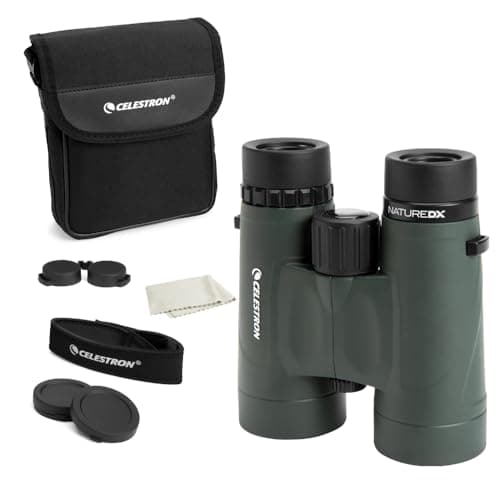
01CelestronNo photoCelestron Nature DX 8x42The pair nearly every birding guide starts with, and the only one in this group that focuses down to 6.5 feet — which matters more than it sounds.Under $250The default first pair, and the closest focus here8.8out of 10
Check price on Amazon

#ad Price shown live on Amazon. How we are funded

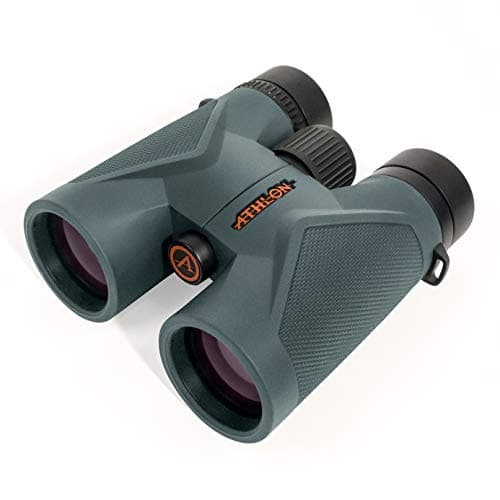
02Athlon OpticsNo photoAthlon Optics Midas G2 UHD 8x428.1 degrees is a visibly bigger picture than anything else in this group, and ED glass is the reason edges stay clean at that width.Under $250The widest view, and the only ED glass here8.9out of 10
Check price on Amazon

#ad Price shown live on Amazon. How we are funded

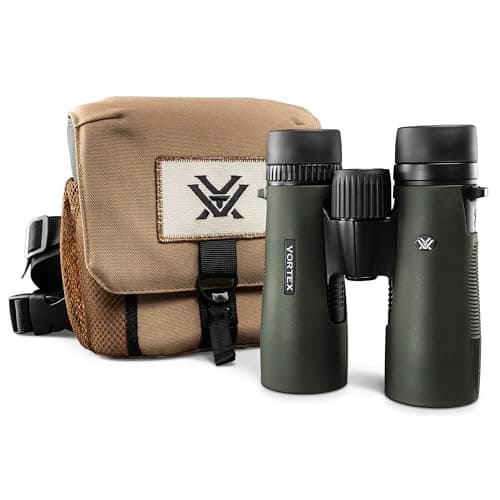
03VortexNo photoVortex Diamondback HD 8x42Nothing here is the best figure in its column, and nothing is the worst — which for a gift is exactly the right shape.Under $250The best balance of the four numbers that matter8.7out of 10
Check price on Amazon

#ad Price shown live on Amazon. How we are funded

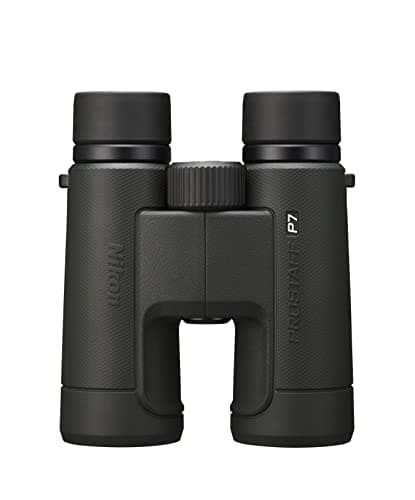
04NikonNo photoNikon PROSTAFF P7 8x4220.2 mm of eye relief is the most generous figure here by a clear margin, and it is the number that decides whether a spectacle wearer keeps them.Under $250Anyone who wears glasses8.4out of 10
Check price on Amazon

#ad Price shown live on Amazon. How we are funded

Scores are ours, from the published rubric on the how-we-pick page. They are editorial judgments about published specifications and cost arithmetic, not test results — we have not handled these products.

Pick 01

CelestronNo photo

The default first pair, and the closest focus here

Celestron Nature DX 8x42

The pair nearly every birding guide starts with, and the only one in this group that focuses down to 6.5 feet — which matters more than it sounds.

Score
8.8
Eye relief
9.0
Field of view
7.0
Close focus
9.5
Value
9.0
Budget band
Under $250
Check price on Amazon

#ad Price shown live on Amazon. How we are funded

Published specifications

Magnification and objective
8x, 42 mmSource: Celestron Nature DX 8x42 specifications, celestron.com, read 2026-09-02
Field of view
7.4 degrees, 388 ft at 1,000 yardsSource: Celestron Nature DX 8x42 specifications, celestron.com, read 2026-09-02
Eye relief
17.5 mm — comfortable over glassesSource: Celestron Nature DX 8x42 specifications, celestron.com, read 2026-09-02
Close focus
6.5 ft (2 m)Source: Celestron Nature DX 8x42 specifications, celestron.com, read 2026-09-02
Weight
22.2 oz (629 g)Source: Celestron Nature DX 8x42 specifications, celestron.com, read 2026-09-02
Prism and glass
Roof prism, BaK-4 with phase coatingSource: Celestron Nature DX 8x42 specifications, celestron.com, read 2026-09-02
Weatherproofing
Waterproof, nitrogen-filled and fogproofSource: Celestron Nature DX 8x42 specifications, celestron.com, read 2026-09-02
Warranty
Limited lifetime warrantySource: Celestron Nature DX 8x42 specifications, celestron.com, read 2026-09-02

What it gets right

  • 6.5 ft close focus, so a bird on the far side of the patio is still usable — and so are butterflies
  • 17.5 mm eye relief works over glasses without cropping the view
  • Phase-coated roof prisms at an entry price, which is not universal here
  • Limited lifetime warranty

What it does not

  • Field of view is the narrowest in this group at 7.4 degrees
  • Heavier than the Nikon by well over an ounce
  • No ED glass, so high-contrast edges show more color fringing than the Athlon

Who it is for

The safe first pair. If you know nothing about the recipient except that they like birds, this is the pair with the fewest ways to be wrong.

Skip this if

You want the widest possible view for following birds in flight. The Athlon's 8.1 degrees is a noticeably easier picture to track with.

Pick 02

Athlon OpticsNo photo

The widest view, and the only ED glass here

Athlon Optics Midas G2 UHD 8x42

8.1 degrees is a visibly bigger picture than anything else in this group, and ED glass is the reason edges stay clean at that width.

Score
8.9
Eye relief
8.5
Field of view
10.0
Close focus
8.5
Value
8.5
Budget band
Under $250
Check price on Amazon

#ad Price shown live on Amazon. How we are funded

Published specifications

Magnification and objective
8x, 42 mmSource: Athlon Midas G2 UHD 8x42 specifications, athlonoptics.com, read 2026-09-02
Field of view
8.1 degrees, 429 ft at 1,000 yards — the widest hereSource: Athlon Midas G2 UHD 8x42 specifications, athlonoptics.com, read 2026-09-02
Eye relief
17.2 mmSource: Athlon Midas G2 UHD 8x42 specifications, athlonoptics.com, read 2026-09-02
Close focus
6.5 ftSource: Athlon Midas G2 UHD 8x42 specifications, athlonoptics.com, read 2026-09-02
Weight
23.3 oz — the heaviest hereSource: Athlon Midas G2 UHD 8x42 specifications, athlonoptics.com, read 2026-09-02
Glass
Extra-low dispersion (ED) glass, fully multi-coated, ESP dielectric prism coatingSource: Athlon Midas G2 UHD 8x42 specifications, athlonoptics.com, read 2026-09-02
Chassis
Magnesium, waterproofSource: Athlon Midas G2 UHD 8x42 specifications, athlonoptics.com, read 2026-09-02
Warranty
Athlon lifetime warrantySource: Athlon Midas G2 UHD 8x42 specifications, athlonoptics.com, read 2026-09-02

What it gets right

  • 429 ft at 1,000 yards is 41 ft wider than the Nature DX, which makes finding a moving bird much easier
  • ED glass reduces the purple fringing you see on a bird against a bright sky
  • Magnesium chassis rather than polycarbonate
  • Lifetime warranty

What it does not

  • Heaviest here at 23.3 oz
  • Least familiar brand of the four, which can matter for a gift recipient looking for help later
  • The wide field makes the pair physically bulkier in the hand

Who it is for

Someone who already owns a cheap pair and has said they struggle to find the bird. Field of view is the fix for that complaint, and this has the most of it.

Skip this if

The recipient has neck or shoulder problems, or will carry these all day. Two and a half ounces sounds trivial and is not, after three hours.

Pick 03

VortexNo photo

The best balance of the four numbers that matter

Vortex Diamondback HD 8x42

Nothing here is the best figure in its column, and nothing is the worst — which for a gift is exactly the right shape.

Score
8.7
Eye relief
8.0
Field of view
8.0
Close focus
10.0
Value
8.5
Budget band
Under $250
Check price on Amazon

#ad Price shown live on Amazon. How we are funded

Published specifications

Magnification and objective
8x, 42 mmSource: Vortex Diamondback HD 8x42 specifications, vortexoptics.com, read 2026-09-02
Field of view
7.5 degrees, 393 ft at 1,000 yardsSource: Vortex Diamondback HD 8x42 specifications, vortexoptics.com, read 2026-09-02
Eye relief
17 mmSource: Vortex Diamondback HD 8x42 specifications, vortexoptics.com, read 2026-09-02
Close focus
5 ft — the closest in this groupSource: Vortex Diamondback HD 8x42 specifications, vortexoptics.com, read 2026-09-02
Weight
21.8 ozSource: Vortex Diamondback HD 8x42 specifications, vortexoptics.com, read 2026-09-02
Size
5.8 in high, 5.1 in wideSource: Vortex Diamondback HD 8x42 specifications, vortexoptics.com, read 2026-09-02
Exit pupil
5.3 mmSource: Vortex Diamondback HD 8x42 specifications, vortexoptics.com, read 2026-09-02
Interpupillary range
55-75 mm — the widest adjustment here, which suits smaller facesSource: Vortex Diamondback HD 8x42 specifications, vortexoptics.com, read 2026-09-02

What it gets right

  • 5 ft close focus, the shortest here — a feeder on the far side of a window is in range
  • 55 mm minimum interpupillary distance fits narrower faces, including most children
  • Vortex's warranty is unconditional and transferable, which for a gift is unusually relevant

What it does not

  • 17 mm eye relief is adequate over glasses rather than generous
  • Heavier than the Nikon
  • Sits at the upper end of this price band once you add a decent harness

Who it is for

The recipient you know least about. A transferable no-fault warranty means the gift survives being dropped, which no specification can promise.

Skip this if

Absolute lightness is the deciding factor. The Nikon is a full ounce lighter and that is noticeable on a long walk.

Pick 04

NikonNo photo

Anyone who wears glasses

Nikon PROSTAFF P7 8x42

20.2 mm of eye relief is the most generous figure here by a clear margin, and it is the number that decides whether a spectacle wearer keeps them.

Score
8.4
Eye relief
10.0
Field of view
6.5
Close focus
5.0
Value
8.5
Budget band
Under $250
Check price on Amazon

#ad Price shown live on Amazon. How we are funded

Published specifications

Magnification and objective
8x, 42 mmSource: Nikon PROSTAFF P7 8x42 specifications, nikonusa.com, read 2026-09-02
Field of view
7.2 degrees real, 53.4 degrees apparent, 377 ft at 1,000 yardsSource: Nikon PROSTAFF P7 8x42 specifications, nikonusa.com, read 2026-09-02
Eye relief
20.2 mm — the longest in this listSource: Nikon PROSTAFF P7 8x42 specifications, nikonusa.com, read 2026-09-02
Close focus
9.8 ft (3.0 m)Source: Nikon PROSTAFF P7 8x42 specifications, nikonusa.com, read 2026-09-02
Weight
20.8 oz (590 g) — the lightest hereSource: Nikon PROSTAFF P7 8x42 specifications, nikonusa.com, read 2026-09-02
Exit pupil
5.3 mmSource: Nikon PROSTAFF P7 8x42 specifications, nikonusa.com, read 2026-09-02
Weatherproofing
Waterproof and fogproofSource: Nikon PROSTAFF P7 8x42 specifications, nikonusa.com, read 2026-09-02

What it gets right

  • 20.2 mm eye relief, which no other pair in this group approaches
  • Lightest here at 20.8 oz, which matters after an hour around the neck
  • Nikon's service network is the easiest of these brands to actually reach

What it does not

  • 9.8 ft close focus is the worst in this group — a bird at the feeder ten feet away may not focus
  • Narrowest real field of view here at 7.2 degrees
  • Plainer finish than rivals at similar money, if that matters to the recipient

Who it is for

A glasses wearer, or anyone who has previously said binoculars give them a tunnel-vision black ring. That symptom is short eye relief, and this is the fix.

Skip this if

The recipient mostly watches a feeder from a kitchen window. At 9.8 ft minimum focus, a close feeder is exactly the shot these cannot take.

FAQ

Questions people ask about this

Is 8x42 or 10x42 better for bird watching?

8x42 for most birding. It is steadier in the hand, wider for finding moving birds, and brighter at dawn and dusk. 10x42 is better for open water, shorelines and raptor watching, where reach matters more than field of view.

What size binoculars for bird watching?

8x42. Eight times magnification is the most a person can hold steady by hand, and a 42 mm objective gathers enough light for the first and last hour of daylight — which is when birds are most active.

Does 10x magnification show more detail?

In theory yes, in practice often no. Ten times magnifies hand shake as well as the bird, and for most people watching handheld the shake becomes the limiting factor — so a 10x pair can deliver less usable detail than an 8x.

What does the second number mean on binoculars?

The diameter of the front lens in millimeters. A 42 mm objective gathers substantially more light than a 25 mm compact, which is why 42 mm is the birding standard.

Is 12x too much for birding?

For handheld use, generally yes. Hand shake at 12x is severe enough that a tripod becomes close to essential, and the field of view narrows to the point where finding a moving bird is genuinely difficult.

Sources

Where these figures come from