
Skip to content
The GiftPerch

Binoculars

Best spotting scopes for birding

A different instrument from binoculars, for a different bird: far away, and not going anywhere. Five scopes on the figures their makers publish, and the one that most people should actually buy.

By Scooter M.Published September 11, 2026Content updated September 11, 2026Prices verified September 12, 2026

We don't test this gear. Here's what we do instead.

A group of shorebirds including a long-billed curlew foraging on a distant coastal mudflat

The Gift Perch earns a commission when you buy through our links, at no extra cost to you. We are an Amazon Associate. We accept no free products, no sponsored placements and no paid inclusion, and the commission rate plays no part in what we recommend. Full disclosure.

For most people buying a first spotting scope, the Celestron Hummingbird 9-27x56 ED is the one to buy: at a published 20.8 oz it weighs what a binocular weighs, its 9.8 ft close focus works in a garden, and it has ED glass at the price of the non-ED full-size scopes. If the recipient watches estuaries or reservoirs from a fixed spot and needs 60x, the Regal M2 20-60x80 ED is the serious answer and the Ultima 20-60x80 is the cheapest complete one.

A spotting scope is not a bigger binocular. It is a single-eyepiece telescope on a tripod, running 20x to 60x, for a bird that is a long way off and staying put — a duck on a reservoir, a shorebird on a mudflat, a raptor on a ridge. Nobody hand-holds one. That is worth saying first, because the main binocular roundup covers what most people should buy, and a scope is the purchase after that, not instead of it. Every figure on this page is from the maker's own specification table, read on the dates named in the sources; we have not handled any of them.

What we judged on

  1. Whether it will actually leave the house. Full-size 80 mm scopes here weigh 54 to 67 oz before the tripod. That is a car-and-fixed-spot instrument. The Hummingbird weighs 20.8 oz, and that single figure changes who it is for.
  2. ED glass or not. Extra-low dispersion glass is what removes the color fringing that spoils a 60x view of a bird against a bright sky. It is the concrete difference between the cheaper and dearer scopes, and the makers state it.
  3. Close focus. Published figures here run from 9.8 ft to 26.2 ft. A scope that cannot focus closer than 26 ft is useless in a garden, which is fine for a seawatcher and a surprise for a gift recipient.
  4. Field of view at the top of the zoom. At 60x the field is narrow — 52 to 60 ft at 1,000 yards here — and the wider figure is the one that lets you follow a bird that moves.
  5. Eye relief across the zoom. Some scopes hold 18 mm or more throughout; others drop to 15 mm at 60x, which crops the view over glasses just when you need it least.
  6. Warranty and where the maker sells. Four of these are sold direct with stock we could confirm; one is sold through dealers only, and we say so on its card.

The picks

Ranked picks with what each is best for, our score out of ten, the budget band it falls in, and a link to check its current price on Amazon.
#PickBest forScorePrice
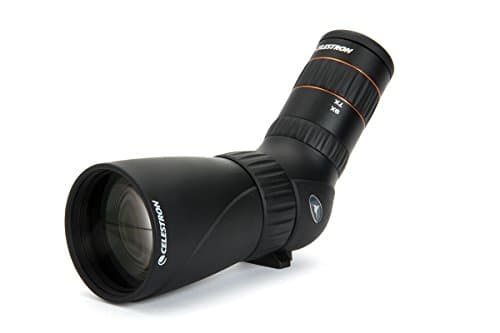
01Celestron Hummingbird 9-27x56mm ED Angled Zoom Micro Spotting ScopeCelestron Hummingbird 9-27x56mm ED Angled Zoom Micro Spotting ScopeAt 20.8 oz it is lighter than every full-size binocular on this site, and its 9.8 ft close focus is the only scope figure here that works in a garden — the trade is a 56 mm objective and 27x at the top.$250 and upThe scope that weighs what binoculars weigh8.4out of 10
$369.95 · View on Amazon

#ad Price as of September 12, 2026. How we are funded

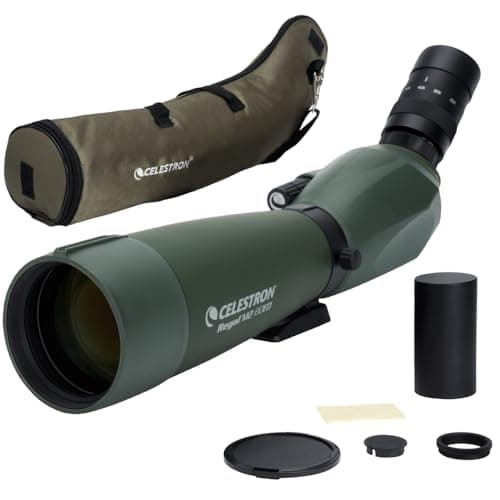
02Celestron Regal M2 20-60x80mm ED Angled Zoom Spotting ScopeCelestron Regal M2 20-60x80mm ED Angled Zoom Spotting ScopeED glass, a magnesium body and 20 mm of eye relief — the point in this range where the published figures stop being trade-offs and start being the real thing.$250 and upThe serious scope, if the budget reaches it7.8out of 10
$799.00 · View on Amazon

$879.959% off

#ad Price as of September 12, 2026. How we are funded

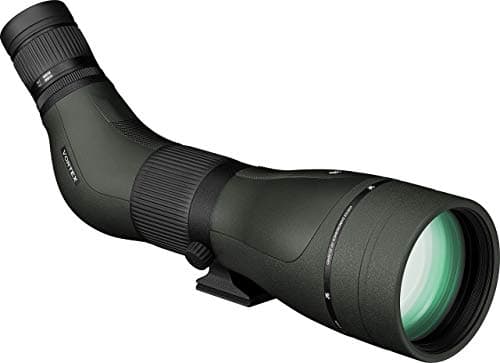
03Vortex Diamondback HD 20-60x85 Angled Spotting ScopeVortex Diamondback HD 20-60x85 Angled Spotting ScopeAn 85 mm HD scope with the widest published field at 60x on this page and Vortex's unconditional lifetime warranty — sold through dealers rather than direct, so we could not confirm stock from the maker.$250 and upThe Vortex option, with the warranty that has no conditions7.6out of 10
$499.00 · View on Amazon

#ad Price as of September 12, 2026. How we are funded

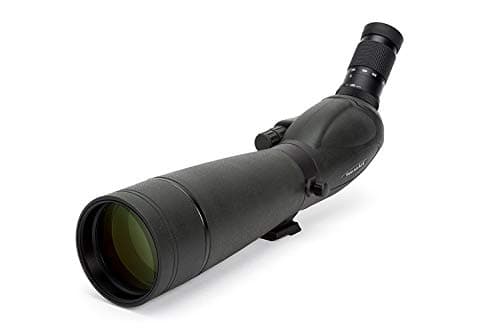
04Celestron TrailSeeker 20-60x80mm Angled Zoom Spotting ScopeCelestron TrailSeeker 20-60x80mm Angled Zoom Spotting ScopeEverything the Ultima has plus a coarse-and-fine focus and a rotating tripod collar, two features that matter more in use than the spec sheet suggests.$250 and upThe mid-step: dual focus and a rotating mount without paying for ED glass7.3out of 10
$349.99 · View on Amazon

$369.955% off

#ad Price as of September 12, 2026. How we are funded

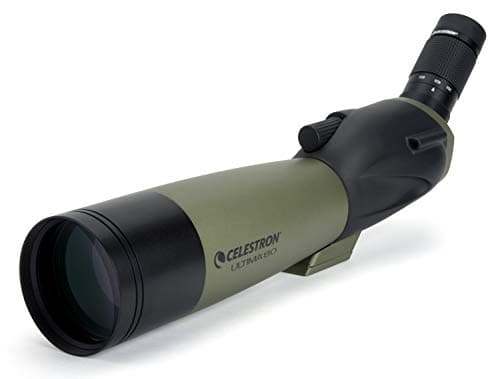
05Celestron Ultima 20-60x80mm Angled Zoom Spotting ScopeCelestron Ultima 20-60x80mm Angled Zoom Spotting ScopeThe entry point: an 80 mm scope with a full published spec sheet and a lifetime warranty, and the trade for the price is glass without ED correction.$250 and upA first spotting scope at the lowest price that still publishes every figure7.2out of 10
$269.95 · View on Amazon

#ad Price as of September 12, 2026. How we are funded

Ranked on the figure that decides whether a scope gets used — which for most gift recipients is weight, not objective size.

Pick 01

Celestron Hummingbird 9-27x56mm ED Angled Zoom Micro Spotting Scope

The scope that weighs what binoculars weigh

Celestron Hummingbird 9-27x56mm ED Angled Zoom Micro Spotting Scope

At 20.8 oz it is lighter than every full-size binocular on this site, and its 9.8 ft close focus is the only scope figure here that works in a garden — the trade is a 56 mm objective and 27x at the top.

Score
8.4
Published specs
10.0
Optical spec
7.5
Portability
9.5
Value
8.0
Budget band
$250 and up
$369.95 · View on Amazon

#ad Price as of September 12, 2026. How we are funded

Published specifications

Magnification and objective
9-27x zoom, 56 mmSource: Celestron Hummingbird 9-27x56mm ED Angled Zoom Micro Spotting Scope (item 52308) product page and specification table, celestron.com, read 2026-09-11
Field of view
216 ft at 9x to 98 ft at 27x, at 1,000 yardsSource: Celestron Hummingbird 9-27x56mm ED Angled Zoom Micro Spotting Scope (item 52308) product page and specification table, celestron.com, read 2026-09-11
Eye relief
15 mmSource: Celestron Hummingbird 9-27x56mm ED Angled Zoom Micro Spotting Scope (item 52308) product page and specification table, celestron.com, read 2026-09-11
Close focus
9.8 ft (3 m)Source: Celestron Hummingbird 9-27x56mm ED Angled Zoom Micro Spotting Scope (item 52308) product page and specification table, celestron.com, read 2026-09-11
Weight and length
20.8 oz (590 g); 8.2 inSource: Celestron Hummingbird 9-27x56mm ED Angled Zoom Micro Spotting Scope (item 52308) product page and specification table, celestron.com, read 2026-09-11
Glass and prisms
ED (extra-low dispersion) glass; BaK-4 phase-coated prisms; fully multi-coatedSource: Celestron Hummingbird 9-27x56mm ED Angled Zoom Micro Spotting Scope (item 52308) product page and specification table, celestron.com, read 2026-09-11
Weatherproofing
Waterproof, nitrogen filledSource: Celestron Hummingbird 9-27x56mm ED Angled Zoom Micro Spotting Scope (item 52308) product page and specification table, celestron.com, read 2026-09-11
Warranty
Limited lifetimeSource: Celestron Hummingbird 9-27x56mm ED Angled Zoom Micro Spotting Scope (item 52308) product page and specification table, celestron.com, read 2026-09-11
Maker's list price and stock
$369.95, in stock on celestron.com on 2026-09-11Source: Celestron Hummingbird 9-27x56mm ED Angled Zoom Micro Spotting Scope (item 52308) product page and specification table, celestron.com, read 2026-09-11

What it gets right

  • 20.8 oz — the same as the lightest full-size binocular on this site, so it genuinely goes in a bag
  • 9.8 ft close focus, against 21 to 26 ft for the 80 mm scopes
  • ED glass and phase-coated prisms at the same price as the non-ED TrailSeeker
  • 216 ft field at 9x makes finding the bird far easier than any 20x scope

What it does not

  • 27x maximum — this cannot do what a 60x scope does on a distant duck
  • 56 mm objective gathers much less light than 80 mm, so dusk is a struggle
  • 15 mm eye relief is on the short side over glasses
  • It is small enough to tempt hand-holding, which does not work above about 10x

Who it is for

Someone who walks to their birds, already owns binoculars, and wants a step up in reach without a tripod-sized commitment. The best gift scope here, precisely because it is the one most likely to actually leave the house.

Skip this if

The recipient birds estuaries and reservoirs where the bird is a quarter of a mile away. 27x is not enough for that job, and no amount of ED glass changes it.

Pick 02

Celestron Regal M2 20-60x80mm ED Angled Zoom Spotting Scope

The serious scope, if the budget reaches it

Celestron Regal M2 20-60x80mm ED Angled Zoom Spotting Scope

ED glass, a magnesium body and 20 mm of eye relief — the point in this range where the published figures stop being trade-offs and start being the real thing.

Score
7.8
Published specs
10.0
Optical spec
9.0
Portability
2.5
Value
6.5
Budget band
$250 and up
$799.00 · View on Amazon

$879.959% off

#ad Price as of September 12, 2026. How we are funded

Published specifications

Magnification and objective
20-60x zoom, 80 mmSource: Celestron Regal M2 20-60x80mm ED Angled Zoom Spotting Scope (item 52305) product page and specification table, celestron.com, read 2026-09-11
Field of view
110 ft at 20x to 52 ft at 60x, at 1,000 yards, with the included eyepieceSource: Celestron Regal M2 20-60x80mm ED Angled Zoom Spotting Scope (item 52305) product page and specification table, celestron.com, read 2026-09-11
Eye relief
20 mm at 20x with the included eyepieceSource: Celestron Regal M2 20-60x80mm ED Angled Zoom Spotting Scope (item 52305) product page and specification table, celestron.com, read 2026-09-11
Close focus
21.3 ft (6.5 m) at 20xSource: Celestron Regal M2 20-60x80mm ED Angled Zoom Spotting Scope (item 52305) product page and specification table, celestron.com, read 2026-09-11
Weight
55.5 oz (1,574 g) without eyepiece; 66.6 oz (1,889 g) with itSource: Celestron Regal M2 20-60x80mm ED Angled Zoom Spotting Scope (item 52305) product page and specification table, celestron.com, read 2026-09-11
Length
16.7 in without eyepieceSource: Celestron Regal M2 20-60x80mm ED Angled Zoom Spotting Scope (item 52305) product page and specification table, celestron.com, read 2026-09-11
Glass and prisms
ED glass; BaK-4 prisms; XLT fully multi-coatedSource: Celestron Regal M2 20-60x80mm ED Angled Zoom Spotting Scope (item 52305) product page and specification table, celestron.com, read 2026-09-11
Body
Magnesium alloySource: Celestron Regal M2 20-60x80mm ED Angled Zoom Spotting Scope (item 52305) product page and specification table, celestron.com, read 2026-09-11
Focus
Dual focus — coarse and fineSource: Celestron Regal M2 20-60x80mm ED Angled Zoom Spotting Scope (item 52305) product page and specification table, celestron.com, read 2026-09-11
Weatherproofing
Waterproof, nitrogen filledSource: Celestron Regal M2 20-60x80mm ED Angled Zoom Spotting Scope (item 52305) product page and specification table, celestron.com, read 2026-09-11
Warranty
Limited lifetimeSource: Celestron Regal M2 20-60x80mm ED Angled Zoom Spotting Scope (item 52305) product page and specification table, celestron.com, read 2026-09-11
Maker's list price and stock
$879.95, in stock on celestron.com on 2026-09-11Source: Celestron Regal M2 20-60x80mm ED Angled Zoom Spotting Scope (item 52305) product page and specification table, celestron.com, read 2026-09-11

What it gets right

  • ED glass on an 80 mm objective is the combination that actually removes the color fringing the cheaper scopes show
  • 20 mm eye relief — the most generous here, and comfortable over glasses
  • Widest field at 20x of the 80 mm scopes, at 110 ft
  • Closest focus of the 80 mm scopes, at 21.3 ft

What it does not

  • 66.6 oz with the eyepiece fitted — heavier than the Ultima once you count the whole instrument
  • Roughly three times the price of the Ultima for the same magnification range
  • Still a tripod scope; the weight and the 20x minimum both rule out hand use
  • A significant gift to get wrong if the recipient turns out to be a walker rather than a sitter

Who it is for

The birder who already owns a tripod and a scope, and has started noticing color fringing at 60x. That person knows what ED glass buys and will use it.

Skip this if

You are not certain the recipient watches from fixed spots. This is the wrong instrument for a walker, and its price makes that an expensive mistake.

Pick 03

Vortex Diamondback HD 20-60x85 Angled Spotting Scope

The Vortex option, with the warranty that has no conditions

Vortex Diamondback HD 20-60x85 Angled Spotting Scope

An 85 mm HD scope with the widest published field at 60x on this page and Vortex's unconditional lifetime warranty — sold through dealers rather than direct, so we could not confirm stock from the maker.

Score
7.6
Published specs
9.0
Optical spec
8.0
Portability
3.0
Value
7.0
Budget band
$250 and up
$499.00 · View on Amazon

#ad Price as of September 12, 2026. How we are funded

Published specifications

Magnification and objective
20-60x zoom, 85 mmSource: Vortex Diamondback HD 20-60x85 Angled Spotting Scope (DS-85A) specifications, vortexoptics.com, read 2026-09-11
Field of view
108 ft at 20x to 60 ft at 60x, at 1,000 yardsSource: Vortex Diamondback HD 20-60x85 Angled Spotting Scope (DS-85A) specifications, vortexoptics.com, read 2026-09-11
Eye relief
20.3 mm at 20x to 18.3 mm at 60xSource: Vortex Diamondback HD 20-60x85 Angled Spotting Scope (DS-85A) specifications, vortexoptics.com, read 2026-09-11
Close focus
24.6 ftSource: Vortex Diamondback HD 20-60x85 Angled Spotting Scope (DS-85A) specifications, vortexoptics.com, read 2026-09-11
Weight and length
60.9 oz; 16.0 inSource: Vortex Diamondback HD 20-60x85 Angled Spotting Scope (DS-85A) specifications, vortexoptics.com, read 2026-09-11
Glass
HD optical system with select glass elements, fully multi-coated; the maker does not use the term EDSource: Vortex Diamondback HD 20-60x85 Angled Spotting Scope (DS-85A) specifications, vortexoptics.com, read 2026-09-11
Focus
Helical focus ring rather than a knobSource: Vortex Diamondback HD 20-60x85 Angled Spotting Scope (DS-85A) specifications, vortexoptics.com, read 2026-09-11
Weatherproofing
Waterproof and fogproof — argon purged, O-ring sealed; ArmorTek exterior coatingSource: Vortex Diamondback HD 20-60x85 Angled Spotting Scope (DS-85A) specifications, vortexoptics.com, read 2026-09-11
Tripod
Arca-Swiss compatible footSource: Vortex Diamondback HD 20-60x85 Angled Spotting Scope (DS-85A) specifications, vortexoptics.com, read 2026-09-11
Warranty
Unlimited, unconditional lifetime warrantySource: Vortex Diamondback HD 20-60x85 Angled Spotting Scope (DS-85A) specifications, vortexoptics.com, read 2026-09-11
Maker's list price and stock
$699.99 MSRP. Vortex sells through dealers; its page gives a Where to Buy link and no stock figureSource: Vortex Diamondback HD 20-60x85 Angled Spotting Scope (DS-85A) specifications, vortexoptics.com, read 2026-09-11

What it gets right

  • 60 ft field at 60x is the widest on this page at full zoom, which matters when tracking a bird at distance
  • Eye relief stays above 18 mm across the whole zoom — the only scope here that holds it at 60x
  • Unconditional, transferable lifetime warranty, the same as on the Diamondback binoculars
  • Arca-Swiss foot fits most modern tripod heads without an adapter plate

What it does not

  • 60.9 oz — the second-heaviest instrument here
  • Vortex does not sell direct, so we could not verify stock from the maker; the buy link is a tagged search
  • The maker says HD rather than ED, and does not publish which glass elements are which
  • Priced between the TrailSeeker and the Regal M2 without the Regal's published ED figure

Who it is for

Someone who already trusts the Vortex warranty from a pair of Diamondback binoculars and wants the scope from the same maker. The field of view at 60x is the concrete reason to choose it.

Skip this if

You need the maker to state ED glass on the spec sheet. Vortex says HD and select glass elements, which is a different claim, and you cannot compare the two on paper.

Pick 04

Celestron TrailSeeker 20-60x80mm Angled Zoom Spotting Scope

The mid-step: dual focus and a rotating mount without paying for ED glass

Celestron TrailSeeker 20-60x80mm Angled Zoom Spotting Scope

Everything the Ultima has plus a coarse-and-fine focus and a rotating tripod collar, two features that matter more in use than the spec sheet suggests.

Score
7.3
Published specs
10.0
Optical spec
6.5
Portability
3.5
Value
7.5
Budget band
$250 and up
$349.99 · View on Amazon

$369.955% off

#ad Price as of September 12, 2026. How we are funded

Published specifications

Magnification and objective
20-60x zoom, 80 mmSource: Celestron TrailSeeker 20-60x80mm Angled Zoom Spotting Scope (item 52332) product page and specification table, celestron.com, read 2026-09-11
Field of view
105 ft at 20x to 52 ft at 60x, at 1,000 yardsSource: Celestron TrailSeeker 20-60x80mm Angled Zoom Spotting Scope (item 52332) product page and specification table, celestron.com, read 2026-09-11
Eye relief
18 mm at 20x, 15 mm at 60xSource: Celestron TrailSeeker 20-60x80mm Angled Zoom Spotting Scope (item 52332) product page and specification table, celestron.com, read 2026-09-11
Close focus
24.6 ft (7.5 m)Source: Celestron TrailSeeker 20-60x80mm Angled Zoom Spotting Scope (item 52332) product page and specification table, celestron.com, read 2026-09-11
Weight and length
54.6 oz (1,548 g); 19.9 inSource: Celestron TrailSeeker 20-60x80mm Angled Zoom Spotting Scope (item 52332) product page and specification table, celestron.com, read 2026-09-11
Glass and prisms
BaK-4 prisms, fully multi-coated XLT coatings; no ED glassSource: Celestron TrailSeeker 20-60x80mm Angled Zoom Spotting Scope (item 52332) product page and specification table, celestron.com, read 2026-09-11
Focus
Dual focus — coarse and fineSource: Celestron TrailSeeker 20-60x80mm Angled Zoom Spotting Scope (item 52332) product page and specification table, celestron.com, read 2026-09-11
Tripod mount
Rotating, 360 degreeSource: Celestron TrailSeeker 20-60x80mm Angled Zoom Spotting Scope (item 52332) product page and specification table, celestron.com, read 2026-09-11
Weatherproofing
Waterproof, nitrogen filledSource: Celestron TrailSeeker 20-60x80mm Angled Zoom Spotting Scope (item 52332) product page and specification table, celestron.com, read 2026-09-11
Warranty
Limited lifetimeSource: Celestron TrailSeeker 20-60x80mm Angled Zoom Spotting Scope (item 52332) product page and specification table, celestron.com, read 2026-09-11
Maker's list price and stock
$369.95, in stock on celestron.com on 2026-09-11Source: Celestron TrailSeeker 20-60x80mm Angled Zoom Spotting Scope (item 52332) product page and specification table, celestron.com, read 2026-09-11

What it gets right

  • Dual focus is the feature that makes a zoom scope usable on a bird that is moving — coarse to find it, fine to sharpen it
  • Rotating collar lets the eyepiece sit at a comfortable angle on any tripod
  • Slightly lighter and slightly closer-focusing than the Ultima
  • Interchangeable eyepiece design, per the maker

What it does not

  • Still no ED glass, so the color fringing at 60x is the same trade as the Ultima at $100 more
  • Eye relief drops to 15 mm at 60x, which is tight over glasses
  • 54.6 oz is still a car-and-tripod weight
  • The gap to the Regal M2 is ED glass and a magnesium body, and it is a large gap in price

Who it is for

A fixed-spot birder who will use the zoom and wants the focus to keep up with it. The right middle step if the ED models are out of reach.

Skip this if

You are choosing between this and the Regal M2 and can afford the Regal. The ED glass is the thing that changes the image; the focus and collar are conveniences.

Pick 05

Celestron Ultima 20-60x80mm Angled Zoom Spotting Scope

A first spotting scope at the lowest price that still publishes every figure

Celestron Ultima 20-60x80mm Angled Zoom Spotting Scope

The entry point: an 80 mm scope with a full published spec sheet and a lifetime warranty, and the trade for the price is glass without ED correction.

Score
7.2
Published specs
10.0
Optical spec
6.0
Portability
3.0
Value
8.5
Budget band
$250 and up
$269.95 · View on Amazon

#ad Price as of September 12, 2026. How we are funded

Published specifications

Magnification and objective
20-60x zoom, 80 mmSource: Celestron Ultima 20-60x80mm Angled Zoom Spotting Scope (item 52250) product page and specification table, celestron.com, read 2026-09-11
Field of view
105 ft at 20x to 53 ft at 60x, at 1,000 yardsSource: Celestron Ultima 20-60x80mm Angled Zoom Spotting Scope (item 52250) product page and specification table, celestron.com, read 2026-09-11
Eye relief
18 mmSource: Celestron Ultima 20-60x80mm Angled Zoom Spotting Scope (item 52250) product page and specification table, celestron.com, read 2026-09-11
Close focus
26.2 ft (8 m)Source: Celestron Ultima 20-60x80mm Angled Zoom Spotting Scope (item 52250) product page and specification table, celestron.com, read 2026-09-11
Weight and length
57 oz (1,616 g); 19.3 inSource: Celestron Ultima 20-60x80mm Angled Zoom Spotting Scope (item 52250) product page and specification table, celestron.com, read 2026-09-11
Glass and prisms
BaK-4 prisms, fully multi-coated optics; no ED glassSource: Celestron Ultima 20-60x80mm Angled Zoom Spotting Scope (item 52250) product page and specification table, celestron.com, read 2026-09-11
Weatherproofing
Waterproof, nitrogen filledSource: Celestron Ultima 20-60x80mm Angled Zoom Spotting Scope (item 52250) product page and specification table, celestron.com, read 2026-09-11
Viewing angle
45 degree angled eyepieceSource: Celestron Ultima 20-60x80mm Angled Zoom Spotting Scope (item 52250) product page and specification table, celestron.com, read 2026-09-11
Warranty
Limited lifetimeSource: Celestron Ultima 20-60x80mm Angled Zoom Spotting Scope (item 52250) product page and specification table, celestron.com, read 2026-09-11
Maker's list price and stock
$269.95, in stock on celestron.com on 2026-09-11Source: Celestron Ultima 20-60x80mm Angled Zoom Spotting Scope (item 52250) product page and specification table, celestron.com, read 2026-09-11

What it gets right

  • The cheapest 80 mm scope here with a complete published specification, so you know exactly what you are giving up
  • 18 mm eye relief is usable over glasses at the low end of the zoom
  • Waterproof and nitrogen filled at this price is not a given
  • Limited lifetime warranty

What it does not

  • No ED glass, so color fringing on high-contrast edges is expected, and it gets worse toward 60x
  • 57 oz is the heaviest scope on this page — it is a tripod instrument, full stop
  • 26.2 ft close focus rules out anything in a small garden
  • Field of view at 60x is 53 ft, which makes finding a moving bird slow

Who it is for

A birder who watches from a fixed spot — a reservoir bank, an estuary, a hawk watch — and wants to try a scope without spending what the ED models cost.

Skip this if

The recipient wants to carry it on walks. At 57 oz plus a tripod, this is a scope for a car boot and a fixed viewpoint, not a trail.

The figures, side by side

Every scope on this page, on the maker's published figures
ScopeZoom / objectiveField at 1,000 ydsEye reliefClose focusWeightED glassMaker's list price
Celestron Hummingbird 9-27x56 ED9-27x / 56 mm216-98 ft15 mm9.8 ft20.8 ozYes$369.95
Celestron Regal M2 20-60x80 ED20-60x / 80 mm110-52 ft20 mm at 20x21.3 ft55.5 oz (66.6 with eyepiece)Yes$879.95
Vortex Diamondback HD 20-60x8520-60x / 85 mm108-60 ft20.3-18.3 mm24.6 ft60.9 ozHD; maker does not say ED$699.99 MSRP
Celestron TrailSeeker 20-60x8020-60x / 80 mm105-52 ft18-15 mm24.6 ft54.6 ozNo$369.95
Celestron Ultima 20-60x8020-60x / 80 mm105-53 ft18 mm26.2 ft57 ozNo$269.95

All figures are the makers' own, read 2026-09-11. Maker's list price is the figure on the maker's page that day and is not a live retail price; the buy buttons carry live prices. Vortex sells through dealers and publishes MSRP without a stock figure.

Why the small scope leads

Because it is the one that gets used. An 80 mm scope on a tripod is a genuinely wonderful instrument for the person who already sits at an estuary every weekend, and a genuinely awkward gift for everyone else — 55 to 67 oz plus a tripod is a commitment, and most recipients do not have the fixed viewpoint that justifies it. The Hummingbird weighs 20.8 oz, focuses to under 10 ft, fits a bag, and has ED glass. It gives up 60x for 27x, which is the honest trade, and 27x is still more than three times what binoculars give.

For the gift buyer this is the whole page. If you do not know for certain that the recipient watches from a fixed spot with a tripod, buy the Hummingbird. If you do know that, read on.

The full-size ladder

Three Celestron 80 mm scopes and one Vortex 85 mm, in a clear price ladder. The Ultima is the cheapest scope here that publishes every figure, and what it gives up is ED glass — expect color fringing at 60x. The TrailSeeker adds a coarse-and-fine focus and a rotating tripod collar for $100 more, and still no ED glass. The Regal M2 is where ED glass, a magnesium body and 20 mm of eye relief arrive, at roughly three times the Ultima's price. The Vortex sits between them, with the widest field at 60x on this page and Vortex's unconditional warranty, and the maker describes its glass as HD rather than ED.

The honest reading of that ladder: ED glass is the thing that changes the image, and the focus and collar on the TrailSeeker are conveniences. If the budget reaches the Regal M2, that is the scope; if it does not, the Ultima is a better buy than the TrailSeeker for most people, because the extra $100 buys handling rather than optics.

What a scope needs that binoculars do not

  • A tripod. None of these is usable without one, and none includes a tripod good enough to hold 60x steady. Budget for it.
  • Somewhere to stand still. A scope is a fixed-spot instrument. Reservoir bank, estuary, hawk watch, sea cliff. Not a woodland trail.
  • Binoculars as well. You find the bird with binoculars and then put the scope on it. A scope alone is a slow way to bird.
  • A car, usually. The full-size scopes plus tripod are not a walk-in kit.

Angled or straight?

Every scope on this page is the angled version. Angled eyepieces let the tripod sit lower, which is steadier and easier to share with someone shorter; straight eyepieces are quicker to point at a moving bird. For birding at distance, angled is the usual recommendation, and it is the version we have linked.

FAQ

Questions people ask about this

What is the best spotting scope for bird watching?

For most buyers, the Celestron Hummingbird 9-27x56 ED: 20.8 oz, 9.8 ft close focus and ED glass at the price of the non-ED full-size scopes. For a fixed-spot birder who needs 60x, the Regal M2 20-60x80 ED is the serious pick and the Ultima 20-60x80 the cheapest complete one.

Do I need a spotting scope for birding?

Only for distant, stationary birds — waterfowl on a reservoir, shorebirds on a mudflat, raptors on a ridge. For everything else, binoculars are the right tool, and a scope is bought after binoculars rather than instead of them.

Is ED glass worth it in a spotting scope?

At 60x, yes. Extra-low dispersion glass removes the color fringing that spoils a high-magnification view of a bird against bright sky. It is the concrete difference between the Ultima and TrailSeeker on one side and the Regal M2 and Hummingbird on the other.

How heavy is a spotting scope?

The 80 to 85 mm scopes here publish 54.6 to 66.6 oz before the tripod. The Celestron Hummingbird 9-27x56 publishes 20.8 oz, which is why it is the one scope on this page that realistically leaves the house on foot.

Angled or straight spotting scope for birding?

Angled, usually. It lets the tripod sit lower and steadier and is easier to share. Straight is quicker to aim at a moving bird. All the scopes linked here are the angled versions.

Can you use a spotting scope without a tripod?

Not usefully. At 20x and above, hand-shake makes the image unusable. Every scope here needs a tripod, and none includes one good enough to hold 60x steady, so budget for that separately.

Sources

Where these figures come from