
Skip to content
The GiftPerch

Binoculars

Best binoculars for beginners

A beginner needs different things from a specification sheet than an experienced birder does — and the difference is not price.

By Scooter M.Published September 2, 2026Content updated September 2, 2026Prices shown live on Amazon

We don't test this gear. Here's what we do instead.

A hiker with a backpack using binoculars in a mountain landscape

The Gift Perch earns a commission when you buy through our links, at no extra cost to you. We are an Amazon Associate. We accept no free products, no sponsored placements and no paid inclusion, and the commission rate plays no part in what we recommend. Full disclosure.

For a first pair, prioritize close focus and eye relief over magnification and brand. A beginner watches birds close to home — at a feeder, in a garden, in a park — so a pair that focuses at 5 to 6.5 feet is far more useful than one with better glass that needs ten. The Celestron Nature DX 8x42 is the safest first pair on published figures.

The standard beginner mistake is buying for magnification. 10x sounds better than 8x and is worse for a beginner in every way that matters: a narrower view makes finding the bird harder, and the extra magnification amplifies hand shake into a visible wobble.

What a beginner should prioritize, in order

  1. Close focus. A beginner watches close birds. Under 7 ft is what you want; the Vortex Diamondback HD manages 5 ft and the Nature DX 6.5 ft.
  2. Eye relief. If they wear glasses, 17 mm or more. Short eye relief produces the black ring that makes people give up.
  3. 8x, not 10x. Steadier, wider, easier. The full argument is here.
  4. Weight, honestly assessed. Twenty-two ounces is fine for a walk and heavy for a child or someone with shoulder problems.
  5. A warranty that survives a drop. First pairs get dropped. Vortex's is unconditional and transferable.
  6. Not brand, and not price above about $200. Neither predicts whether a beginner will enjoy the pair.

The picks

Ranked picks with what each is best for, our score out of ten, the budget band it falls in, and a link to check its current price on Amazon.
#PickBest forScorePrice
01CelestronNo photoCelestron Nature DX 8x42The pair nearly every birding guide starts with, and the only one in this group that focuses down to 6.5 feet — which matters more than it sounds.Under $250The default first pair, and the closest focus here8.8out of 10
Check price on Amazon

#ad Price shown live on Amazon. How we are funded

02VortexNo photoVortex Diamondback HD 8x42Nothing here is the best figure in its column, and nothing is the worst — which for a gift is exactly the right shape.Under $250The best balance of the four numbers that matter8.7out of 10
Check price on Amazon

#ad Price shown live on Amazon. How we are funded

03CelestronNo photoCelestron Outland X 8x42Genuinely waterproof, genuinely lifetime-warrantied, and honest about the compromise: it cannot focus close.Under $100A real pair of waterproof binoculars under $1007.5out of 10
Check price on Amazon

#ad Price shown live on Amazon. How we are funded

04Athlon OpticsNo photoAthlon Optics Midas G2 UHD 8x428.1 degrees is a visibly bigger picture than anything else in this group, and ED glass is the reason edges stay clean at that width.Under $250The widest view, and the only ED glass here8.9out of 10
Check price on Amazon

#ad Price shown live on Amazon. How we are funded

05Op/TechNo photoOp/Tech Binocular Harness StrapMoves the weight from the neck to the shoulders, which is the difference between binoculars worn all morning and binoculars left in the car.Under $25The cheapest upgrade to binoculars someone already owns6.8out of 10
Check price on Amazon

#ad Price shown live on Amazon. How we are funded

Scores are ours, from the published rubric on the how-we-pick page. They are editorial judgments about published specifications and cost arithmetic, not test results — we have not handled these products.

Pick 01

CelestronNo photo

The default first pair, and the closest focus here

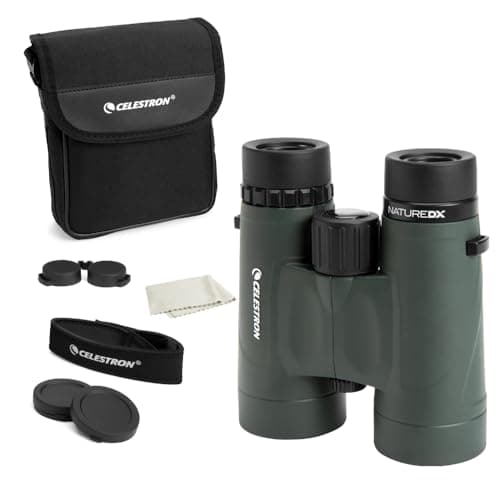
Celestron Nature DX 8x42

The pair nearly every birding guide starts with, and the only one in this group that focuses down to 6.5 feet — which matters more than it sounds.

Score
8.8
Eye relief
9.0
Field of view
7.0
Close focus
9.5
Value
9.0
Budget band
Under $250
Check price on Amazon

#ad Price shown live on Amazon. How we are funded

Published specifications

Magnification and objective
8x, 42 mmSource: Celestron Nature DX 8x42 specifications, celestron.com, read 2026-09-02
Field of view
7.4 degrees, 388 ft at 1,000 yardsSource: Celestron Nature DX 8x42 specifications, celestron.com, read 2026-09-02
Eye relief
17.5 mm — comfortable over glassesSource: Celestron Nature DX 8x42 specifications, celestron.com, read 2026-09-02
Close focus
6.5 ft (2 m)Source: Celestron Nature DX 8x42 specifications, celestron.com, read 2026-09-02
Weight
22.2 oz (629 g)Source: Celestron Nature DX 8x42 specifications, celestron.com, read 2026-09-02
Prism and glass
Roof prism, BaK-4 with phase coatingSource: Celestron Nature DX 8x42 specifications, celestron.com, read 2026-09-02
Weatherproofing
Waterproof, nitrogen-filled and fogproofSource: Celestron Nature DX 8x42 specifications, celestron.com, read 2026-09-02
Warranty
Limited lifetime warrantySource: Celestron Nature DX 8x42 specifications, celestron.com, read 2026-09-02

What it gets right

  • 6.5 ft close focus, so a bird on the far side of the patio is still usable — and so are butterflies
  • 17.5 mm eye relief works over glasses without cropping the view
  • Phase-coated roof prisms at an entry price, which is not universal here
  • Limited lifetime warranty

What it does not

  • Field of view is the narrowest in this group at 7.4 degrees
  • Heavier than the Nikon by well over an ounce
  • No ED glass, so high-contrast edges show more color fringing than the Athlon

Who it is for

The safe first pair. If you know nothing about the recipient except that they like birds, this is the pair with the fewest ways to be wrong.

Skip this if

You want the widest possible view for following birds in flight. The Athlon's 8.1 degrees is a noticeably easier picture to track with.

Pick 02

VortexNo photo

The best balance of the four numbers that matter

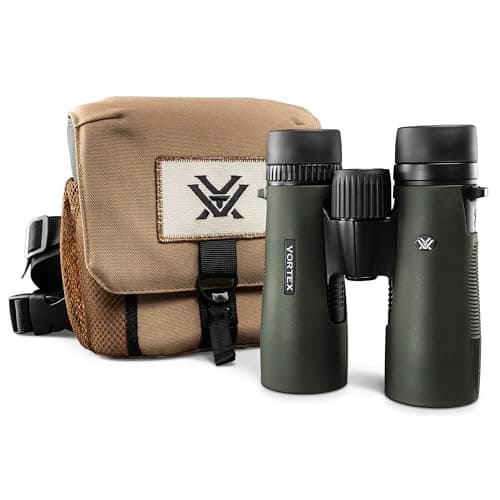
Vortex Diamondback HD 8x42

Nothing here is the best figure in its column, and nothing is the worst — which for a gift is exactly the right shape.

Score
8.7
Eye relief
8.0
Field of view
8.0
Close focus
10.0
Value
8.5
Budget band
Under $250
Check price on Amazon

#ad Price shown live on Amazon. How we are funded

Published specifications

Magnification and objective
8x, 42 mmSource: Vortex Diamondback HD 8x42 specifications, vortexoptics.com, read 2026-09-02
Field of view
7.5 degrees, 393 ft at 1,000 yardsSource: Vortex Diamondback HD 8x42 specifications, vortexoptics.com, read 2026-09-02
Eye relief
17 mmSource: Vortex Diamondback HD 8x42 specifications, vortexoptics.com, read 2026-09-02
Close focus
5 ft — the closest in this groupSource: Vortex Diamondback HD 8x42 specifications, vortexoptics.com, read 2026-09-02
Weight
21.8 ozSource: Vortex Diamondback HD 8x42 specifications, vortexoptics.com, read 2026-09-02
Size
5.8 in high, 5.1 in wideSource: Vortex Diamondback HD 8x42 specifications, vortexoptics.com, read 2026-09-02
Exit pupil
5.3 mmSource: Vortex Diamondback HD 8x42 specifications, vortexoptics.com, read 2026-09-02
Interpupillary range
55-75 mm — the widest adjustment here, which suits smaller facesSource: Vortex Diamondback HD 8x42 specifications, vortexoptics.com, read 2026-09-02

What it gets right

  • 5 ft close focus, the shortest here — a feeder on the far side of a window is in range
  • 55 mm minimum interpupillary distance fits narrower faces, including most children
  • Vortex's warranty is unconditional and transferable, which for a gift is unusually relevant

What it does not

  • 17 mm eye relief is adequate over glasses rather than generous
  • Heavier than the Nikon
  • Sits at the upper end of this price band once you add a decent harness

Who it is for

The recipient you know least about. A transferable no-fault warranty means the gift survives being dropped, which no specification can promise.

Skip this if

Absolute lightness is the deciding factor. The Nikon is a full ounce lighter and that is noticeable on a long walk.

Pick 03

CelestronNo photo

A real pair of waterproof binoculars under $100

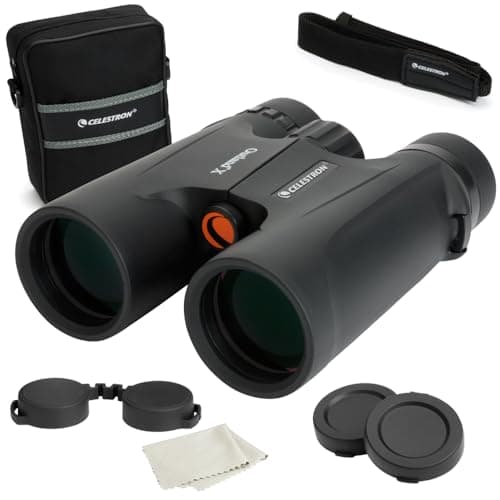
Celestron Outland X 8x42

Genuinely waterproof, genuinely lifetime-warrantied, and honest about the compromise: it cannot focus close.

Score
7.5
Eye relief
9.0
Field of view
6.0
Close focus
3.0
Value
8.5
Budget band
Under $100
Check price on Amazon

#ad Price shown live on Amazon. How we are funded

Published specifications

Magnification and objective
8x, 42 mmSource: Celestron Outland X 8x42 specifications, celestron.com, read 2026-09-02
Field of view
7 degrees, 368.4 ft at 1,000 yardsSource: Celestron Outland X 8x42 specifications, celestron.com, read 2026-09-02
Eye relief
17.8 mmSource: Celestron Outland X 8x42 specifications, celestron.com, read 2026-09-02
Close focus
13.1 ft (4 m) — the longest here by a wide marginSource: Celestron Outland X 8x42 specifications, celestron.com, read 2026-09-02
Weight
23.6 oz (670 g)Source: Celestron Outland X 8x42 specifications, celestron.com, read 2026-09-02
Prism and coatings
BaK-4 prisms, multi-coated (not fully multi-coated)Source: Celestron Outland X 8x42 specifications, celestron.com, read 2026-09-02
Weatherproofing
Waterproof, nitrogen filled, fogproofSource: Celestron Outland X 8x42 specifications, celestron.com, read 2026-09-02
Warranty
Limited lifetime warrantySource: Celestron Outland X 8x42 specifications, celestron.com, read 2026-09-02

What it gets right

  • 17.8 mm eye relief — better over glasses than binoculars costing twice as much
  • Nitrogen-filled and genuinely waterproof at this price, which most sub-$100 pairs are not
  • Limited lifetime warranty on an entry-level pair
  • Tripod adaptable, and ships with case, strap, cloth and rainguard

What it does not

  • 13.1 ft close focus rules out most feeder watching from a window
  • Multi-coated rather than fully multi-coated, so it is dimmer at dawn and dusk than the Nature DX
  • Heaviest pair in this whole comparison at 23.6 oz

Who it is for

A walker or hiker on a real budget, or a spare pair to keep in the car. For feeder watching, spend up to the Nature DX instead.

Skip this if

The recipient wants to watch their own feeder. At just over 13 ft minimum focus, the feeder outside the kitchen window is inside the blind spot.

Pick 04

Athlon OpticsNo photo

The widest view, and the only ED glass here

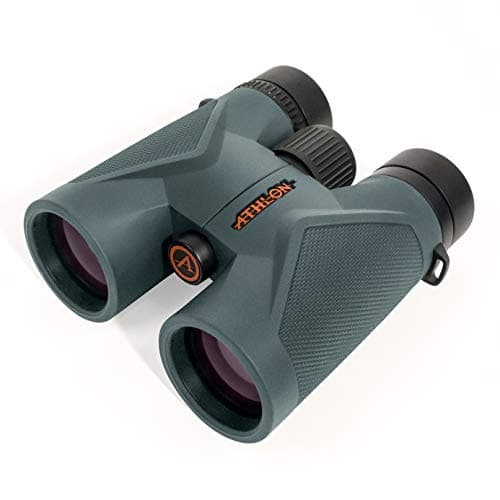
Athlon Optics Midas G2 UHD 8x42

8.1 degrees is a visibly bigger picture than anything else in this group, and ED glass is the reason edges stay clean at that width.

Score
8.9
Eye relief
8.5
Field of view
10.0
Close focus
8.5
Value
8.5
Budget band
Under $250
Check price on Amazon

#ad Price shown live on Amazon. How we are funded

Published specifications

Magnification and objective
8x, 42 mmSource: Athlon Midas G2 UHD 8x42 specifications, athlonoptics.com, read 2026-09-02
Field of view
8.1 degrees, 429 ft at 1,000 yards — the widest hereSource: Athlon Midas G2 UHD 8x42 specifications, athlonoptics.com, read 2026-09-02
Eye relief
17.2 mmSource: Athlon Midas G2 UHD 8x42 specifications, athlonoptics.com, read 2026-09-02
Close focus
6.5 ftSource: Athlon Midas G2 UHD 8x42 specifications, athlonoptics.com, read 2026-09-02
Weight
23.3 oz — the heaviest hereSource: Athlon Midas G2 UHD 8x42 specifications, athlonoptics.com, read 2026-09-02
Glass
Extra-low dispersion (ED) glass, fully multi-coated, ESP dielectric prism coatingSource: Athlon Midas G2 UHD 8x42 specifications, athlonoptics.com, read 2026-09-02
Chassis
Magnesium, waterproofSource: Athlon Midas G2 UHD 8x42 specifications, athlonoptics.com, read 2026-09-02
Warranty
Athlon lifetime warrantySource: Athlon Midas G2 UHD 8x42 specifications, athlonoptics.com, read 2026-09-02

What it gets right

  • 429 ft at 1,000 yards is 41 ft wider than the Nature DX, which makes finding a moving bird much easier
  • ED glass reduces the purple fringing you see on a bird against a bright sky
  • Magnesium chassis rather than polycarbonate
  • Lifetime warranty

What it does not

  • Heaviest here at 23.3 oz
  • Least familiar brand of the four, which can matter for a gift recipient looking for help later
  • The wide field makes the pair physically bulkier in the hand

Who it is for

Someone who already owns a cheap pair and has said they struggle to find the bird. Field of view is the fix for that complaint, and this has the most of it.

Skip this if

The recipient has neck or shoulder problems, or will carry these all day. Two and a half ounces sounds trivial and is not, after three hours.

Pick 05

Op/TechNo photo

The cheapest upgrade to binoculars someone already owns

Op/Tech Binocular Harness Strap

Moves the weight from the neck to the shoulders, which is the difference between binoculars worn all morning and binoculars left in the car.

Score
6.8
Usefulness
9.0
Gift appeal
5.5
Published specs
3.0
Value
9.0
Budget band
Under $25
Check price on Amazon

#ad Price shown live on Amazon. How we are funded

Published specifications

What it changes
A neck strap hangs about 21-23 oz from the cervical spine. A harness distributes the same weight across both shoulders and stops the binoculars swinging when you bend.Source: Athlon Midas G2 UHD 8x42 specifications, athlonoptics.com, read 2026-09-02
Fit
Universal — attaches to the standard strap lugs on essentially any binocular
Detailed specification
Not published by the manufacturer in a form we could verify

What it gets right

  • Solves the most common complaint about binoculars, for the least money on this site
  • Works with a pair the recipient already owns, so it is never a duplicate gift
  • Stops the pair swinging forward and knocking into things when bending down

What it does not

  • It is a strap. As a standalone gift it needs pairing with something
  • Some harnesses are fiddly to get on over a winter coat
  • No published specifications to compare between brands

Who it is for

Someone who already has binoculars and complains about their neck. Add it to a book and it becomes a thoughtful pair rather than an accessory.

Skip this if

You are looking for a gift that feels like a gift on its own. This is a stocking addition, not a centerpiece.

The published figures

Published figures for every pair on this site
PairField of viewEye reliefClose focusWeightWarranty
Celestron Nature DX 8x427.4 deg / 388 ft17.5 mm6.5 ft22.2 ozLimited lifetime
Nikon PROSTAFF P7 8x427.2 deg / 377 ft20.2 mm9.8 ft20.8 ozNot published here
Vortex Diamondback HD 8x427.5 deg / 393 ft17 mm5 ft21.8 ozUnconditional, transferable
Athlon Midas G2 UHD 8x428.1 deg / 429 ft17.2 mm6.5 ft23.3 ozAthlon lifetime
Celestron Outland X 8x427 deg / 368.4 ft17.8 mm13.1 ft23.6 ozLimited lifetime

Every figure is from the manufacturer's own published specification table, read 2026-09-02. Field of view is at 1,000 yards.

Three things to teach with them

  1. Set the interpupillary distance first. Hinge the barrels until the two circles merge into one. Most first-time frustration is skipping this.
  2. Set the diopter once. Cover the right lens, focus with the center wheel on the left eye, then cover the left and adjust the right-hand diopter ring. After that, only the center wheel is used.
  3. Find the bird with your eyes first, then lift the binoculars without moving your head. Almost nobody does this instinctively, and it is the difference between finding a bird in two seconds and losing it entirely.

FAQ

Questions people ask about this

What binoculars should a beginner bird watcher buy?

An 8x42 pair with close focus under about 7 feet and eye relief of 17 mm or more. The Celestron Nature DX 8x42 publishes 6.5 ft and 17.5 mm, which makes it the safest first pair on the numbers.

Is 10x42 too much for a beginner?

Usually. Ten times magnification narrows the field of view, which makes finding a bird harder, and it amplifies hand shake into a visible wobble. 8x42 is easier in both respects.

How do you set up binoculars properly?

Hinge the barrels until the two circles merge into one, then set the diopter: cover the right lens and focus on the left eye with the center wheel, then cover the left and adjust the right-hand diopter ring. After that only the center wheel is used.

Do beginners need expensive binoculars?

No. Above about $200 the published figures barely move, and none of the remaining differences help a beginner. Close focus and eye relief matter far more than price.

Sources

Where these figures come from