
Skip to content
The GiftPerch

Binoculars

Best binoculars for kids

There is a physical reason a child cannot use an adult pair, it is not about strength or patience, and almost nobody mentions it.

By Scooter M.Published September 2, 2026Content updated September 2, 2026Prices shown live on Amazon

We don't test this gear. Here's what we do instead.

A group of children exploring outdoors with binoculars

The Gift Perch earns a commission when you buy through our links, at no extra cost to you. We are an Amazon Associate. We accept no free products, no sponsored placements and no paid inclusion, and the commission rate plays no part in what we recommend. Full disclosure.

Adult binoculars usually fail a young child because of interpupillary distance — the gap between the two barrels. Most adult pairs adjust down to about 55 to 57 mm, and a young child's eyes are often closer together than that, so the two circles never merge into one image no matter how the child holds them. Buy a small, light, narrow pair and spend the difference on a bird book.

The Vortex Diamondback HD publishes an interpupillary range of 55 to 75 mm, which is among the narrowest in adult optics. For many children under about ten, 55 mm is still too wide — which is why handing a child a good adult pair often produces frustration rather than delight.

What matters for a child, in order

  1. Narrow enough to fit their face. The barrels must close far enough for the circles to merge. Nothing else matters if this fails.
  2. Light enough to hold up. A child cannot keep 22 ounces steady for more than a few seconds.
  3. Cheap enough to be dropped. It will be dropped, in a creek, on the first day.
  4. 8x or less. Lower magnification is steadier in unsteady hands.
  5. Optical quality, a distant fifth. A dim image a child can actually see beats a bright one they cannot.

The picks

Ranked picks with what each is best for, our score out of ten, the budget band it falls in, and a link to check its current price on Amazon.
#PickBest forScorePrice
01OccerNo photoOccer 8x21 Compact Binoculars for KidsCheap, light and small enough for a child's face — which is the specification that actually matters, and the one adult binoculars fail.Under $25A child's first pair6.6out of 10
Check price on Amazon

#ad Price shown live on Amazon. How we are funded

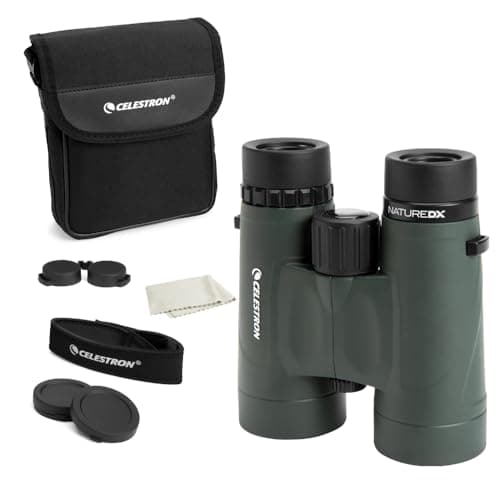
02CelestronNo photoCelestron Nature DX 8x25 CompactHalf the objective means half the light, and that is the entire trade: you accept a dimmer dawn in exchange for actually having them with you.Under $100A pair that lives in a coat pocket6.9out of 10
Check price on Amazon

#ad Price shown live on Amazon. How we are funded

03CelestronNo photoCelestron Nature DX 8x42The pair nearly every birding guide starts with, and the only one in this group that focuses down to 6.5 feet — which matters more than it sounds.Under $250The default first pair, and the closest focus here8.8out of 10
Check price on Amazon

#ad Price shown live on Amazon. How we are funded

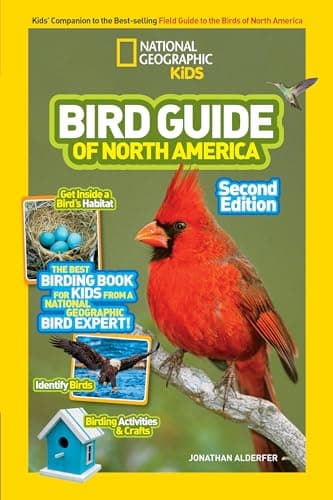
04National Geographic KidsNo photoNational Geographic Kids Bird Guide of North AmericaA proper reference scaled to a child — which beats a picture book for a kid who has just started noticing birds.Under $25A child who wants their own real book7.9out of 10
Check price on Amazon

#ad Price shown live on Amazon. How we are funded

Scores are ours, from the published rubric on the how-we-pick page. They are editorial judgments about published specifications and cost arithmetic, not test results — we have not handled these products.

Pick 01

OccerNo photo

A child's first pair

Occer 8x21 Compact Binoculars for Kids

Cheap, light and small enough for a child's face — which is the specification that actually matters, and the one adult binoculars fail.

Score
6.6
Fits a child
9.5
Optics
4.0
Published specs
3.5
Value
8.0
Budget band
Under $25
Check price on Amazon

#ad Price shown live on Amazon. How we are funded

Published specifications

Why an adult pair fails a child
Interpupillary distance. Most adult binoculars adjust down to about 55-57 mm; a young child's eyes are typically closer together than that, so the two barrels never merge into one circle no matter how they are held.Source: Vortex Diamondback HD 8x42 specifications, vortexoptics.com, read 2026-09-02
Magnification and objective
8x, 21 mm
Weight
Light enough for a child to hold up for more than a few seconds, which is the real constraint
Detailed specification
Not published by the manufacturer in a form we could verify in a manufacturer table we could verify

What it gets right

  • Narrow enough that a child's eyes actually line up with both barrels
  • Light enough to be held steady by small arms
  • Inexpensive enough that dropping it in a creek is not a disaster

What it does not

  • Optically well behind any adult pair here
  • 21 mm objective is dim in anything but bright daylight
  • Manufacturer specifications for budget kids' binoculars are rarely published in full

Who it is for

A child aged roughly five to eleven. Buy the cheap pair, and spend the difference on a bird book they can keep.

Skip this if

The child is a teenager. By then an adult 8x42 fits their face and will outlast three of these.

Pick 02

CelestronNo photo

A pair that lives in a coat pocket

Celestron Nature DX 8x25 Compact

Half the objective means half the light, and that is the entire trade: you accept a dimmer dawn in exchange for actually having them with you.

Score
6.9
Portability
9.5
Low light
4.0
Published specs
5.0
Value
7.5
Budget band
Under $100
Check price on Amazon

#ad Price shown live on Amazon. How we are funded

Published specifications

Magnification and objective
8x, 25 mm
The trade-off, stated plainly
A 25 mm objective gathers roughly a third of the light of a 42 mm at the same magnification, so dawn and dusk — the two best birding hours — are where a compact pair struggles most.
Exit pupil
About 3.1 mm at 8x25, against 5.3 mm on a 42 mm pair. A smaller exit pupil is harder to hold steady on the eye.
Detailed specification
Not published by the manufacturer in a form we could verify for the specific 25 mm variant on the page we could read; check the maker's spec table for the exact model before buying

What it gets right

  • Small enough that it actually gets carried, which is worth more than optical quality nobody uses
  • Light on the neck for a child or an older recipient
  • Cheap enough to be a second pair rather than the only pair

What it does not

  • Noticeably dimmer at dawn and dusk than any 42 mm pair here
  • Smaller exit pupil is fussier to hold on the eye, which beginners find frustrating
  • Compacts usually have shorter eye relief, so check the figure if the recipient wears glasses

Who it is for

A travel pair, a glovebox pair, or a gift for someone who already has full-size binoculars and never brings them.

Skip this if

This is the recipient's only pair and they are serious about it. A compact as a first and only pair teaches someone that birding is difficult, which is the wrong lesson.

Pick 03

CelestronNo photo

The default first pair, and the closest focus here

Celestron Nature DX 8x42

The pair nearly every birding guide starts with, and the only one in this group that focuses down to 6.5 feet — which matters more than it sounds.

Score
8.8
Eye relief
9.0
Field of view
7.0
Close focus
9.5
Value
9.0
Budget band
Under $250
Check price on Amazon

#ad Price shown live on Amazon. How we are funded

Published specifications

Magnification and objective
8x, 42 mmSource: Celestron Nature DX 8x42 specifications, celestron.com, read 2026-09-02
Field of view
7.4 degrees, 388 ft at 1,000 yardsSource: Celestron Nature DX 8x42 specifications, celestron.com, read 2026-09-02
Eye relief
17.5 mm — comfortable over glassesSource: Celestron Nature DX 8x42 specifications, celestron.com, read 2026-09-02
Close focus
6.5 ft (2 m)Source: Celestron Nature DX 8x42 specifications, celestron.com, read 2026-09-02
Weight
22.2 oz (629 g)Source: Celestron Nature DX 8x42 specifications, celestron.com, read 2026-09-02
Prism and glass
Roof prism, BaK-4 with phase coatingSource: Celestron Nature DX 8x42 specifications, celestron.com, read 2026-09-02
Weatherproofing
Waterproof, nitrogen-filled and fogproofSource: Celestron Nature DX 8x42 specifications, celestron.com, read 2026-09-02
Warranty
Limited lifetime warrantySource: Celestron Nature DX 8x42 specifications, celestron.com, read 2026-09-02

What it gets right

  • 6.5 ft close focus, so a bird on the far side of the patio is still usable — and so are butterflies
  • 17.5 mm eye relief works over glasses without cropping the view
  • Phase-coated roof prisms at an entry price, which is not universal here
  • Limited lifetime warranty

What it does not

  • Field of view is the narrowest in this group at 7.4 degrees
  • Heavier than the Nikon by well over an ounce
  • No ED glass, so high-contrast edges show more color fringing than the Athlon

Who it is for

The safe first pair. If you know nothing about the recipient except that they like birds, this is the pair with the fewest ways to be wrong.

Skip this if

You want the widest possible view for following birds in flight. The Athlon's 8.1 degrees is a noticeably easier picture to track with.

Pick 04

National Geographic KidsNo photo

A child who wants their own real book

National Geographic Kids Bird Guide of North America

A proper reference scaled to a child — which beats a picture book for a kid who has just started noticing birds.

Score
7.9
Age fit
9.0
Completeness
6.0
Gift appeal
8.0
Value
8.5
Budget band
Under $25
Check price on Amazon

#ad Price shown live on Amazon. How we are funded

Published specifications

Audience
Written for children, with the structure of a real field guide rather than a storybook
Coverage
North American species, with photographs and range maps
Why it works
A child who has just been given binoculars needs somewhere to look the bird up, and adult guides are discouraging
Page count and edition
Not published by the manufacturer in a form we could verify on a publisher page we could read

What it gets right

  • Treats the child as a real birder rather than as an audience for cartoons
  • Pairs naturally with a cheap pair of kids' binoculars to make a complete gift
  • Cheap enough to be one part of a gift rather than the whole thing

What it does not

  • A confident older child will outgrow it within a year or two
  • Fewer species than an adult guide, so an unusual bird may be missing
  • We could not verify the current printing's specifications from the publisher

Who it is for

A five to eleven year old who has started asking what the birds in the garden are called.

Skip this if

The child is over about twelve and already interested. Buy them the Kaufman guide and treat them like a birder.

When to upgrade to an adult pair

Roughly, by age
Roughly, by age
AgeBuyWhy
3-5No binoculars — a window feederClose, immediate, needs no equipment skill at all.
5-8A small 8x21 or similar, plus a kids' bird guideFits the face, light enough to hold, cheap enough to survive.
8-12The same, or a compact 8x25 if they are carefulMore light, still narrow and light enough to manage.
12+A full adult 8x42The face now fits, and one good pair will outlast three children's pairs.

The upgrade that is actually worth it

At around twelve, buying a real adult 8x42 rather than a fourth children's pair is the right call. It fits, it is bright enough for dawn, and a pair with a lifetime warranty will still be working when they are forty. That is the moment to spend, not before.

FAQ

Questions people ask about this

Why can't kids use adult binoculars?

Interpupillary distance. Most adult pairs only close to about 55 to 57 mm between the barrels, and a young child's eyes are often nearer together than that, so the two circles never merge into a single image.

What magnification is best for children's binoculars?

8x or lower. Higher magnification amplifies hand shake, and children's hands are less steady, so a 10x pair produces a wobbling image that is harder to use rather than a closer one.

At what age can a child use adult binoculars?

Around twelve for most children, when their face is wide enough for a standard 55 mm minimum interpupillary setting. At that point an adult 8x42 is a better buy than another child's pair.

Are expensive binoculars worth it for a child?

Not before about twelve. The pair needs to be narrow, light and expendable more than it needs to be sharp, and optical quality is wasted if the child cannot merge the image.

Sources

Where these figures come from