These are not two versions of the same gift. One feeds birds that already live nearby; the other asks a pair to raise a family in your yard, which is a much bigger request.
By Scooter M.Published September 6, 2026Content updated September 6, 2026Prices verified October 20, 2026
The Gift Perch earns a commission when you buy through our links, at no extra cost to you. We are an Amazon Associate. We accept no free products, no sponsored placements and no paid inclusion, and the commission rate plays no part in what we recommend. Full disclosure.
Buy the feeder first. A feeder works within days, in every season, and attracts a wide range of species that already live nearby. A bird house works for one pair, of one species, for a few weeks in spring, and only if it happens to be built to the right dimensions and mounted in the right place. Both are worth owning; the feeder is the one that pays off immediately.
The hero photograph on this page is the reason the question gets asked. That object is a feeder shaped like a house, with a decorative hole that leads nowhere — and a great many things sold as bird houses are exactly that. Sorting out the terminology first is its own page; this one assumes you know the difference and are choosing between two real things.
They are not competing for the same job
What each one actually does
What each one actually does
Bird feeder
Bird house / nest box
What it offers
Food
A cavity to raise young in
Who uses it
Many species at once — finches, cardinals, chickadees, woodpeckers, jays
One pair, of one cavity-nesting species, per season
When it works
All year, and hardest-working in winter
Spring nesting season only
How fast
Days to a few weeks
Often the following spring, sometimes never
What decides success
Seed type and placement
Entrance hole diameter, floor size, height and habitat
Effort
Refilling, and cleaning to prevent disease
One clean-out a year, plus checking for the wrong tenants
Failure mode
Squirrels empty it
Nothing ever moves in, or starlings do
The picks
Ranked picks with what each is best for, our score out of ten, the budget band it falls in, and a link to check its current price on Amazon.
#
Pick
Best for
Score
Price
01
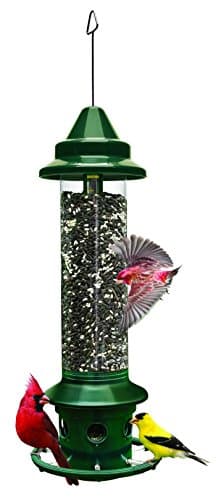
Brome Squirrel Buster PlusA weight-activated shroud closes the ports under a squirrel, and the warranty is written for the lifetime of the original owner.Under $100
Droll YankeesNo photoDroll Yankees Onyx Clever Clean Tube FeederA plain tube feeder whose base twists off, which is the feature that decides whether a feeder gets cleaned or quietly stops being used.Under $50
3 quarts, about 5 lb of seedSource: Brome Squirrel Buster Plus published product specifications, read 2026-09-02
Mechanism
Weight-activated shroud closes the seed ports; the trigger weight is adjustableSource: Brome Squirrel Buster Plus published product specifications, read 2026-09-02
Feeding ports
6, with a cardinal ring includedSource: Brome Squirrel Buster Plus published product specifications, read 2026-09-02
Dimensions
6 in x 6 in x 23 inSource: Brome Squirrel Buster Plus published product specifications, read 2026-09-02
Weight empty
2.2 lbSource: Brome Squirrel Buster Plus published product specifications, read 2026-09-02
Warranty
Lifetime of the original owner, with replacement parts, when used per the instructionsSource: Brome Squirrel Buster Plus published product specifications, read 2026-09-02
Cleaning
Dishwasher safeSource: Brome Squirrel Buster Plus published product specifications, read 2026-09-02
What it gets right
The mechanism is physical rather than electronic, so there is nothing to fail in the cold
Adjustable trigger weight lets you exclude large birds as well as squirrels
The cardinal ring means the feeder still works for the bird most people actually want
Lifetime warranty on a product that lives outdoors
What it does not
No camera, no app — this is a feeder, not a gadget
23 inches tall, which is a lot of feeder for a small balcony
Squirrels will still empty the tray beneath it
Who it is for
Anyone who has complained about squirrels. It is the least glamorous gift on this site and one of the most gratefully received.
Skip this if
The recipient wants to watch birds on a phone. This solves a different problem, and pairing it with a camera feeder rather than substituting for one is the better gift.
Pick 02
A nest box a bluebird will actually use
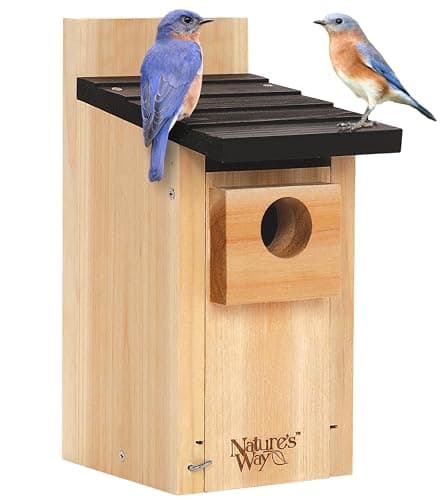
Nature's Way Cedar Bluebird House
The entrance hole is the whole product. Everything else is joinery.
Floor 5.5 x 5.5 in, interior cavity depth 9 in, and mounting 4 to 6 feet above the ground.Source: NestWatch (Cornell Lab of Ornithology), Eastern Bluebird nest box specifications, nestwatch.org, read 2026-09-02
Entrance hole
1.5 in diameter is the standard bluebird hole. Mountain Bluebirds take 1 9/16 in. Chickadees need about 1 1/8 in and wrens about 1 1/4 in, so a box sold as generic will exclude or admit species depending on this one number.
Why the hole size is not decoration
A hole sized correctly for the target species also excludes larger non-native competitors. Oversizing it hands the box to European Starlings.
Material
Cedar, which weathers without treatment. Never paint or stain the interior of a nest box.
The feature to check
A side or front panel that opens. A box that cannot be cleaned out between seasons will not be used for long.
What it gets right
Cedar lasts outdoors untreated, which is the right material for a box that cannot be painted inside
The published NestWatch dimensions give you something concrete to check the listing against
A nest box is a gift that produces an event, not just an object
What it does not
Only works if it is mounted correctly, at the right height, facing away from prevailing weather
Decorative birdhouses far outnumber functional ones, and they look identical online
Nothing guarantees occupancy in the first season
Who it is for
Someone with open ground, a post, and the patience for a bird to find it. Include a note with the 4 to 6 foot mounting height; almost every box is hung too high.
Skip this if
The recipient wants something to hang on a fence and look at. Buy a decorative one and be honest that it is ornamental — an unused nest box is a small annual disappointment.
Pick 03
Droll YankeesNo photo
A feeder that is genuinely easy to keep clean
Droll Yankees Onyx Clever Clean Tube Feeder
A plain tube feeder whose base twists off, which is the feature that decides whether a feeder gets cleaned or quietly stops being used.
1 lb to 3 lb depending on tube lengthSource: Droll Yankees Onyx Clever Clean published product specifications, read 2026-09-02
Ports
2 ports on the 12 in model, 4 on the 18 in, 6 on the 24 inSource: Droll Yankees Onyx Clever Clean published product specifications, read 2026-09-02
Construction
Powder-coated metal cap, base and ports; unobstructed interior for brush cleaningSource: Droll Yankees Onyx Clever Clean published product specifications, read 2026-09-02
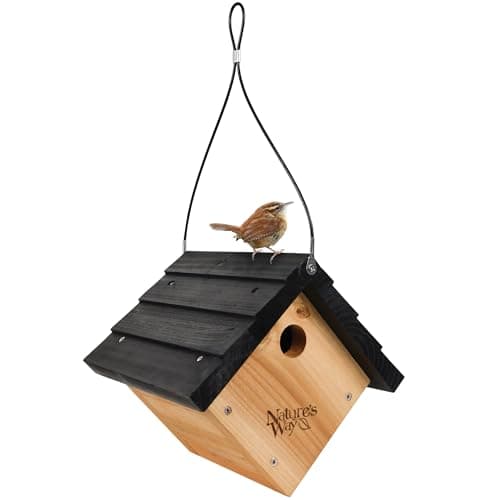
About 1 1/4 in for wrens and about 1 1/8 in for chickadees. Both are smaller than the 1.5 in bluebird standard, and the difference decides which bird moves in.
Why this suits a small garden
Bluebirds want open ground and a 4 to 6 foot post. Wrens and chickadees will use a box among shrubs and trees, which is what most gardens have.Source: NestWatch (Cornell Lab of Ornithology), Eastern Bluebird nest box specifications, nestwatch.org, read 2026-09-02
Material
Cedar, unpainted inside
The feature to check
An opening panel for cleaning between seasons
Published interior dimensions
Not published by the manufacturer in a form we could verify on many listings in this class — compare against NestWatch's per-species tables
What it gets right
Fits the habitat most recipients actually have
The smaller hole excludes starlings automatically
Wrens are quick to adopt new boxes, so occupancy is more likely in year one
What it does not
Will not attract bluebirds, which is what many gift buyers picture
Interior dimensions are frequently unpublished
House Wrens are territorial and may reduce activity in other boxes nearby
Who it is for
A suburban garden with shrubs and trees rather than open lawn — which is most of them.
Skip this if
The recipient specifically wants bluebirds and has the open ground for them. Then the hole size is wrong and the gift will not do what they hoped.
Pick 05
Nature's WayNo photo
Woodpeckers, and winter generally
Nature's Way Cedar Suet Feeder
Suet brings in the birds seed does not, and a cedar cage lasts where a wire one rusts.
High-fat food that suits woodpeckers, nuthatches, chickadees and wrens — species that largely ignore a seed tube
Season
Best in cold weather. Rendered suet softens and can go rancid in summer heat; some makers sell no-melt cakes for warm months.
Placement
Against a trunk or on a pole with a tail prop suits woodpeckers, which brace their tails while feeding
Capacity and dimensions
Not published by the manufacturer in a form we could verify consistently across this class
What it gets right
Attracts a completely different set of birds to a seed feeder
Cheap enough to add to any other gift on this site
Cold-weather timing matches when most bird gifts are given
What it does not
Rancid in summer heat unless no-melt cakes are used
Cakes are a consumable, so it is a gift with an ongoing cost
Starlings will empty an unprotected suet cage quickly
Who it is for
Anyone who already has a seed feeder and has said they only ever see the same three birds. Suet is the answer to that.
Skip this if
The recipient lives somewhere hot year-round. Suet is a cold-weather food and it will make a mess.
Why the feeder is the easier win
Because it asks less of the birds. Feeding is opportunistic — a chickadee passing through will investigate a new seed source within days, and nothing about its life has to change. Nesting is not opportunistic. A pair choosing a box is committing their entire breeding season to it, and they will reject anything that is the wrong size, in the wrong place, too exposed, or too close to a competitor's territory.
The practical consequence: a feeder gives a beginner visible results in the first fortnight, and a nest box very often gives nothing at all in year one. That is not a defect. It is just a slower kind of gift, and it is worth knowing before you give one and then field the question about why nothing has happened.
Where the nest box wins
It is a bigger event when it works. A pair raising a brood in your yard is a season-long story. A feeder is a stream of visitors; a box is a family you watch grow up.
It costs nothing to run. No seed, no refilling. One clean-out a year and that is the whole commitment.
It helps species that are genuinely short of somewhere to nest. Cavity nesters depend on dead wood and mature trees, both of which tidy landscaping removes. A correctly built box is a real substitution.
No squirrels. There is nothing in it for them.
The one number that decides a box
Entrance hole diameter. It is the whole product. Cornell's NestWatch publishes the figures per species: roughly 1.5 inches for Eastern Bluebirds, about 1 9/16 for Mountain Bluebirds, about 1 1/4 for wrens and about 1 1/8 for chickadees. A hole much over 1 5/8 inches lets European Starlings in, and once starlings are in, that box is theirs. NestWatch also specifies a 5.5 by 5.5 inch floor with a 9 inch interior cavity for Eastern Bluebirds, mounted 4 to 6 feet up.
A functional box also has no perch below the hole. Perches help predators and competitors and are of no use to the birds, which is why they appear on decorative boxes and not on the ones built to published specifications. Our nest box picks are judged against those figures.
So: which, and in what order?
A feeder. Immediate results, all year, many species. If it is a gift and you only buy one thing, buy this.
Water. Not on this page's menu, but honestly the second-best purchase and cheaper than either — a bath brings in species that never visit feeders at all. The case is here.
A second feeder type. A hopper or tray for cardinals alongside a tube for finches roughly doubles the species list.
Then the nest box, hung in late winter so it is in place before the season starts, and built to the published dimensions rather than to a shape.
FAQ
Questions people ask about this
Should I get a bird house or a bird feeder first?
A feeder. It works within days, all year round, and attracts many species at once. A nest box serves one pair of one species for a few weeks in spring, and often nothing moves in during the first year.
Do bird houses attract birds like feeders do?
No, and not in the same way. A feeder offers food to birds already living nearby, so they investigate quickly. A nest box asks a pair to commit their whole breeding season to it, so they are far more selective — dimensions, height, habitat and exposure all have to be right.
Can a bird house be used as a bird feeder?
Many things sold as bird houses are actually house-shaped feeders with a decorative hole that leads nowhere. A real nest box is a sealed cavity with a specified entrance diameter and no perch, and putting seed in one is not how it is meant to work.
What size hole does a bird house need?
It depends on the species you want. Cornell's NestWatch publishes roughly 1.5 inches for Eastern Bluebirds, about 1 1/4 for wrens and about 1 1/8 for chickadees. Holes much over 1 5/8 inches admit European Starlings, which will take the box over.
When should I put up a bird house?
Late winter, so it is weathered and in place before birds start prospecting for nest sites in spring. A box put up in May has largely missed the season.