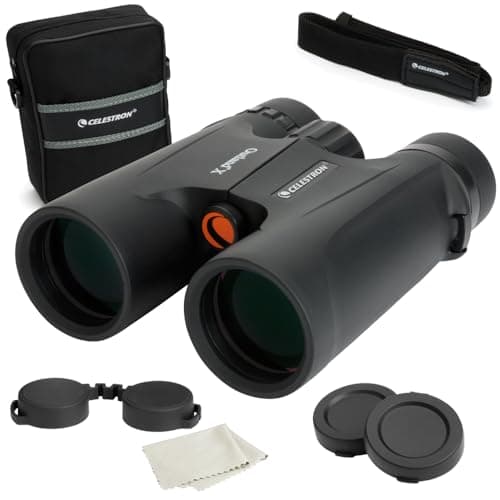
The pair we recommend under $100, assessed on what Celestron publishes — including the one figure that disqualifies it for half the people who want it.
By Scooter M.Published October 17, 2026Content updated October 17, 2026Prices verified October 17, 2026
The Gift Perch earns a commission when you buy through our links, at no extra cost to you. We are an Amazon Associate. We accept no free products, no sponsored placements and no paid inclusion, and the commission rate plays no part in what we recommend. Full disclosure.
Buy it if the recipient walks; do not buy it if they watch a feeder through a window. The Celestron Outland X 8x42 is genuinely waterproof and nitrogen-filled, publishes 17.8 mm of eye relief — better over glasses than pairs costing twice as much — carries a limited lifetime warranty, and costs under $100. Its disqualifying figure is close focus at 13.1 ft, which puts a feeder six feet from the glass inside its blind spot entirely.
That is an unusually sharp split for a product recommendation, and it is why this pair deserves its own page rather than a line in a roundup. Under $100 you can have weatherproofing and warranty, or you can have close focus. The Outland X picks the first two deliberately, and whether that is the right trade depends entirely on where the person stands when they use it.
How this review was built
We have not handled this pair. Every figure below is from Celestron's own published specification, read on the date in the sources, and every comparison is against rivals' own published figures. Binoculars are the one category on this site where that is enough to review honestly, because every maker publishes the four numbers that decide the purchase: field of view, eye relief, close focus and weight. There is no testing claim anywhere on this page, and no scored verdict pretending to be a measurement.
The published specification
Celestron's own figures for the Outland X 8x42
Celestron's own figures for the Outland X 8x42
Figure
Published value
What it means in use
Magnification and objective
8x, 42 mm
The birding default — enough reach, findable field, steady handheld
Field of view
7 degrees — 368.4 ft at 1,000 yards
Slightly narrower than the Nature DX's 388 ft; you notice it following a moving bird
Eye relief
17.8 mm
The standout figure. Comfortable over glasses, and more than the Nature DX publishes
Close focus
13.1 ft (4 m)
The disqualifying figure. Twice the Nature DX's 6.5 ft
Weight
23.6 oz (670 g)
The heaviest pair in this comparison
Prisms and coatings
BaK-4 prisms, multi-coated
Note: multi-coated, NOT fully multi-coated — see below
Weatherproofing
Waterproof, nitrogen filled, fogproof
Genuinely unusual under $100
Warranty
Limited lifetime
Also unusual at this price
The coating distinction that explains the price
Celestron describes the Outland X as multi-coated and the Nature DX as fully multi-coated with phase coating. Those are not the same claim. "Multi-coated" means some air-to-glass surfaces have been coated; "fully multi-coated" means all of them have. Phase coating on a roof prism is a separate treatment again, and it affects resolution and contrast rather than brightness.
What that adds up to is a pair that is dimmer at dawn and dusk than the pair one step up. In full daylight the difference is small. In the first and last hour of the day — which is when birds are most active — it is the difference you notice first, and it is the single best reason to spend the extra.
The picks, and the rivals
Ranked picks with what each is best for, our score out of ten, the budget band it falls in, and a link to check its current price on Amazon.
#
Pick
Best for
Score
Price
01
Celestron Outland X 8x42Genuinely waterproof, genuinely lifetime-warrantied, and honest about the compromise: it cannot focus close.Under $100
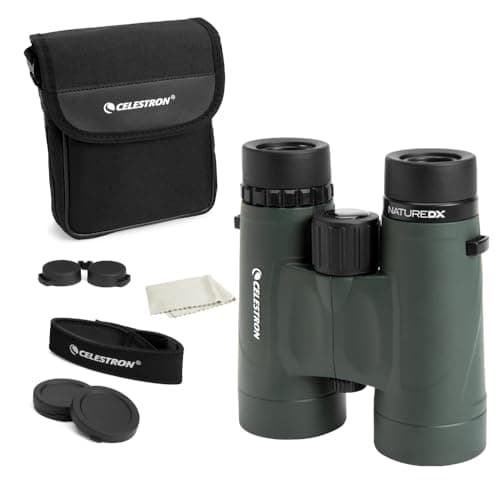
Celestron Nature DX 8x42The pair nearly every birding guide starts with, and the only one in this group that focuses down to 6.5 feet — which matters more than it sounds.Under $250
The default first pair, and the closest focus here
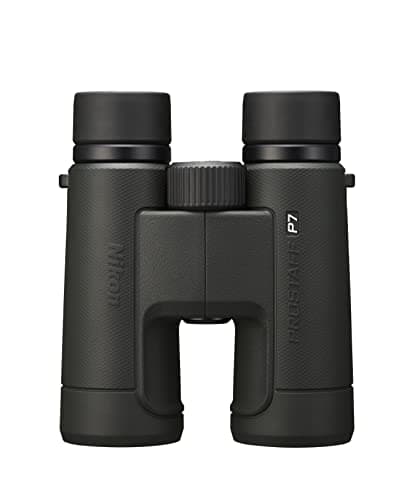
Nikon PROSTAFF P7 8x4220.2 mm of eye relief is the most generous figure here by a clear margin, and it is the number that decides whether a spectacle wearer keeps them.Under $250
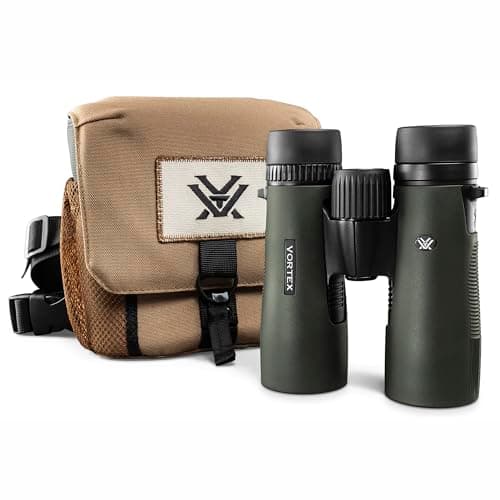
Vortex Diamondback HD 8x42Nothing here is the best figure in its column, and nothing is the worst — which for a gift is exactly the right shape.Under $250
Scores are ours, from the published rubric on the how-we-pick page. They are editorial judgments about published specifications and cost arithmetic, not test results — we have not handled these products.
Pick 01
A real pair of waterproof binoculars under $100
Celestron Outland X 8x42
Genuinely waterproof, genuinely lifetime-warrantied, and honest about the compromise: it cannot focus close.
20.2 mm eye relief, which no other pair in this group approaches
Lightest here at 20.8 oz, which matters after an hour around the neck
Nikon's service network is the easiest of these brands to actually reach
What it does not
9.8 ft close focus is the worst in this group — a bird at the feeder ten feet away may not focus
Narrowest real field of view here at 7.2 degrees
Plainer finish than rivals at similar money, if that matters to the recipient
Who it is for
A glasses wearer, or anyone who has previously said binoculars give them a tunnel-vision black ring. That symptom is short eye relief, and this is the fix.
Skip this if
The recipient mostly watches a feeder from a kitchen window. At 9.8 ft minimum focus, a close feeder is exactly the shot these cannot take.
Pick 04
The best balance of the four numbers that matter
Vortex Diamondback HD 8x42
Nothing here is the best figure in its column, and nothing is the worst — which for a gift is exactly the right shape.
7.5 degrees, 393 ft at 1,000 yardsSource: Vortex Diamondback HD 8x42 specifications, vortexoptics.com, read 2026-09-02
Eye relief
17 mmSource: Vortex Diamondback HD 8x42 specifications, vortexoptics.com, read 2026-09-02
Close focus
5 ft — the closest in this groupSource: Vortex Diamondback HD 8x42 specifications, vortexoptics.com, read 2026-09-02
Weight
21.8 ozSource: Vortex Diamondback HD 8x42 specifications, vortexoptics.com, read 2026-09-02
Size
5.8 in high, 5.1 in wideSource: Vortex Diamondback HD 8x42 specifications, vortexoptics.com, read 2026-09-02
Exit pupil
5.3 mmSource: Vortex Diamondback HD 8x42 specifications, vortexoptics.com, read 2026-09-02
Interpupillary range
55-75 mm — the widest adjustment here, which suits smaller facesSource: Vortex Diamondback HD 8x42 specifications, vortexoptics.com, read 2026-09-02
What it gets right
5 ft close focus, the shortest here — a feeder on the far side of a window is in range
55 mm minimum interpupillary distance fits narrower faces, including most children
Vortex's warranty is unconditional and transferable, which for a gift is unusually relevant
What it does not
17 mm eye relief is adequate over glasses rather than generous
Heavier than the Nikon
Sits at the upper end of this price band once you add a decent harness
Who it is for
The recipient you know least about. A transferable no-fault warranty means the gift survives being dropped, which no specification can promise.
Skip this if
Absolute lightness is the deciding factor. The Nikon is a full ounce lighter and that is noticeable on a long walk.
Against the pair one step up
The Outland X against the Nature DX, on published figures
The Outland X against the Nature DX, on published figures
Outland X 8x42
Nature DX 8x42
Close focus
13.1 ft
6.5 ft
Coatings
Multi-coated
Fully multi-coated, BaK-4 with phase coating
Field of view
368.4 ft
388 ft
Eye relief
17.8 mm
17.5 mm
Weight
23.6 oz
22.2 oz
Waterproof and fogproof
Yes
Yes
Warranty
Limited lifetime
Limited lifetime
Celestron's own published figures. Note how little separates them on eye relief, weatherproofing and warranty — the real gaps are close focus and the coatings, and both favour the Nature DX.
Read down that table and the Outland X wins exactly one row, by 0.3 mm of eye relief, which is not a difference anybody perceives. That is the honest case for treating the Nature DX as the default and the Outland X as the budget answer rather than the better buy.
Who should buy it anyway
Walkers and hikers. At 13.1 ft close focus, distance is where these work, and distance is what a walker is looking at.
Anyone who needs a pair that can get rained on. Nitrogen-filled and genuinely waterproof under $100 is the thing this pair does that its price class usually does not.
Glasses wearers on a strict budget. 17.8 mm of eye relief is a real figure and the usual failure of cheap binoculars is cropping the view for anyone wearing glasses.
A spare pair for the car, the boat or the cabin. Waterproof, lifetime warranty, and it does not matter if it lives in a glovebox.
A child over about twelve, where an adult pair now fits and durability matters more than optical quality.
Who should not
Anyone who watches birds from inside their own house. This is the most common way people actually birdwatch and it is the one thing this pair cannot do: a feeder is typically six to ten feet from the window, and at 13.1 ft minimum focus the image will not resolve at all. No amount of adjusting fixes it — it is a mechanical limit of the focus mechanism. For that person the answer is the Nature DX at 6.5 ft, or any pair that publishes a close focus under about 8 ft.
Also not for anyone who mainly birds at dawn. The coating difference is real and it shows up precisely then.
The honest downsides
13.1 ft close focus, the longest figure in this comparison by a wide margin, and a hard disqualifier for window and feeder birding.
Multi-coated rather than fully multi-coated, so dimmer in the two hours of the day that matter most.
23.6 oz — the heaviest pair here, and weight is what decides whether binoculars get carried on a long walk.
368.4 ft field of view, the narrowest of the four pairs on this page. Following a warbler through a canopy is where you feel it.
It is the budget answer, not a giant-killer. The Nature DX beats it on six of seven published figures for a modest step up in price, and we would rather say so than oversell the cheaper pair.
The verdict
The best binoculars under $100 for someone who walks, and the wrong binoculars at any price for someone who watches a feeder through glass. Celestron has made a clear-eyed decision about what to spend the budget on — sealing, eye relief and warranty, rather than coatings and close focus — and published every figure needed to check whether that decision suits you. That is more than most of this price class offers, and it is why this is the pair we recommend in the band.
FAQ
Questions people ask about this
Is the Celestron Outland X 8x42 good for bird watching?
For walking and distance birding, yes - it is genuinely waterproof and nitrogen-filled, publishes 17.8 mm of eye relief and carries a limited lifetime warranty, all under $100. For watching a feeder through a window, no: its 13.1 ft close focus puts a typical feeder inside its blind spot.
What is the close focus on the Celestron Outland X?
13.1 ft, or 4 m, per Celestron's own specification. That is roughly twice the 6.5 ft the Nature DX publishes, and it is the figure that decides whether this pair suits how you watch birds.
Celestron Outland X or Nature DX?
Nature DX, unless budget is the binding constraint. On Celestron's published figures the Nature DX wins on close focus (6.5 ft against 13.1 ft), coatings (fully multi-coated with phase coating against multi-coated), field of view (388 ft against 368.4 ft) and weight. The Outland X leads only on eye relief, by 0.3 mm.
Does the Celestron Outland X work with glasses?
Yes. At 17.8 mm it publishes more eye relief than the Nature DX and more than many pairs costing twice as much, and short eye relief is the usual reason cheap binoculars disappoint glasses wearers.
Is the Celestron Outland X waterproof?
Celestron publishes it as waterproof, nitrogen filled and fogproof. That combination under $100 is genuinely uncommon, and it is the main thing the budget has been spent on.
What does multi-coated mean versus fully multi-coated?
Multi-coated means some air-to-glass surfaces are coated; fully multi-coated means all of them are. The Outland X is the former and the Nature DX the latter, which is why the Nature DX is brighter at dawn and dusk - the hours when birds are most active.