The Gift Perch earns a commission when you buy through our links, at no extra cost to you. We are an Amazon Associate. We accept no free products, no sponsored placements and no paid inclusion, and the commission rate plays no part in what we recommend. Full disclosure.
You can, and for a distant bird sitting still on open water they can even be better. But a typical astronomy pair — 10x50, 12x60 or 15x70 — is heavier, shakier, narrower and unable to focus on anything close. A 15x70 usually cannot focus nearer than about 40 feet, which puts every bird in a garden inside its blind spot. For birds, 8x42 is the answer.
The question is a reasonable one, because the two hobbies look adjacent and someone who already owns a stargazing pair would rather not buy twice. The honest answer is that they overlap less than they appear to, and it comes down to four numbers every maker publishes. If you want the short version of what to buy instead, how to choose birding binoculars is the seven-step version.
The four figures, and where astronomy pairs fall down
What each design optimizes for
What each design optimizes for
Figure
Typical astronomy pair
Birding 8x42
Why it matters on birds
Magnification
10x to 15x, sometimes 20x
8x
Above about 10x, hand shake is visible and you cannot hold the image still without a tripod.
Objective
50 mm to 70 mm+
42 mm
Bigger gathers more light — genuinely useful at night, mostly wasted in daylight, and it drives the weight.
Field of view
Often 4 to 5 degrees
7 to 8.1 degrees
A narrow field makes finding a moving bird slow. This is the difference people actually notice first.
Close focus
Frequently 25 to 40 ft or more
5 to 9.8 ft
Astronomy designs have no reason to focus close, so they often will not. A feeder ten feet away is unusable.
Weight
Commonly 2.5 to 5 lb
20.8 to 23.6 oz
A 15x70 is a tripod instrument. You will not walk a trail with one round your neck.
The birding column uses the published figures for the pairs reviewed on this site. The astronomy column describes the usual design range for that class rather than one specific model, because the point is the category, not a product.
The shake problem, stated properly
Magnification multiplies everything, including the tremor in your hands. At 8x that tremor is present but tolerable; at 15x the image moves enough that fine detail — the exact face pattern that separates two sparrows — is simply not resolvable freehand. Astronomers solve this with a tripod, and a tripod is a fine thing to use on a stationary galaxy. It is a poor thing to use on a warbler that will be gone in four seconds.
This is also why the advice for birding lands on 8x rather than 10x for most people, and why it leans harder toward 8x again for anyone walking. That reasoning is worked through in 8x42 vs 10x42.
Where astronomy binoculars genuinely win
Distant waterfowl on a lake or estuary. Big, slow, far away, and often viewed from a fixed spot where you can brace or use a tripod. This is the one birding situation the design suits.
Raptor watching from a fixed point. Same reasoning: a hawk watch is a stationary activity with distant targets.
Seawatching. Distant, and you are usually sitting down behind a windbreak anyway.
Dawn and dusk, if you can hold them still. The larger objective does gather more light, and that is a real advantage rather than a marketing one.
Notice what those four have in common: the bird is far away and you are not moving. That is the astronomy use case wearing a coat. For everything else — woodland, a garden, a trail, anything at speed — the wide field and close focus of an 8x42 wins comfortably.
If you already own a stargazing pair
Do not rush to replace it. Take it out on birds first and find out which of the problems above actually bother you, because the answer depends entirely on where you watch. Someone who birds a reservoir from a fixed bank may find a 10x50 perfectly good. Someone watching a feeder from a kitchen window will discover within a minute that the close focus makes it useless, and that is the fastest way to learn what to buy next.
What to buy instead
Ranked picks with what each is best for, our score out of ten, the budget band it falls in, and a link to check its current price on Amazon.
#
Pick
Best for
Score
Price
01
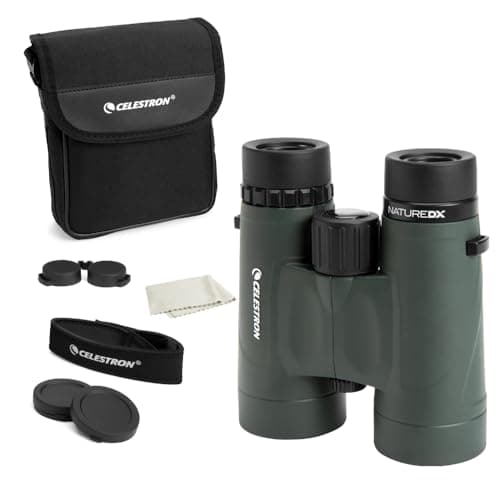
Celestron Nature DX 8x42The pair nearly every birding guide starts with, and the only one in this group that focuses down to 6.5 feet — which matters more than it sounds.Under $250
The default first pair, and the closest focus here
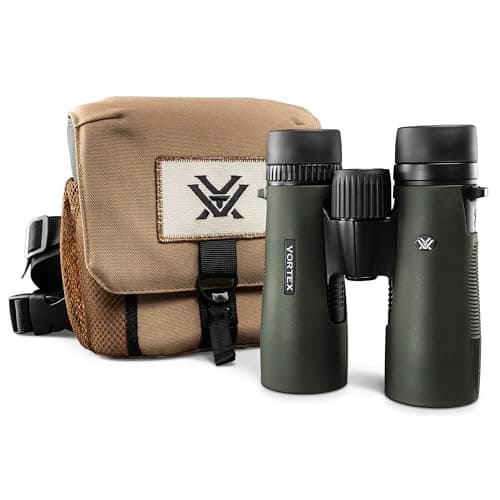
Vortex Diamondback HD 8x42Nothing here is the best figure in its column, and nothing is the worst — which for a gift is exactly the right shape.Under $250
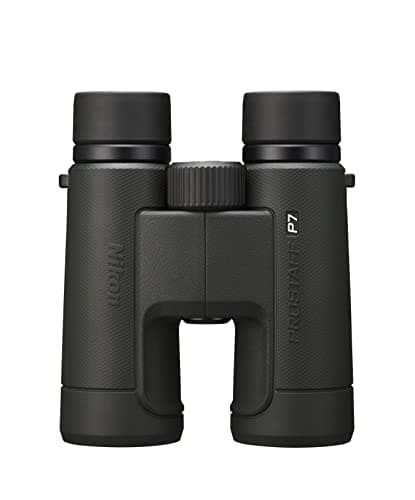
Nikon PROSTAFF P7 8x4220.2 mm of eye relief is the most generous figure here by a clear margin, and it is the number that decides whether a spectacle wearer keeps them.Under $250
Scores are ours, from the published rubric on the how-we-pick page. They are editorial judgments about published specifications and cost arithmetic, not test results — we have not handled these products.
Pick 01
The default first pair, and the closest focus here
Celestron Nature DX 8x42
The pair nearly every birding guide starts with, and the only one in this group that focuses down to 6.5 feet — which matters more than it sounds.
20.2 mm eye relief, which no other pair in this group approaches
Lightest here at 20.8 oz, which matters after an hour around the neck
Nikon's service network is the easiest of these brands to actually reach
What it does not
9.8 ft close focus is the worst in this group — a bird at the feeder ten feet away may not focus
Narrowest real field of view here at 7.2 degrees
Plainer finish than rivals at similar money, if that matters to the recipient
Who it is for
A glasses wearer, or anyone who has previously said binoculars give them a tunnel-vision black ring. That symptom is short eye relief, and this is the fix.
Skip this if
The recipient mostly watches a feeder from a kitchen window. At 9.8 ft minimum focus, a close feeder is exactly the shot these cannot take.
FAQ
Questions people ask about this
Can you use astronomy binoculars for bird watching?
Yes, but they are the wrong tool for most birding. Typical 10x50 to 15x70 pairs are heavy, shaky without a tripod, narrow in field of view, and frequently cannot focus closer than 25 to 40 feet — which rules out anything in a garden.
Can you use 10x50 binoculars for birding?
A 10x50 is the most usable astronomy size for birds. It is heavier than an 8x42 and harder to hold steady, but it is not absurd, and for distant waterfowl from a fixed spot it works well. Check the close focus figure before buying — that is where these designs usually disappoint.
Are 15x70 binoculars good for bird watching?
No. At 15x you cannot hold the image steady freehand, the field of view is too narrow to find a moving bird quickly, and close focus is typically around 40 feet. They are tripod instruments for stationary targets.
What is the difference between astronomy and birding binoculars?
Astronomy designs maximize magnification and light gathering for distant, stationary objects, accepting weight and a narrow field. Birding designs maximize field of view and close focus at a hand-holdable 8x, accepting a smaller objective. Different jobs, different optimizations.
Do I need two pairs of binoculars?
Only if you do both seriously. An 8x42 birding pair is a perfectly decent casual stargazing instrument for the moon and bright clusters. A 15x70 astronomy pair is not a usable birding instrument at all, so if you are buying one pair to do both, buy the 8x42.