Skip to content
The GiftPerch

Backyard

Best wren houses

One published number does most of the work here. An eighth of an inch at the entrance decides whether you get wrens, chickadees, or a pair of House Sparrows you cannot evict.

By Scooter M.Published September 27, 2026Content updated September 27, 2026Prices verified September 27, 2026

We don't test this gear. Here's what we do instead.

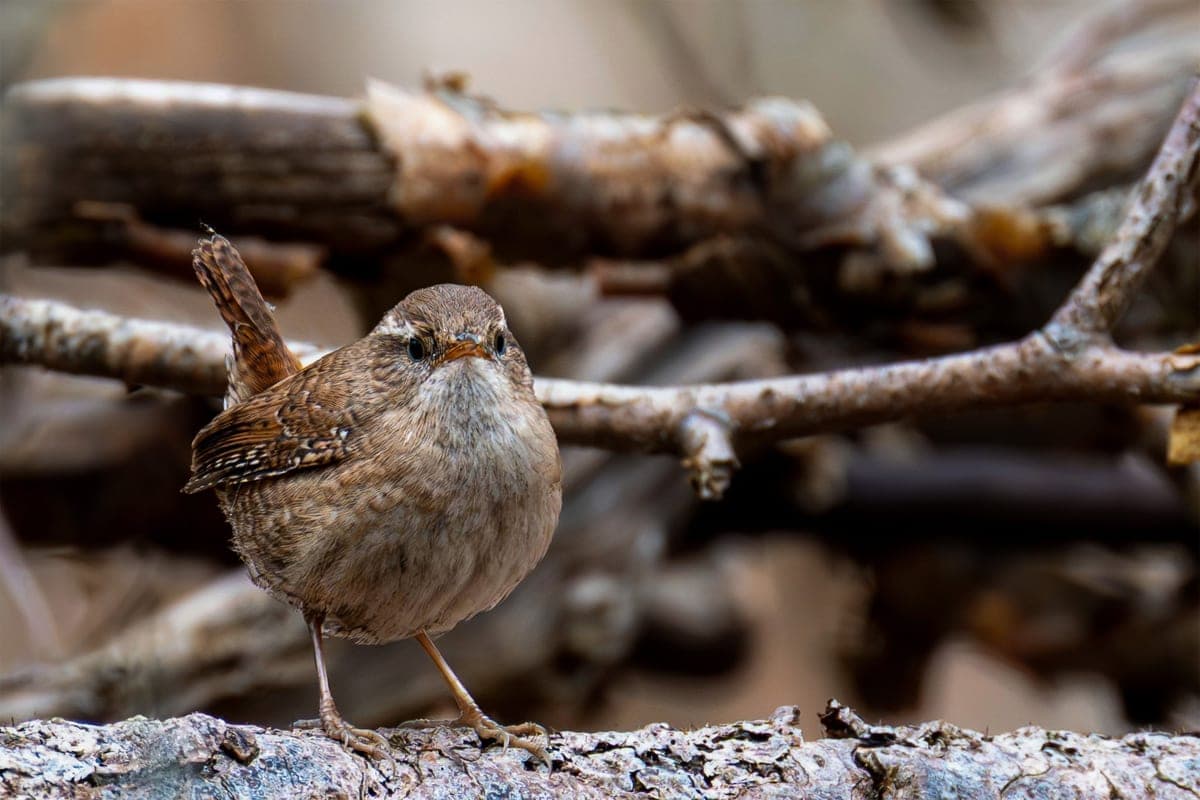
A wren perched on a bare branch in its natural habitat

The Gift Perch earns a commission when you buy through our links, at no extra cost to you. We are an Amazon Associate. We accept no free products, no sponsored placements and no paid inclusion, and the commission rate plays no part in what we recommend. Full disclosure.

Buy on the entrance hole, then on whether it has a predator guard. NestWatch publishes a 1 in hole, a 5.5 in x 5.5 in floor and an 8 in inside depth for House Wren, mounted 5 to 10 ft up within about 100 ft of woody vegetation. Kettle Moraine's wren and chickadee boxes use 1-1/8 in, which is an eighth over NestWatch's wren figure and is what also lets chickadees in — while still being comfortably under the roughly 1-1/4 in a House Sparrow needs. The recycled-roof version is the one to buy because it adds a predator guard for six dollars; the nuthatch and titmouse box opens the hole to 1-1/4 in, which is a different decision rather than a better one.

Wren boxes are the cheapest way into nest boxes and the easiest to get wrong, because almost every decorative birdhouse sold is nominally a wren house and almost none of them publish a hole diameter. That single number is the product. Everything below is either NestWatch's published specification or the maker's own, read on the dates in the sources — we have not handled these boxes.

What we judged on

  1. The entrance hole, to the eighth of an inch. It decides the species, and it decides whether House Sparrows can get in and take the box over. This is the first specification on every product here.
  2. Whether there is a predator guard. A plain hole in 3/4 in cedar can be chewed wider by a squirrel in an afternoon, which turns a wren box into a squirrel box permanently.
  3. Whether the box opens. Old nests have to come out between seasons. A flip-up front or a swing-open panel is what makes that happen; a sealed decorative box does not get cleaned.
  4. Drainage and ventilation. Both published by this maker, and both are the difference between a dry brood and a failed one in a wet spring.
  5. What it is made of. Cedar with stainless screws lasts; pine with nails loosens. Recycled HDPE never rots at all. All three are on this page and all three are honest trades.
  6. What the maker publishes at all. Kettle Moraine publishes hole size and external dimensions on two of these three and hole size only on the third. Nobody in this class publishes an internal floor dimension, which is the figure NestWatch actually specifies.

The picks

Ranked picks with what each is best for, our score out of ten, the budget band it falls in, and a link to check its current price on Amazon.
#PickBest forScorePrice
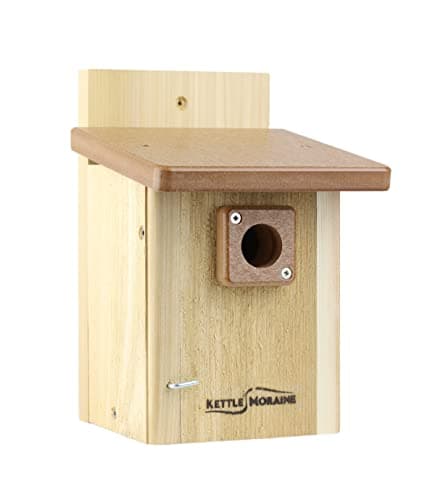
01Kettle Moraine Wren & Chickadee Nest Box with Recycled RoofKettle Moraine Wren & Chickadee Nest Box with Recycled RoofIdentical cedar body and 1-1/8 in hole, plus a recycled-plastic roof and a predator guard — the version to buy if anything has ever chewed a box in your yard.Under $50The same box with the two things the cedar version lacks8.2out of 10
$40.00 · View on Amazon

#ad Price as of September 27, 2026. How we are funded

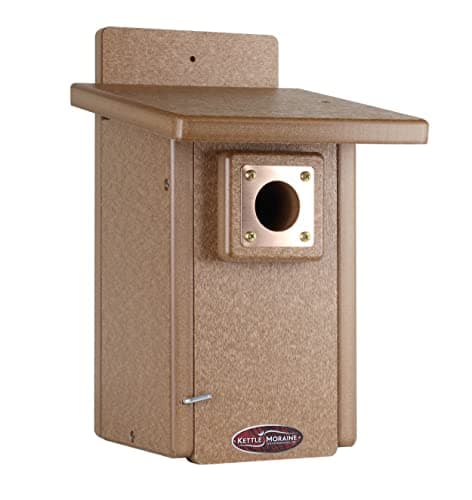
02Kettle Moraine Recycled Nuthatch & Titmouse Nest BoxKettle Moraine Recycled Nuthatch & Titmouse Nest BoxA 1-1/4 in copper portal and a fledgling ladder, in recycled milk-jug lumber — built for nuthatches and titmice rather than wrens, and it says so.Under $100A wider hole, for the species a wren box shuts out7.9out of 10
$50.00 · View on Amazon

#ad Price as of September 27, 2026. How we are funded

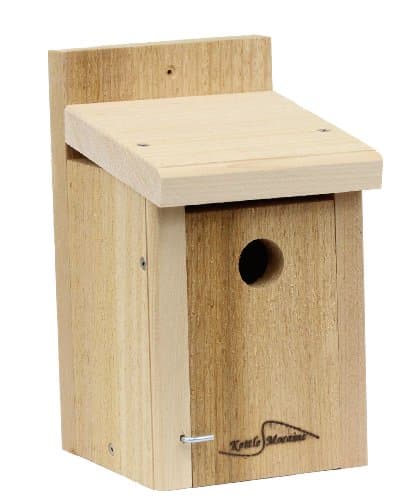
03Kettle Moraine Wren & Chickadee Nest Box, cedar (for mounting)Kettle Moraine Wren & Chickadee Nest Box, cedar (for mounting)Solid cedar, stainless screws, a flip-up front and a 1-1/8 in hole — the plain version of a box that does not need to be complicated.Under $50The straightforward cedar box, at the lowest maker price here7.8out of 10
$36.00 · View on Amazon

#ad Price as of September 27, 2026. How we are funded

Ranked for a yard that wants wrens and chickadees and has had a box chewed at before. If nothing has ever damaged a box, the plain cedar version at the bottom does the same job for six dollars less.

Pick 01

Kettle Moraine Wren & Chickadee Nest Box with Recycled Roof

The same box with the two things the cedar version lacks

Kettle Moraine Wren & Chickadee Nest Box with Recycled Roof

Identical cedar body and 1-1/8 in hole, plus a recycled-plastic roof and a predator guard — the version to buy if anything has ever chewed a box in your yard.

Score
8.2
Meets the spec
8.0
Durability
9.0
Predator defense
8.0
Value
8.0
Budget band
Under $50
$40.00 · View on Amazon

#ad Price as of September 27, 2026. How we are funded

Published specifications

The published requirement for a House Wren box
NestWatch specifies a 5.5 in x 5.5 in floor, a 1 in entrance hole, an 8 in inside depth, mounting 5 to 10 ft above the ground, boxes about 100 ft apart, any orientation, and a position within 100 ft of woody vegetation with clear flying room at the hole.Source: NestWatch (Cornell Lab of Ornithology), House Wren nest box specifications, nestwatch.org, read 2026-09-27
Entrance hole
1-1/8 in, with a predator guardSource: Kettle Moraine Woodworking, Wren & Chickadee Nest Box with Recycled Roof product page, kmwoodworking.com, read 2026-09-27
Why the guard matters
A predator guard thickens the entrance so a squirrel cannot chew the hole wider and a raccoon cannot reach throughSource: Kettle Moraine Woodworking, Wren & Chickadee Nest Box with Recycled Roof product page, kmwoodworking.com, read 2026-09-27
Roof
Recycled plastic, offered in five colors, for weather protection the cedar roof does not matchSource: Kettle Moraine Woodworking, Wren & Chickadee Nest Box with Recycled Roof product page, kmwoodworking.com, read 2026-09-27
Dimensions
5.5 in wide x 6.25 in deep x 9.5 in tall — the same body as the all-cedar versionSource: Kettle Moraine Woodworking, Wren & Chickadee Nest Box with Recycled Roof product page, kmwoodworking.com, read 2026-09-27
Construction
Cedar with stainless steel screwsSource: Kettle Moraine Woodworking, Wren & Chickadee Nest Box with Recycled Roof product page, kmwoodworking.com, read 2026-09-27
Cleaning
Flip-up frontSource: Kettle Moraine Woodworking, Wren & Chickadee Nest Box with Recycled Roof product page, kmwoodworking.com, read 2026-09-27
Mounting
Screw included; ready to mount out of the boxSource: Kettle Moraine Woodworking, Wren & Chickadee Nest Box with Recycled Roof product page, kmwoodworking.com, read 2026-09-27
Maker's list price
$40.00 on 2026-09-27. The green colorway was showing as temporarily unavailable on the maker's store that daySource: Kettle Moraine Woodworking, Wren & Chickadee Nest Box with Recycled Roof product page, kmwoodworking.com, read 2026-09-27

What it gets right

  • A predator guard for six dollars over the plain cedar box is the best-value upgrade on this page
  • The recycled roof is the part that takes the most weather, and plastic does not split or need treating
  • Same published dimensions as the cedar version, so nothing is traded away for the upgrade
  • Five color options, which matters only because a box you like the look of is a box that stays up

What it does not

  • A plastic roof on a cedar box is a mixed-material object and looks like one
  • Still a 1-1/8 in hole rather than NestWatch's 1 in House Wren figure
  • One colorway was unavailable from the maker when we checked, so the color you want may not be the color you get
  • No published internal floor dimension, same as the cedar version

Who it is for

Anyone in squirrel or raccoon country, or anyone replacing a box whose entrance hole has already been chewed open.

Skip this if

You want the box to be all wood. This is the practical version rather than the handsome one, and the all-cedar model costs less.

Pick 02

Kettle Moraine Recycled Nuthatch & Titmouse Nest Box

A wider hole, for the species a wren box shuts out

Kettle Moraine Recycled Nuthatch & Titmouse Nest Box

A 1-1/4 in copper portal and a fledgling ladder, in recycled milk-jug lumber — built for nuthatches and titmice rather than wrens, and it says so.

Score
7.9
Meets the spec
7.0
Durability
9.5
Predator defense
9.0
Value
6.5
Budget band
Under $100
$50.00 · View on Amazon

#ad Price as of September 27, 2026. How we are funded

Published specifications

The published requirement for a House Wren box
NestWatch specifies a 5.5 in x 5.5 in floor, a 1 in entrance hole, an 8 in inside depth, mounting 5 to 10 ft above the ground, boxes about 100 ft apart, any orientation, and a position within 100 ft of woody vegetation with clear flying room at the hole.Source: NestWatch (Cornell Lab of Ornithology), House Wren nest box specifications, nestwatch.org, read 2026-09-27
Entrance hole
1-1/4 in predator guard with a copper portal, which the maker says helps keep squirrels and larger birds outSource: Kettle Moraine Woodworking, Recycled Nuthatch & Titmouse Nest Box product page, kmwoodworking.com, read 2026-09-27
Birds the maker lists
Red-breasted and white-breasted nuthatches by design; also tufted titmice, downy woodpeckers, chickadees and wrensSource: Kettle Moraine Woodworking, Recycled Nuthatch & Titmouse Nest Box product page, kmwoodworking.com, read 2026-09-27
Fledgling ladder
Inside the swing-open front panel, so young birds can climb to the holeSource: Kettle Moraine Woodworking, Recycled Nuthatch & Titmouse Nest Box product page, kmwoodworking.com, read 2026-09-27
Roof
Wide overhanging roof with ventilation in the eavesSource: Kettle Moraine Woodworking, Recycled Nuthatch & Titmouse Nest Box product page, kmwoodworking.com, read 2026-09-27
Material
HDPE plastic lumber made in the USA from recycled milk jugsSource: Kettle Moraine Woodworking, Recycled Nuthatch & Titmouse Nest Box product page, kmwoodworking.com, read 2026-09-27
Mounting
Two screws included for attaching to a post or treeSource: Kettle Moraine Woodworking, Recycled Nuthatch & Titmouse Nest Box product page, kmwoodworking.com, read 2026-09-27
Dimensions
Not published by the manufacturer in a form we could verify on the maker's product page for this model
Maker's list price
$50.00 on 2026-09-27; two of the five colorways were showing as temporarily unavailableSource: Kettle Moraine Woodworking, Recycled Nuthatch & Titmouse Nest Box product page, kmwoodworking.com, read 2026-09-27

What it gets right

  • A copper portal is the most durable entrance treatment here — squirrels cannot chew metal
  • The fledgling ladder is a detail aimed at whether the young get out, not at the buyer
  • Recycled HDPE does not rot, split or need treating, and this is the only box here made of it throughout
  • Names the species it is designed for, and the ones it also suits, rather than claiming to fit everything

What it does not

  • A 1-1/4 in hole is at the size where House Sparrows start to become a problem, which the smaller boxes here avoid by design
  • The maker publishes no dimensions at all for this model, which the cedar wren boxes do
  • The most expensive box on this page, for a hole size some yards specifically do not want
  • Two of five colorways were unavailable from the maker on the day we checked

Who it is for

Someone who has nuthatches or titmice around and wants a box sized for them rather than a wren box they will ignore.

Skip this if

House Sparrows are already a problem in your yard. The 1-1/8 in boxes on this page exclude them by geometry; a 1-1/4 in hole does not.

Pick 03

Kettle Moraine Wren & Chickadee Nest Box, cedar (for mounting)

The straightforward cedar box, at the lowest maker price here

Kettle Moraine Wren & Chickadee Nest Box, cedar (for mounting)

Solid cedar, stainless screws, a flip-up front and a 1-1/8 in hole — the plain version of a box that does not need to be complicated.

Score
7.8
Meets the spec
8.0
Durability
8.0
Predator defense
3.0
Value
9.0
Budget band
Under $50
$36.00 · View on Amazon

#ad Price as of September 27, 2026. How we are funded

Published specifications

The published requirement for a House Wren box
NestWatch specifies a 5.5 in x 5.5 in floor, a 1 in entrance hole, an 8 in inside depth, mounting 5 to 10 ft above the ground, boxes about 100 ft apart, any orientation, and a position within 100 ft of woody vegetation with clear flying room at the hole.Source: NestWatch (Cornell Lab of Ornithology), House Wren nest box specifications, nestwatch.org, read 2026-09-27
Entrance hole
1-1/8 in, which the maker describes as ideal for wrens and chickadeesSource: Kettle Moraine Woodworking, Wren & Chickadee Nest Box (for Mounting) product page, kmwoodworking.com, read 2026-09-27
How that compares
NestWatch publishes 1 in for House Wren specifically. The extra eighth of an inch is what also admits chickadees, and it is still far below the roughly 1-1/4 in a House Sparrow needsSource: NestWatch (Cornell Lab of Ornithology), House Wren nest box specifications, nestwatch.org, read 2026-09-27
Dimensions
5.5 in wide x 6.25 in deep x 9.5 in tallSource: Kettle Moraine Woodworking, Wren & Chickadee Nest Box (for Mounting) product page, kmwoodworking.com, read 2026-09-27
Construction
Cedar, not pine, with stainless steel screws rather than nailsSource: Kettle Moraine Woodworking, Wren & Chickadee Nest Box (for Mounting) product page, kmwoodworking.com, read 2026-09-27
Cleaning
Flip-up frontSource: Kettle Moraine Woodworking, Wren & Chickadee Nest Box (for Mounting) product page, kmwoodworking.com, read 2026-09-27
Ventilation and drainage
The maker states both are built inSource: Kettle Moraine Woodworking, Wren & Chickadee Nest Box (for Mounting) product page, kmwoodworking.com, read 2026-09-27
Mounting
Screw included; ready to mount out of the box. Mounting poles sold separatelySource: Kettle Moraine Woodworking, Wren & Chickadee Nest Box (for Mounting) product page, kmwoodworking.com, read 2026-09-27
Predator guard
None on this version — the recycled-roof model adds one
Maker's list price
$34.00 on 2026-09-27Source: Kettle Moraine Woodworking, Wren & Chickadee Nest Box (for Mounting) product page, kmwoodworking.com, read 2026-09-27

What it gets right

  • The floor area and depth sit close to NestWatch's published House Wren figures, which most decorative boxes do not even publish
  • Cedar and stainless screws rather than pine and nails — the difference between a box that lasts a decade and one that loosens in three winters
  • A flip-up front means it actually gets cleaned out between seasons, which matters more on a wren box than most
  • Cheapest of the three here at the maker's own price, and it needs nothing else to go up

What it does not

  • No predator guard, so the entrance is a plain hole in 3/4 in cedar
  • 1-1/8 in is a chickadee hole rather than the 1 in NestWatch publishes for House Wren specifically
  • The maker does not publish an internal floor dimension, only the external size
  • Cedar will gray over, which is a look rather than a fault but worth expecting

Who it is for

Anyone who wants a properly built small-cavity box, in a yard with woody vegetation nearby and no history of squirrel damage.

Skip this if

Squirrels chew at your boxes. A plain cedar hole gets enlarged, and the recycled-roof version with its predator guard is the answer to that for six dollars more.

The eighth of an inch that decides the tenant

Hole size against what it admits
HoleGets youKeeps outOn this page
1 inHouse Wrens — NestWatch's published figureChickadees and almost everything largerNothing here is built at exactly 1 in
1-1/8 inWrens and chickadeesHouse Sparrows, which need roughly 1-1/4 inBoth Kettle Moraine wren boxes
1-1/4 inNuthatches, titmice, downy woodpeckers, plus wrens and chickadeesStarlings, but not House SparrowsThe nuthatch and titmouse box
1-1/2 in and upBluebirds and largerStarlings only at 1-1/2 inSee best bluebird houses

NestWatch's House Wren figure is published; the species each larger hole admits is taken from each maker's own stated design intent. Hole sizes are the makers' published figures, read 2026-09-27.

The practical consequence is that 1-1/8 in is the sweet spot for most yards, and it is what both Kettle Moraine wren boxes use. You give up nothing a wren wants, you gain chickadees, and you stay below the size at which House Sparrows become a problem — which matters because House Sparrows are not protected and will evict or kill native cavity nesters in a box they can enter.

The published figures, side by side

Every box on this page, on the maker's own numbers
BoxHolePredator guardMaterialOpens for cleaningDimensionsMaker's list price
Wren & Chickadee, recycled roof1-1/8 inYesCedar body, recycled plastic roofFlip-up front5.5 x 6.25 x 9.5 in$40.00
Nuthatch & Titmouse, recycled1-1/4 inYes, copper portalRecycled HDPE throughoutSwing-open front, fledgling ladderNot published$50.00
Wren & Chickadee, cedar1-1/8 inNoCedar, stainless screwsFlip-up front5.5 x 6.25 x 9.5 in$34.00

Kettle Moraine's own published figures, read 2026-09-27. Maker's list price is the number on the maker's own store that day, not a live retail price — the buy buttons carry the live Amazon price. Several colorways on the two recycled models were showing as temporarily unavailable from the maker on that date.

Where to put it, and why wrens are forgiving

  • 5 to 10 ft up, per NestWatch — lower than a bluebird box and well within reach of a stepladder, which makes cleaning realistic.
  • Any orientation. NestWatch states this plainly for House Wren, which is unusual: most box species have a preferred facing.
  • Within about 100 ft of woody vegetation, with enough clear space that the birds can fly straight to the hole.
  • About 100 ft between boxes. House Wrens are territorial, so a cluster of boxes does not produce a cluster of pairs.
  • Clean it out between seasons. All three boxes here open; that is what the hinge is for.

What not to buy

  • A decorative birdhouse with no published hole size. It is the only figure that matters and its absence is the answer.
  • Anything with a perch below the hole. Cavity nesters do not need one and it gives predators and House Sparrows somewhere to stand.
  • A box that does not open. Old nest material has to come out, and a sealed box is an ornament with a hole in it.
  • A 1-1/4 in hole, if House Sparrows are already a problem in your yard. That is the size at which they get in, and the 1-1/8 in boxes here are the specific answer.

FAQ

Questions people ask about this

What size hole does a wren house need?

NestWatch publishes 1 in for House Wren. In practice most quality boxes use 1-1/8 in, which also admits chickadees and still stays below the roughly 1-1/4 in a House Sparrow needs. Both Kettle Moraine wren boxes on this page use 1-1/8 in.

What are the dimensions of a wren house?

NestWatch specifies a 5.5 in x 5.5 in floor and an 8 in inside depth. Note that makers publish external dimensions rather than internal ones — the Kettle Moraine boxes here are 5.5 in wide x 6.25 in deep x 9.5 in tall on the outside.

How high should a wren house be mounted?

5 to 10 feet above the ground, per NestWatch, in any orientation, within about 100 feet of woody vegetation and with clear flying room at the entrance. That is lower than a bluebird box, which makes annual cleaning far easier.

Do wren houses need a perch?

No, and a perch is actively unhelpful. Cavity-nesting birds land directly at the hole, while a perch gives House Sparrows and predators somewhere to stand. None of the boxes on this page has one.

How do I keep House Sparrows out of a wren box?

Use a hole no larger than 1-1/8 in. House Sparrows generally need around 1-1/4 in, which is why the two wren boxes here exclude them by geometry and the nuthatch and titmouse box does not.

Will chickadees use a wren house?

Yes, at 1-1/8 in. Kettle Moraine markets both of its boxes here as wren and chickadee boxes for exactly that reason, and its nuthatch box lists chickadees and wrens among the species it also suits.

How far apart should wren houses be?

About 100 feet, per NestWatch. House Wrens are territorial, so putting several boxes close together does not get you several pairs — it gets you one pair and some empty boxes.

Sources

Where these figures come from