The Gift Perch earns a commission when you buy through our links, at no extra cost to you. We are an Amazon Associate. We accept no free products, no sponsored placements and no paid inclusion, and the commission rate plays no part in what we recommend. Full disclosure.
Buy straight black oil sunflower seed. Cornell's Project FeederWatch names it the preferred food of the widest variety of feeder birds, and the Wagner's 5 lb bag is the one to start with — a single ingredient, nothing to throw away, cheap enough to find out which birds you actually have. If you want the fat and protein figures printed on the bag rather than a sentence about energy, buy Kaytee's instead: it publishes 15.5% minimum protein and 30% minimum fat on the same seed.
That is the whole answer, and it is slightly deflating, because the seed aisle is built to suggest otherwise. There are blends named after cardinals, blends named after songbirds, blends with fruit in them and blends with a photograph of a finch on the front. Most of them are black oil sunflower with cheaper material added to bring the price per pound down.
What makes this decidable rather than a matter of taste is that two makers publish enough to compare. Kaytee prints a full guaranteed analysis and an ingredient list in descending order for every product it sells. Wagner's prints ingredients and bag sizes, and no analysis anywhere. Everybody else publishes neither, which is why nothing else is on this page.
What we judged on
Whether the maker publishes a guaranteed analysis. Crude protein, crude fat, crude fiber and moisture. A bag that declares nothing cannot be compared with a bag that declares everything, and the absence is a finding in itself.
The ingredient list, in the maker's own order. Ingredients are listed by descending weight. Where the sunflower stops and the cracked corn starts is the most useful sentence on any bag of bird food.
What Cornell says birds prefer, rather than what the packaging says they prefer. Project FeederWatch's feeding guidance is the only seed advice here that did not come from somebody selling seed.
The fiber figure, because fiber is shell. A 23% maximum fiber on shelled sunflower means roughly a quarter of what you carry home ends up on the ground.
Whether the seed suits the feeder you own. A mix in a tube feeder gets sorted and two thirds of it lands underneath. This is the single most common reason people conclude that birds do not like their feeder.
The picks
Ranked picks with what each is best for, our score out of ten, the budget band it falls in, and a link to check its current price on Amazon.
#
Pick
Best for
Score
Price
01
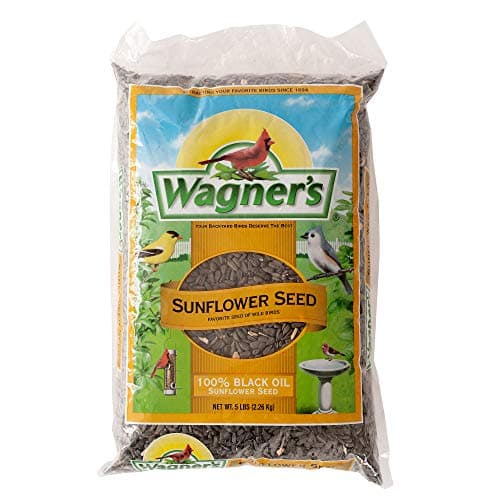
Wagner's Oil Sunflower Seed, 5 lb (52023)Straight black oil sunflower in a 5 lb bag: the single seed Cornell names as the preferred food of the widest range of feeder birds, with no corn and no millet to throw out.Under $25
Kaytee Black Oil Sunflower, 20 lbThe only black oil sunflower here whose maker publishes a guaranteed analysis — 15.5% protein and 30% fat minimum — and the size that makes the per-pound cost sane.Under $50
The same seed, bought by the numbers and by the sack
Kaytee Cardinal Blend, 7 lbThree ingredients — sunflower, safflower, soybean oil — and 36% minimum fat, the highest published figure of any seed on this site. No corn, no millet, nothing to sort out.Under $25
Cardinals without the filler, and the highest published fat here
Wagner's Nyjer Seed, 5 lb (62051)The one seed on this list that works by exclusion: goldfinches, purple finches and siskins take it, and most other birds cannot be bothered — which is the point of buying it.Under $25
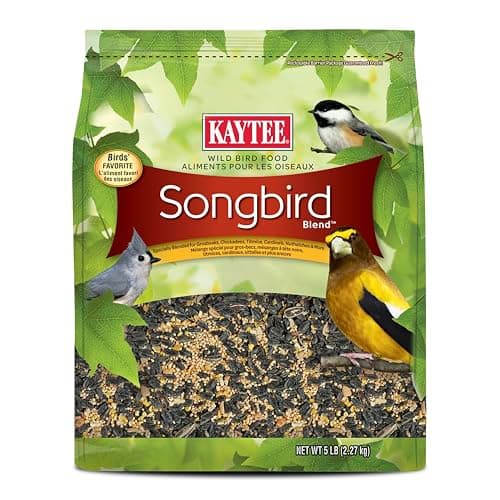
Kaytee Songbird Blend, 5 lbA mix whose ingredient list is published in order and leads with black oil sunflower — but cracked corn and millet are second and third, and that is what the 11% protein reflects.Under $25
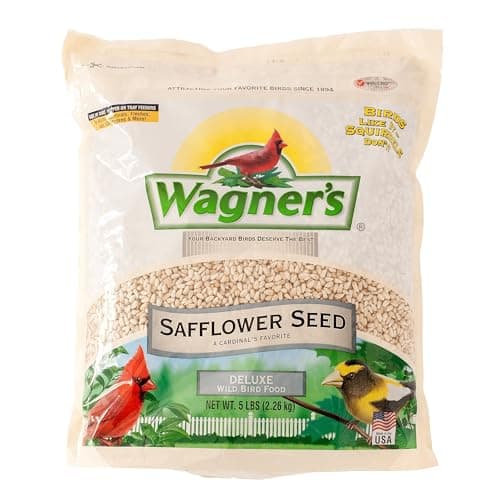
Wagner's Safflower Seed, 5 lb (57075)The safflower bag whose maker states the squirrel case outright — "disliked by most squirrels" — which is exactly why it is worth reading what Cornell does and does not say back.Under $25
Cardinals, with the clearest published squirrel claim to test
Live prices. Bag sizes differ enormously in this category, so compare the price per pound rather than the price.
Pick 01
The one bag to buy if you only buy one
Wagner's Oil Sunflower Seed, 5 lb (52023)
Straight black oil sunflower in a 5 lb bag: the single seed Cornell names as the preferred food of the widest range of feeder birds, with no corn and no millet to throw out.
Cornell's Project FeederWatch names black-oil sunflower "the preferred food item for a wide variety of birds", and the most common feeder seed in North America. It is the one seed recommendation on this page that comes from ornithologists rather than from a bag.Source: Project FeederWatch (Cornell Lab of Ornithology), Feeding Birds: seed types, feeder hygiene and nectar, feederwatch.org/learn/feeding-birds, read 2026-10-17
Contents
Oil sunflower seed, nothing else — Wagner's lists no second ingredientSource: Wagner's Oil Sunflower Seed product page, wagners.com/product_pages/oil_sf.html, read 2026-10-17
Shell
"Extra clean, thin shelled Sunflower" — the maker's phrase; thin shells are what let small-billed birds open itSource: Wagner's Oil Sunflower Seed product page, wagners.com/product_pages/oil_sf.html, read 2026-10-17
Energy
"High energy content" — Wagner's publishes no fat or protein percentage for it, or for anything else in its rangeSource: Wagner's Oil Sunflower Seed product page, wagners.com/product_pages/oil_sf.html, read 2026-10-17
Not published by the manufacturer in a form we could verify — Wagner's publishes none for any product in its catalogueSource: Wagner's Oil Sunflower Seed product page, wagners.com/product_pages/oil_sf.html, read 2026-10-17
What it gets right
A single ingredient, so nothing in the bag is filler and nothing gets kicked to the ground
Cornell's own feeding guidance names black oil sunflower as the preferred food for a wide variety of birds — this is not a marketing claim
The thin shell is the reason chickadees and finches can use it and striped sunflower defeats them
The cheapest way to find out which birds you actually have before buying anything specialised
What it does not
Wagner's publishes no guaranteed analysis, so you cannot compare its fat and protein against Kaytee's on paper
Shells. A sunflower feeder leaves a hull pile, and the hulls suppress grass under it
5 lb is a few weeks at a busy feeder, so the per-pound cost is worse than a 20 lb bag
Squirrels like it as much as the birds do, which is a feeder problem this bag cannot solve
Who it is for
Anyone filling their first feeder, and anyone who has been buying a mixed bag and finding half of it on the ground.
Skip this if
The feeder sits over a deck, a patio or a lawn you care about. Hulls are the whole objection, and [hulled seed](/feeders/best-no-mess-bird-seed) is the answer to it.
Pick 02
The same seed, bought by the numbers and by the sack
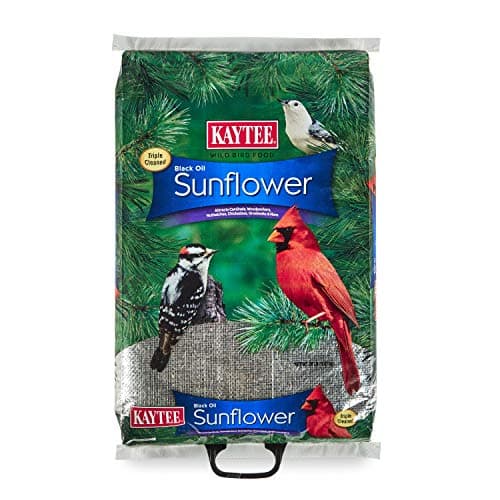
Kaytee Black Oil Sunflower, 20 lb
The only black oil sunflower here whose maker publishes a guaranteed analysis — 15.5% protein and 30% fat minimum — and the size that makes the per-pound cost sane.
Cornell's Project FeederWatch names black-oil sunflower "the preferred food item for a wide variety of birds", and the most common feeder seed in North America. It is the one seed recommendation on this page that comes from ornithologists rather than from a bag.Source: Project FeederWatch (Cornell Lab of Ornithology), Feeding Birds: seed types, feeder hygiene and nectar, feederwatch.org/learn/feeding-birds, read 2026-10-17
Who publishes a guaranteed analysis
Kaytee prints a full guaranteed analysis and an ordered ingredient list for every product. Wagner's prints ingredients, bag sizes and its own claims, but no analysis anywhere in its range. Most other brands publish neither, which is why they are not on this site.
Ingredients
Oil Sunflower Seed — the complete listSource: Kaytee Black Oil Sunflower product page, kaytee.com/all-products/wild-bird/black-oil-sunflower, read 2026-10-17
Crude protein (min)
15.5%Source: Kaytee Black Oil Sunflower product page, kaytee.com/all-products/wild-bird/black-oil-sunflower, read 2026-10-17
Crude fat (min)
30.0%Source: Kaytee Black Oil Sunflower product page, kaytee.com/all-products/wild-bird/black-oil-sunflower, read 2026-10-17
Crude fiber (max)
23.0% — this is the shell, and it is why hulled seed tests so differentlySource: Kaytee Black Oil Sunflower product page, kaytee.com/all-products/wild-bird/black-oil-sunflower, read 2026-10-17
Moisture (max)
12.0%Source: Kaytee Black Oil Sunflower product page, kaytee.com/all-products/wild-bird/black-oil-sunflower, read 2026-10-17
Maker's description
"The best single grain for attracting the widest variety of wild birds"Source: Kaytee Black Oil Sunflower product page, kaytee.com/all-products/wild-bird/black-oil-sunflower, read 2026-10-17
Bag sizes
5 lb, 10 lb and 20 lbSource: Kaytee Black Oil Sunflower product page, kaytee.com/all-products/wild-bird/black-oil-sunflower, read 2026-10-17
What it gets right
A full guaranteed analysis on a single-ingredient seed, which is as transparent as this category gets
30% minimum fat is the figure that matters in cold weather, and it is published rather than implied
20 lb is four times the common bag at roughly four times the price, so nothing is lost on packaging
Identical seed to any other black oil sunflower, so the choice is honestly about price per pound and disclosure
What it does not
20 lb needs somewhere dry and rodent-proof to live, which a 5 lb bag does not
The 23% fiber figure is the hull — about a quarter of what you carry home goes on the ground
No cheaper per pound than a hardware-store sack of the same seed; you are paying for the published analysis
Too much seed to discover with. Buy the 5 lb bag first if you have never run a feeder
Who it is for
An established feeder station, and anyone who wants the fat and protein figures on the bag rather than a sentence about energy.
Skip this if
You are feeding one small tube on a balcony. A 20 lb sack will go stale before it goes empty, and stale seed is the most common reason a feeder quietly stops working.
Pick 03
Cardinals without the filler, and the highest published fat here
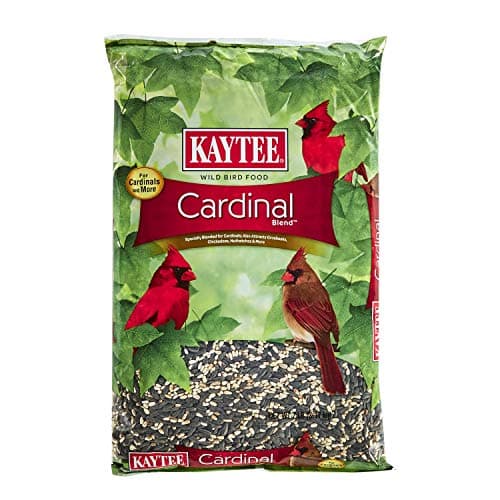
Kaytee Cardinal Blend, 7 lb
Three ingredients — sunflower, safflower, soybean oil — and 36% minimum fat, the highest published figure of any seed on this site. No corn, no millet, nothing to sort out.
Kaytee prints a full guaranteed analysis and an ordered ingredient list for every product. Wagner's prints ingredients, bag sizes and its own claims, but no analysis anywhere in its range. Most other brands publish neither, which is why they are not on this site.
36.0% — the highest published fat figure of any seed on this siteSource: Kaytee Cardinal Blend product page, kaytee.com/all-products/wild-bird/cardinal, read 2026-10-17
A three-ingredient mix is a blend of the two seeds cardinals actually eat, not a sunflower bag with corn in it
36% minimum fat beats straight black oil sunflower's 30%, which is the figure that matters in winter
Combining sunflower and safflower hedges the safflower gamble — the birds that refuse safflower still have something to eat
No milo, no corn, no millet, so nothing gets flicked onto the ground
What it does not
13.5% protein is below straight black oil sunflower's 15.5%, because safflower drags it down
26% fiber means a quarter of the bag is shell, and the hull pile is a sunflower hull pile
Costs more per pound than buying the two seeds separately, for a ratio Kaytee does not publish
Narrower species list than the Songbird Blend — this is a mix that excludes on purpose
Who it is for
A cardinal-focused feeder, and anyone who wants the safflower effect without betting the whole feeder on it.
Skip this if
You want ground foragers as well. Juncos, doves and sparrows want millet and cracked corn, and this bag deliberately has neither.
Pick 04
Goldfinches, and almost nothing else
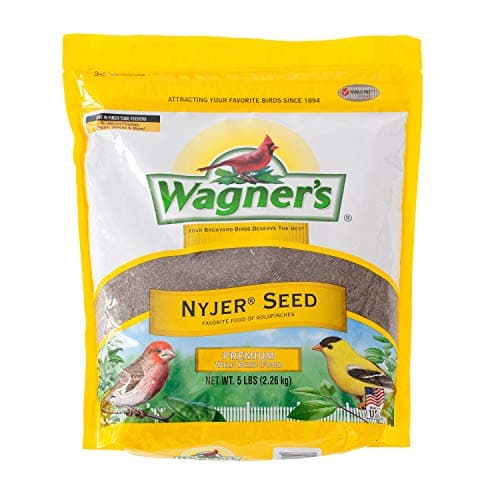
Wagner's Nyjer Seed, 5 lb (62051)
The one seed on this list that works by exclusion: goldfinches, purple finches and siskins take it, and most other birds cannot be bothered — which is the point of buying it.
A small oil-rich seed, imported rather than grown domestically, fed from a tube with ports too small for most beaks. Often sold as "thistle", which it is not.Source: Wagner's Nyjer Seed product page, wagners.com/product_pages/nyjer.html, read 2026-10-17
"High fat and protein content" — no percentage publishedSource: Wagner's Nyjer Seed product page, wagners.com/product_pages/nyjer.html, read 2026-10-17
Birds the maker names
American goldfinch, purple finch, pine siskin and other small songbirdsSource: Wagner's Nyjer Seed product page, wagners.com/product_pages/nyjer.html, read 2026-10-17
Why the feeder matters
Wagner's notes that small-holed finch feeders discourage larger birds — the exclusion is mechanical as well as dietarySource: Wagner's Nyjer Seed product page, wagners.com/product_pages/nyjer.html, read 2026-10-17
Not published by the manufacturer in a form we could verify — Wagner's publishes noneSource: Wagner's Nyjer Seed product page, wagners.com/product_pages/nyjer.html, read 2026-10-17
What it gets right
Brings goldfinches, which are the birds most people actually want and the ones sunflower feeders attract least reliably
Excludes grackles, starlings, jays and doves by seed size, with no mechanism to fail
Squirrels largely ignore it, which is the one uncontested pest claim in the whole seed aisle
Four bag sizes, so you can buy 2 lb to find out whether you have finches at all
What it does not
Needs its own feeder. Nyjer in a standard tube pours straight through the ports
Goes stale and oily faster than sunflower, and finches reject stale nyjer outright
No published analysis, so "high fat and protein" is a sentence rather than a number
The most expensive seed here per pound by a wide margin
Who it is for
Anyone who already has finches on a sunflower feeder and wants a second feeder that only they can use.
Skip this if
You have not seen a goldfinch in the garden. Nyjer does not summon them; it feeds them once they are there. Start with [black oil sunflower](/feeders/best-bird-seed) and see who turns up.
Pick 05
The best ready-made mix, with its padding visible
Kaytee Songbird Blend, 5 lb
A mix whose ingredient list is published in order and leads with black oil sunflower — but cracked corn and millet are second and third, and that is what the 11% protein reflects.
Kaytee prints a full guaranteed analysis and an ordered ingredient list for every product. Wagner's prints ingredients, bag sizes and its own claims, but no analysis anywhere in its range. Most other brands publish neither, which is why they are not on this site.
11.0% — the lowest of any Kaytee product on this siteSource: Kaytee Songbird Blend product page, kaytee.com/all-products/wild-bird/songbird-blend, read 2026-10-17
The ingredient list is published in descending order, so you can see exactly where the sunflower stops and the corn starts
No milo, which is the ingredient Cornell specifically says to avoid in large amounts
Cracked corn and millet do feed ground foragers — juncos, doves and sparrows — so the padding is not purely padding
Cheap, and the widest species list of any single bag here
What it does not
11% minimum protein against 15.5% for straight black oil sunflower — the mix is measurably thinner
Cracked corn is the second ingredient by weight, and tube-feeder birds will flick it out to get at the sunflower
A mix is the wrong format for a tube feeder and the right one for a tray, and the bag does not say so
Striped sunflower is fifth on the list and most small birds cannot open it
Who it is for
Someone running a platform or hopper feeder who wants ground foragers as well as perching birds, and who would rather read the order of the ingredients than guess.
Skip this if
Your feeder is a tube. Mixes get sorted and the rejected two-thirds end up underneath. A tube wants [one seed](/feeders/best-bird-seed), and a [tray or hopper](/feeders/best-platform-feeders) is what a mix is for.
Pick 06
Cardinals, with the clearest published squirrel claim to test
Wagner's Safflower Seed, 5 lb (57075)
The safflower bag whose maker states the squirrel case outright — "disliked by most squirrels" — which is exactly why it is worth reading what Cornell does and does not say back.
Both makers here say squirrels dislike safflower's bitter taste. Cornell's own feeding guidance does not repeat that claim: it describes safflower as a food that "attracts cardinals and other big-billed birds" while noting that "most birds prefer sunflower seeds over safflower", and its squirrel advice is baffles, distraction feeding and capsaicin-treated seed instead.Source: Project FeederWatch (Cornell Lab of Ornithology), Feeding Birds: seed types, feeder hygiene and nectar, feederwatch.org/learn/feeding-birds, read 2026-10-17
"Disliked by most squirrels" — and "most squirrels don't like the bitter taste so they will stay away as well"Source: Wagner's Safflower Seed product page, wagners.com/product_pages/safflower.html, read 2026-10-17
Maker's nuisance-bird claim
Can "discourage the 'feeder hogs' like Grackles and Starlings that keep smaller birds away"Source: Wagner's Safflower Seed product page, wagners.com/product_pages/safflower.html, read 2026-10-17
Not published by the manufacturer in a form we could verify — Wagner's publishes noneSource: Wagner's Safflower Seed product page, wagners.com/product_pages/safflower.html, read 2026-10-17
What it gets right
The maker states the squirrel and grackle claims plainly instead of hinting at them, which makes them checkable
Cardinals genuinely do take safflower, and Cornell lists it as a food for cardinals and other big-billed birds
A white-shelled seed is easy to tell apart from sunflower in a mixed feeder, so you can see what is being eaten
Cheaper per pound than any of the no-mess blends here
What it does not
Cornell's own feeding guidance says most birds prefer sunflower over safflower — switching costs you species
Cornell does not repeat the bitter-taste squirrel claim anywhere, and its squirrel advice is baffles and capsaicin instead
No published analysis, so the fat and protein are unknown
Shelled, so it leaves hulls like sunflower does
Who it is for
Someone whose cardinals are being crowded out by grackles and starlings and who wants to try the food answer before buying hardware.
Skip this if
Squirrels are the actual problem you are trying to solve. A [weight-activated feeder or a baffled pole](/feeders/best-feeder-poles) has a published mechanism; a seed's flavour does not.
The published analysis, side by side
Every figure below is the maker's own published guaranteed analysis
Every figure below is the maker's own published guaranteed analysis
Read 2026-10-17 from each maker's own product pages. Wagner's publishes no guaranteed analysis for anything in its catalogue, which is not a criticism of the seed — it is a limit on what can be checked before buying.
Two things in that table are worth sitting with. The single-ingredient sunflower has the highest protein of any bag here, and the mix with the friendliest name has the lowest — 11% against 15.5%. And the lowest fat figure on the whole site, 18%, belongs to a no-mess blend, because the corn and millet that make it cheap also make it thin.
The one ingredient to check for
Milo. It is a round, reddish-brown grain, it is cheap, and Cornell's feeding guidance is unusually blunt about it: it is "often a major component of inexpensive seed mixes", it "is not a favorite of most birds", and "in the east, it is best to avoid mixes with large amounts of milo". If milo appears in the first three ingredients, you are buying ballast.
Millet is a different case and gets unfairly lumped in with it. Cornell describes millet as "a favored food of many smaller, ground foraging birds" — juncos, doves, sparrows. In a tray feeder millet is food. In a tube feeder it is something chickadees flick out of the way, which is why the same bag can look like value or like waste depending entirely on the feeder it goes into.
Which seed brings which bird
Seed against species, with the source of the claim
Seed against species, with the source of the claim
Seed
Brings
On whose authority
Black oil sunflower
The widest range of any single seed — cardinals, chickadees, finches, nuthatches, woodpeckers
Cornell names it the preferred food for a wide variety of birds; Wagner's names those five families
Sunflower hearts and chips
The same birds, with no hulls on the ground
Cornell notes many species actively prefer hulled sunflower
Safflower
Cardinals and other big-billed birds; Kaytee also names blue jays
Cornell, which adds that most birds prefer sunflower to safflower
Nyjer
Goldfinches, purple finches, pine siskins — and very little else
Wagner's names those three; the exclusion is by seed and port size
Millet and cracked corn
Ground foragers: juncos, doves, sparrows
Cornell, which calls millet a favored food of smaller ground-foraging birds
Milo
Little that you want
Cornell, which advises avoiding mixes with large amounts of it
If you are buying one bag, and only one
Black oil sunflower, 5 lb, in whatever brand is in front of you. The seed is a commodity — Kaytee calls it "the best single grain for attracting the widest variety of wild birds" and Wagner's calls it "the favorite seed of most wild birds", and for once the two makers and the ornithologists agree. What you are choosing between is bag size, price per pound, and whether the maker publishes the analysis.
Buy the small bag first even if the large one is better value. Seed goes stale, stale seed gets refused, and a refused feeder looks exactly like a feeder in the wrong place. Find out what your garden has, then buy 20 lb of the seed it eats.
What not to buy
Anything with milo in the first three ingredients. Cornell's position on this is explicit and it is the cheapest material in the aisle.
Mixes with fruit pieces, unless the ingredient list shows the fruit before the corn. Dried fruit photographs well and weighs almost nothing.
Striped sunflower as a main seed. The shell is thick enough that chickadees, finches and titmice cannot open it. Kaytee lists it fifth in the Songbird Blend, which is about right as a minor ingredient.
A bag that publishes nothing at all. Not because unlabelled seed is bad seed, but because you have no way to tell, and two makers in this category do publish.
Bread, which is not seed and is not food. It fills a bird without feeding it, and a feeder is not the place for it.
The cost nobody mentions
Shelled seed is about a quarter shell by weight — that is what the 23% fiber figure on black oil sunflower means, and 32% on safflower. So a 5 lb bag of shelled sunflower is roughly 3.8 lb of food and 1.2 lb of hulls, and hulled seed at three times the shelf price is nowhere near three times the real price. If the hull pile is your objection, the honest arithmetic is on the no-mess page rather than in the price per bag.
FAQ
Questions people ask about this
What is the best bird seed for wild birds?
Black oil sunflower seed. Cornell's Project FeederWatch names it the preferred food for the widest variety of birds and the most common feeder seed in North America. Buy it straight rather than as part of a mix: Kaytee's single-ingredient black oil sunflower publishes 15.5% minimum protein against 11% for its own Songbird Blend.
Is expensive bird seed worth it?
Only when the extra cost buys hulled seed or a shorter ingredient list. A premium mix with cracked corn and millet high on the list is not better seed than a cheap bag of straight black oil sunflower — it publishes less protein and less fat. Price per pound of actual food is the figure that matters, and roughly a quarter of any shelled bag is shell.
What bird seed attracts the most birds?
Black oil sunflower, on Cornell's own assessment. Its thin shell is what lets small-billed birds such as chickadees and finches open it, which is why it outperforms striped sunflower despite being the same plant.
What seed do cardinals like?
Oil sunflower and safflower. Kaytee's Cardinal Blend is those two seeds and nothing else, and it publishes the highest fat figure on this site at 36% minimum. But cardinals also need somewhere to stand — a hopper or tray rather than a narrow tube — and that is more often the problem than the seed.
Should I buy a seed mix or a single seed?
It depends on the feeder, not the birds. A tube feeder wants one seed, because birds sort a mix and the rejected part lands on the ground. A tray, platform or hopper feeder is where a mix works, because ground foragers will eat the millet and cracked corn that tube birds discard.
What is milo and should I avoid it?
Milo is a cheap round reddish grain used to bulk out inexpensive mixes. Cornell's feeding guidance says it is not a favorite of most birds and advises avoiding mixes containing large amounts of it, particularly in the east. Check the first three ingredients.
How long does bird seed keep?
Buy what you will use in a few weeks rather than a sack that sits open for a season. Seed goes stale and oily, birds reject stale seed, and a rejected feeder is easily mistaken for a badly placed one. Hulled seed spoils fastest because it has no shell protecting the kernel.