The Gift Perch earns a commission when you buy through our links, at no extra cost to you. We are an Amazon Associate. We accept no free products, no sponsored placements and no paid inclusion, and the commission rate plays no part in what we recommend. Full disclosure.
Yes, if the feeder hangs over a deck, a patio, a path or a lawn you care about — and the pick is Wagner's Sunflower Hearts & Chips, because it is kernel and nothing else, so nothing can fall and nothing can sprout. If you want a blend rather than a single seed, Wagner's Gourmet Waste Free has the shortest ingredient list we could source: five items, all of them food. Everywhere else, buy ordinary shelled sunflower and accept the hull pile.
The thing to understand before spending three times as much per bag is what the phrase actually promises. "No mess" means the hulls have been removed. It does not mean every ingredient in the bag is one a bird wants, and the published ingredient lists show the difference immediately.
The one number that proves the case
Fiber. On a guaranteed analysis, crude fiber on a seed is essentially shell, and the figures are not close. Kaytee publishes 23.0% maximum fiber on its black oil sunflower, 32.0% on its safflower — and 9.0% on its No Mess Blend. That 9% against 23% is the entire argument for hulled seed, stated by a maker rather than by us.
Published fiber — the shell, by weight
Published fiber — the shell, by weight
Seed
Fiber (max)
What that means in a 5 lb bag
Kaytee No Mess Blend
9.0%
About 0.45 lb of material that is not food
Kaytee Black Oil Sunflower
23.0%
About 1.2 lb of hulls, on the ground
Kaytee Cardinal Blend
26.0%
About 1.3 lb of hulls
Kaytee Safflower
32.0%
About 1.6 lb of hulls — the highest on this site
Kaytee's own published guaranteed analyses, read 2026-10-17. Wagner's publishes no analysis for any product, including its hulled ones, so its bags cannot be placed in this table.
Run that through the price and hulled seed stops looking like a luxury. A 5 lb bag of shelled sunflower at $11 is about 3.8 lb of food, so roughly $2.90 a pound. A 3 lb bag of sunflower hearts at $15 is 3 lb of food, so $5.00 a pound. Still more expensive — but around 1.7 times, not the three times the shelf prices suggest.
What we judged on
Whether it is actually hull-free. Kernel only, or kernel plus bulk? The ingredient list answers this and the marketing does not.
The published ingredient list, in the maker's order. This is where "100% edible" and "no filler" turn out to be different claims.
Fiber, where the maker publishes it. The only hard proof that the hulls are gone.
Whether it can sprout. Kaytee puts this better than anyone: "Sunflower seeds can't germinate without their shell." For anyone feeding over a lawn or a border, this is half the point.
How fast it spoils. A kernel with no shell has no protection from damp. This is the real cost of hulled seed and almost nobody mentions it.
The picks
Ranked picks with what each is best for, our score out of ten, the budget band it falls in, and a link to check its current price on Amazon.
#
Pick
Best for
Score
Price
01
Wagner'sNo photoWagner's Sunflower Hearts & ChipsThe only honest answer to a deck, a patio or a path: shelled sunflower kernel and nothing else, so there is no hull to fall and nothing that can sprout.Under $25
Genuinely zero mess, because there is nothing in it but kernel
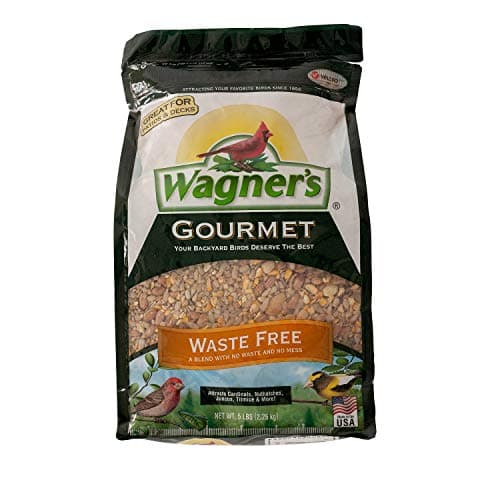
Wagner's Gourmet Waste Free, 5 lb (82056)Five ingredients, all of them things a bird eats: sunflower chips, peanut pieces, cracked corn, tree nuts, pumpkin seeds. In a category built on long labels, that is the recommendation.Under $25
KayteeNo photoKaytee No Mess BlendThe only no-mess blend here with a published analysis — 13.5% protein, 18% fat — and the one that shows what "100% edible" really means: no hulls, but cracked corn and millet still in the bag.Under $25
A no-mess blend you can actually read the numbers on
Wagner's Oil Sunflower Seed, 5 lb (52023)Straight black oil sunflower in a 5 lb bag: the single seed Cornell names as the preferred food of the widest range of feeder birds, with no corn and no millet to throw out.Under $25
Live prices. Hulled seed looks expensive per bag and is much closer to shelled seed per pound of food — the arithmetic is below.
Pick 01
Wagner'sNo photo
Genuinely zero mess, because there is nothing in it but kernel
Wagner's Sunflower Hearts & Chips
The only honest answer to a deck, a patio or a path: shelled sunflower kernel and nothing else, so there is no hull to fall and nothing that can sprout.
It means no hulls, not no filler. Hulled sunflower cannot germinate, so nothing sprouts under the feeder, and Cornell notes that many species actively prefer hulled sunflower to shelled. It does not mean every ingredient is one a bird queues for: most blends sold as no-mess still contain cracked corn.Source: Project FeederWatch (Cornell Lab of Ornithology), Feeding Birds: seed types, feeder hygiene and nectar, feederwatch.org/learn/feeding-birds, read 2026-10-17
Contents
Sunflower hearts and chips — kernel only, no second ingredient and no cracked cornSource: Wagner's Sunflower Hearts & Chips product page, wagners.com/product_pages/sf_chips.html, read 2026-10-17
Maker's mess claim
"No shells equals no mess" — the headline reads "No shells, no waste, lots of Songbirds"Source: Wagner's Sunflower Hearts & Chips product page, wagners.com/product_pages/sf_chips.html, read 2026-10-17
Maker's appeal claim
"Rated #1 for attracting Songbirds" and "the number one rated food for attracting the widest variety of birds" — Wagner's does not say who rated itSource: Wagner's Sunflower Hearts & Chips product page, wagners.com/product_pages/sf_chips.html, read 2026-10-17
Not published by the manufacturer in a form we could verify — Wagner's publishes noneSource: Wagner's Sunflower Hearts & Chips product page, wagners.com/product_pages/sf_chips.html, read 2026-10-17
What it gets right
No hulls at all, which is the only version of "no mess" that is literally true
Cornell notes that many species actively prefer hulled sunflower to the shelled kind
Every ounce is edible, so the real cost per pound of food is far closer to shelled seed than the shelf price suggests
Cannot sprout, so nothing grows under the feeder
What it does not
Spoils faster than shelled seed. The kernel has no shell protecting it from damp, and wet chips go moldy in days
Two to three times the shelf price per pound of any shelled sunflower here
Wagner's publishes no analysis, and its "#1 rated" claim names no rater
No ASIN we could match to this exact product with confidence, so the buy link resolves to a search
Who it is for
A feeder over a deck, a patio, a path or a lawn — anywhere the hull pile is the reason feeding stopped.
Skip this if
The feeder is exposed to rain and you fill it weekly rather than daily. Hulled seed needs a covered feeder and fast turnover or it is money going moldy.
Pick 02
The shortest ingredient list in the no-mess aisle
Wagner's Gourmet Waste Free, 5 lb (82056)
Five ingredients, all of them things a bird eats: sunflower chips, peanut pieces, cracked corn, tree nuts, pumpkin seeds. In a category built on long labels, that is the recommendation.
It means no hulls, not no filler. Hulled sunflower cannot germinate, so nothing sprouts under the feeder, and Cornell notes that many species actively prefer hulled sunflower to shelled. It does not mean every ingredient is one a bird queues for: most blends sold as no-mess still contain cracked corn.Source: Project FeederWatch (Cornell Lab of Ornithology), Feeding Birds: seed types, feeder hygiene and nectar, feederwatch.org/learn/feeding-birds, read 2026-10-17
Not published by the manufacturer in a form we could verify — Wagner's publishes noneSource: Wagner's Gourmet Blend Waste Free product page, wagners.com/product_pages/gourmet_waste_free.html, read 2026-10-17
What it gets right
Five ingredients, every one of them recognizable as food — the shortest list of any no-mess blend we could source
Tree nuts and pumpkin seeds are genuinely high-value items, not bulk
Shell-less throughout, so the no-growth claim holds
Half the price of the premium no-mess blends and no artificial coloring anywhere in it
What it does not
Cracked corn is on the list, so this is not pure kernel — a corn-free bag is straight sunflower hearts
No guaranteed analysis at all, so the protein and fat are unknown
Tree nuts, which matters in a household with a severe nut allergy handling the feeder
5 lb only, so there is no bulk size to bring the per-pound cost down
Who it is for
Anyone who wants a no-mess blend rather than a single seed and would rather read five ingredients than sixty.
Skip this if
You want literally nothing on the ground. Cracked corn is the one ingredient here that birds sort and drop, and [sunflower hearts alone](/feeders/best-no-mess-bird-seed) do not have it.
Pick 03
KayteeNo photo
A no-mess blend you can actually read the numbers on
Kaytee No Mess Blend
The only no-mess blend here with a published analysis — 13.5% protein, 18% fat — and the one that shows what "100% edible" really means: no hulls, but cracked corn and millet still in the bag.
It means no hulls, not no filler. Hulled sunflower cannot germinate, so nothing sprouts under the feeder, and Cornell notes that many species actively prefer hulled sunflower to shelled. It does not mean every ingredient is one a bird queues for: most blends sold as no-mess still contain cracked corn.Source: Project FeederWatch (Cornell Lab of Ornithology), Feeding Birds: seed types, feeder hygiene and nectar, feederwatch.org/learn/feeding-birds, read 2026-10-17
Who publishes a guaranteed analysis
Kaytee prints a full guaranteed analysis and an ordered ingredient list for every product. Wagner's prints ingredients, bag sizes and its own claims, but no analysis anywhere in its range. Most other brands publish neither, which is why they are not on this site.
13.5%Source: Kaytee No Mess Blend product page, kaytee.com/all-products/wild-bird/no-mess, read 2026-10-17
Crude fat (min)
18.0% — the lowest fat figure of any seed on this site, because the corn and millet dilute itSource: Kaytee No Mess Blend product page, kaytee.com/all-products/wild-bird/no-mess, read 2026-10-17
Crude fiber (max)
9.0% — and this is the real point of hulled seed; shelled sunflower publishes 23%Source: Kaytee No Mess Blend product page, kaytee.com/all-products/wild-bird/no-mess, read 2026-10-17
Moisture (max)
12.0%Source: Kaytee No Mess Blend product page, kaytee.com/all-products/wild-bird/no-mess, read 2026-10-17
Maker's mess claim
"0% Waste, 100% Edible" and "won't leave messy leftovers under feeders"Source: Kaytee No Mess Blend product page, kaytee.com/all-products/wild-bird/no-mess, read 2026-10-17
Maker's sprouting claim
"Sunflower seeds can't germinate without their shell, which prevents fallen seeds from growing into pesky weeds" — the clearest statement of the real benefit anyone publishesSource: Kaytee No Mess Blend product page, kaytee.com/all-products/wild-bird/no-mess, read 2026-10-17
Bag sizes
5 lb and 10 lbSource: Kaytee No Mess Blend product page, kaytee.com/all-products/wild-bird/no-mess, read 2026-10-17
What it gets right
9% maximum fiber against 23% for shelled sunflower is the single number that proves the hulled-seed case
A published analysis on a no-mess blend, which nothing else in the category offers
Kaytee explains the germination point explicitly rather than leaving "no mess" to the imagination
Hulled sunflower is the first ingredient by weight, so the bag leads with the right thing
What it does not
Cracked corn and white millet are second and third, so "100% edible" is true while "no filler" is not
18% minimum fat is the lowest figure on this site — markedly below straight sunflower's 30%
Canary grass seed and calcium carbonate are bulk and supplement, not food birds queue for
Amazon's listings under this name do not match the 5 lb and 10 lb sizes Kaytee publishes, so the buy link resolves to a search rather than a single listing
Who it is for
Anyone who wants hulled seed with the analysis printed, and is content that a blend means some bulk.
Skip this if
Your objection to mess is the sorting as much as the hulls. Birds still flick corn and millet out of a tube, and this bag has both.
Pick 04
The one bag to buy if you only buy one
Wagner's Oil Sunflower Seed, 5 lb (52023)
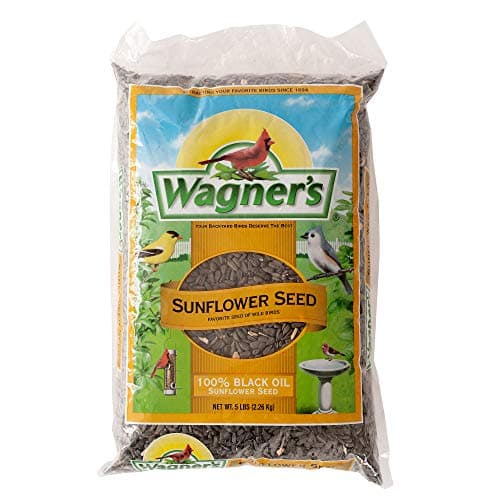
Straight black oil sunflower in a 5 lb bag: the single seed Cornell names as the preferred food of the widest range of feeder birds, with no corn and no millet to throw out.
Cornell's Project FeederWatch names black-oil sunflower "the preferred food item for a wide variety of birds", and the most common feeder seed in North America. It is the one seed recommendation on this page that comes from ornithologists rather than from a bag.Source: Project FeederWatch (Cornell Lab of Ornithology), Feeding Birds: seed types, feeder hygiene and nectar, feederwatch.org/learn/feeding-birds, read 2026-10-17
Contents
Oil sunflower seed, nothing else — Wagner's lists no second ingredientSource: Wagner's Oil Sunflower Seed product page, wagners.com/product_pages/oil_sf.html, read 2026-10-17
Shell
"Extra clean, thin shelled Sunflower" — the maker's phrase; thin shells are what let small-billed birds open itSource: Wagner's Oil Sunflower Seed product page, wagners.com/product_pages/oil_sf.html, read 2026-10-17
Energy
"High energy content" — Wagner's publishes no fat or protein percentage for it, or for anything else in its rangeSource: Wagner's Oil Sunflower Seed product page, wagners.com/product_pages/oil_sf.html, read 2026-10-17
Not published by the manufacturer in a form we could verify — Wagner's publishes none for any product in its catalogueSource: Wagner's Oil Sunflower Seed product page, wagners.com/product_pages/oil_sf.html, read 2026-10-17
What it gets right
A single ingredient, so nothing in the bag is filler and nothing gets kicked to the ground
Cornell's own feeding guidance names black oil sunflower as the preferred food for a wide variety of birds — this is not a marketing claim
The thin shell is the reason chickadees and finches can use it and striped sunflower defeats them
The cheapest way to find out which birds you actually have before buying anything specialised
What it does not
Wagner's publishes no guaranteed analysis, so you cannot compare its fat and protein against Kaytee's on paper
Shells. A sunflower feeder leaves a hull pile, and the hulls suppress grass under it
5 lb is a few weeks at a busy feeder, so the per-pound cost is worse than a 20 lb bag
Squirrels like it as much as the birds do, which is a feeder problem this bag cannot solve
Who it is for
Anyone filling their first feeder, and anyone who has been buying a mixed bag and finding half of it on the ground.
Skip this if
The feeder sits over a deck, a patio or a lawn you care about. Hulls are the whole objection, and [hulled seed](/feeders/best-no-mess-bird-seed) is the answer to it.
"100% edible" and "no filler" are different claims
Kaytee's No Mess Blend is described on its own page as "0% Waste, 100% Edible", and both are true: there are no hulls in it. Its published ingredient list, in descending order, is hulled sunflower, cracked corn, white millet, shelled peanuts, canary grass seed, calcium carbonate, soybean oil. Corn is the second ingredient by weight. A bird can eat cracked corn, so nothing on the bag is false — but a chickadee at a tube feeder will still flick it out to reach the sunflower, and it will still be on your deck.
That is also what the fat figure shows. The No Mess Blend publishes 18.0% minimum crude fat, the lowest figure of any seed on this site, against 30% for straight black oil sunflower. The corn and millet that keep a no-mess blend affordable are also what dilute it.
The far end of this is Kaytee's Ultra No Mess Nut & Raisin Blend, which publishes an excellent-looking analysis — 20% protein, 40% fat — above an ingredient list running to around sixty entries, among them ground corn, wheat middlings, corn gluten meal, soybean meal and, at the end, "Artificial Colors". Artificial coloring in bird food serves the person at the shelf. It is the clearest illustration in the category that a long label and a good analysis can arrive together.
What hulled seed costs you
It goes off. A sunflower kernel has no shell between it and the weather, and in a feeder that gets rain it will be moldy within days rather than weeks. Moldy seed is not a cosmetic problem — it is the fastest way to make a feeder a health risk for the birds using it. Hulled seed wants a covered feeder, a small fill, and a weekly clean, which is the routine on the cleaning page anyway.
It is also the wrong seed for a tray in the open. The economics of hulled seed depend on every kernel being eaten, and a platform feeder in the rain does not deliver that.
When to buy ordinary seed instead
The feeder is over a border, a hedge or rough grass. Hulls break down. Nobody is looking.
You fill the feeder fortnightly. Hulled seed will not survive two weeks of damp, and the saving disappears into the bin.
You feed in volume. At 20 lb-a-month rates the price difference stops being marginal.
The mess you mind is sprouting rather than hulls — in which case note that this is the one problem hulled seed solves outright, because a shelled kernel cannot germinate.
The honest summary
Hulled seed is a solution to a location problem, not an upgrade in bird food. The birds that come are the same birds; Cornell notes that many species actively prefer hulled sunflower, but the species list does not change. What changes is what lands underneath. If that is why you stopped feeding, this is the fix. If it is not, straight black oil sunflower is better value and publishes more fat.
FAQ
Questions people ask about this
Is no-mess bird seed worth the money?
Over a deck, patio or path, yes. Hulls are roughly a quarter of a shelled bag by weight — Kaytee publishes 23% maximum fiber on black oil sunflower against 9% on its No Mess Blend — so hulled seed costs about 1.7 times as much per pound of actual food rather than the three times the shelf price suggests. Over a border or rough grass, it is not worth it.
What does no-mess bird seed actually mean?
That the hulls have been removed, so nothing falls under the feeder and nothing sprouts — Kaytee notes that sunflower seeds cannot germinate without their shell. It does not mean the bag contains no filler. Most blends sold as no-mess still list cracked corn as their second ingredient.
Is there a bird seed with no millet or corn?
Straight sunflower hearts and chips. Every multi-ingredient no-mess blend we could source lists cracked corn, including the ones whose packaging emphasises how little waste they leave. If you want no corn and no millet, buy a single-ingredient bag.
Does hulled sunflower seed attract the same birds?
Yes, and Cornell notes that many species actively prefer it to shelled sunflower. The species list does not change; only what lands under the feeder does.
Why does my no-mess seed go moldy?
Because the kernel has no shell protecting it from damp. Hulled seed needs a covered feeder, small fills and a weekly clean. Moldy seed is a genuine health risk to the birds eating it, not just unsightly — discard it rather than topping up over it.
Does no-mess seed stop weeds growing under the feeder?
Yes, and this is the one claim in the category that holds without qualification. A sunflower seed cannot germinate once the shell is off, so fallen kernels get eaten by ground birds rather than sprouting.