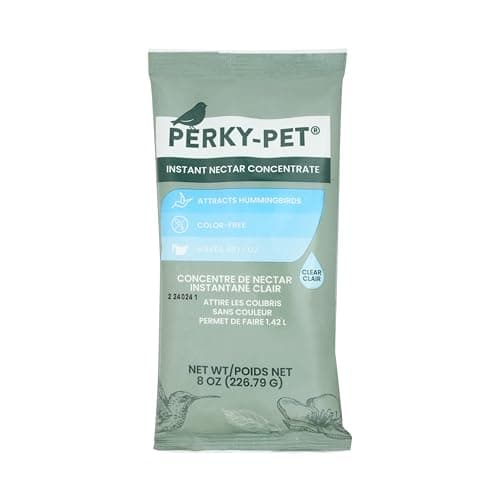
Cornell publishes the recipe in one sentence and it costs pennies. Here is the one bought product that matches it, and what the red bottle actually contains.
By Scooter M.Published October 17, 2026Content updated October 17, 2026Prices verified October 18, 2026
The Gift Perch earns a commission when you buy through our links, at no extra cost to you. We are an Amazon Associate. We accept no free products, no sponsored placements and no paid inclusion, and the commission rate plays no part in what we recommend. Full disclosure.
Make it. Cornell's Project FeederWatch publishes the recipe as one part white sugar to four parts boiling water, stirred and left to cool before filling — nothing else, and no coloring. It costs a few cents a batch and it is what every bought nectar is imitating. If you want a product anyway, buy Perky-Pet's clear powder concentrate: it states 100% sucrose and no artificial coloring, which is the only shop-bought option that matches the recipe. Avoid the red ready-to-use bottles — the maker's own Q&A puts their sugar base at 85% high fructose corn syrup.
This is the one page on this site where the honest recommendation is largely not to buy anything, so it is worth being precise about where the exceptions are. There are two real ones: a gift, where a bag of sugar does not work; and somebody who will not mix nectar at all, where a ready-to-use bottle is the difference between a full feeder and an empty one.
The recipe, in full
One part white sugar to four parts water. Cornell's figure. For orioles it is one part to six.
Boil the water, then stir the sugar in until it dissolves.
Let it cool completely before it goes anywhere near the feeder.
Add nothing else. No coloring, no honey, no brown sugar, no artificial sweetener.
Refrigerate the surplus and fill from it, rather than making a fresh batch each time.
What we judged on
Whether the maker publishes what the sugar is. Sucrose — ordinary white sugar — is what Cornell's recipe calls for. "All-natural sugars" is a phrase, not a composition.
Color, and what it is made of. The only nectar question with a flatly stated answer from an ornithological source.
Cost per finished ounce, not per bottle. A powder that makes 48 oz from an 8 oz bag is a different purchase from a 64 oz bottle of liquid.
Whether it removes a step. A concentrate still has to be mixed, so it saves nothing over the recipe except measuring. A ready-to-use bottle genuinely does remove the step, and that is worth something to some people.
The picks
Ranked picks with what each is best for, our score out of ten, the budget band it falls in, and a link to check its current price on Amazon.
#
Pick
Best for
Score
Price
01
Perky-Pet Clear Hummingbird Instant Nectar Concentrate, 8 oz (243SF)100% sucrose, no dye, 8 oz makes up to 48 oz of nectar: the one shop-bought option that matches what Cornell tells you to make, for roughly the price of a bag of sugar.Under $25
The only bought nectar that is honestly just sugar
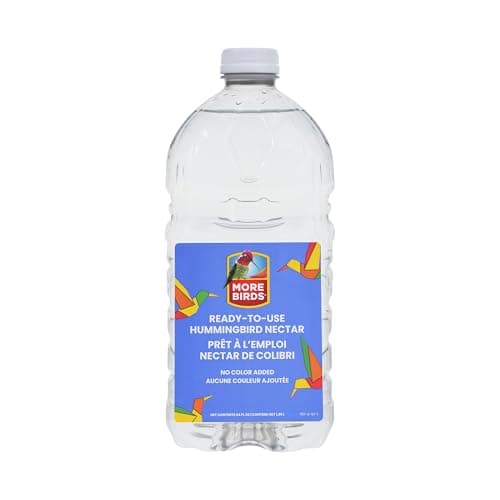
More Birds All-Natural Clear Ready-to-Use Hummingbird Nectar, 64 fl oz (MB707)Clear, ready to pour, no artificial dyes — and the honest caveat is that the maker says "all-natural sugars" without ever saying how much of that is sucrose.Under $25
No mixing and no dye, if convenience is the whole point
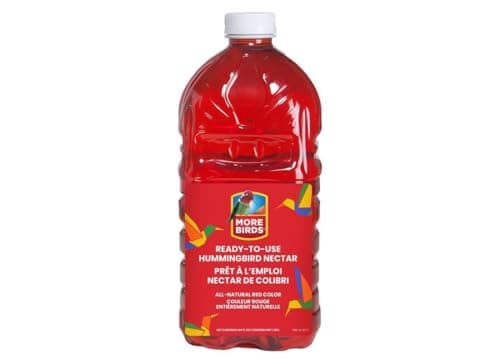
More Birds Red Ready-to-Use Hummingbird Nectar, 64 fl oz (MB700)Colored with fruit and vegetable extracts rather than synthetic dye, which is better than it sounds — but the maker's own Q&A puts the sugar base at 85% high fructose corn syrup, and the color does nothing for the bird.Under $25
The red bottle, and the reason to understand it before buying
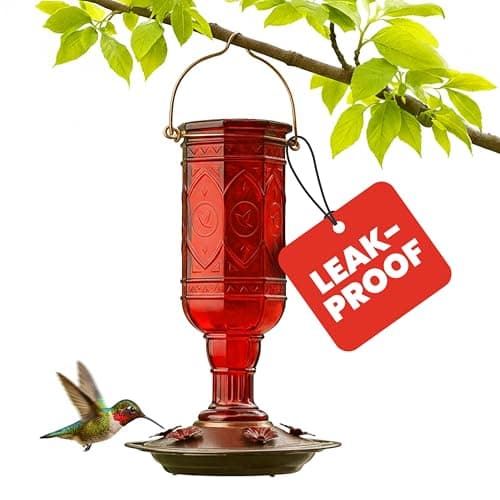
More Birds Glass Hummingbird FeederGlass rather than plastic, because the part that decides whether a nectar feeder works is how easily it comes apart to be washed.Under $25
Live prices. Compare per ounce of finished nectar, not per bottle: an 8 oz bag of powder makes 48 oz, and a 64 oz bottle makes 64 oz.
Pick 01
The only bought nectar that is honestly just sugar
Perky-Pet Clear Hummingbird Instant Nectar Concentrate, 8 oz (243SF)
100% sucrose, no dye, 8 oz makes up to 48 oz of nectar: the one shop-bought option that matches what Cornell tells you to make, for roughly the price of a bag of sugar.
Cornell publishes it as one part white sugar to four parts boiling water, stirred and left to cool before filling, and one part to six for orioles. It also states plainly: "Do not add red food coloring, as this is harmful to birds" — red feeder parts or a red ribbon attract hummingbirds just as well.Source: Project FeederWatch (Cornell Lab of Ornithology), Feeding Birds: seed types, feeder hygiene and nectar, feederwatch.org/learn/feeding-birds, read 2026-10-17
Composition
"100% sucrose" — the maker's own words, and sucrose is what Cornell's recipe calls forSource: Perky-Pet Clear Hummingbird Instant Nectar Concentrate 8 oz (model 243SF) product page, perkypet.com, read 2026-10-17
Color
Clear. "Free of any artificial coloring or dyes", and non-stainingSource: Perky-Pet Clear Hummingbird Instant Nectar Concentrate 8 oz (model 243SF) product page, perkypet.com, read 2026-10-17
Yield
Makes up to 48 fl oz of nectar from an 8 oz bagSource: Perky-Pet Clear Hummingbird Instant Nectar Concentrate 8 oz (model 243SF) product page, perkypet.com, read 2026-10-17
Mixing
3 tablespoons of powder to 7 fl oz of water; no boiling requiredSource: Perky-Pet Clear Hummingbird Instant Nectar Concentrate 8 oz (model 243SF) product page, perkypet.com, read 2026-10-17
8 oz powder bag; a 2 lb bag (244CLSF) making up to 192 fl oz is also publishedSource: Perky-Pet Clear Hummingbird Instant Nectar Concentrate 8 oz (model 243SF) product page, perkypet.com, read 2026-10-17
What it gets right
100% sucrose is chemically the same thing as the white sugar in Cornell's recipe, so nothing is being added
No dye, which is the one nectar question with an unambiguous answer
Powder weighs nothing and stores indefinitely, unlike a 64 oz bottle of liquid
Cheaper per ounce of finished nectar than any ready-to-use bottle here
What it does not
You are buying sugar at a markup. White table sugar and water cost a fraction of this and Cornell's recipe is two ingredients
The published ratio of 3 tbsp to 7 fl oz is not the same as Cornell's 1:4 by volume, so you are trusting the maker's dilution rather than the one the ornithologists publish
Still has to be mixed, so it saves no step over doing it from scratch
Perky-Pet's own page carries a customer exchange referring to a dye formula and an acid change that the product copy does not mention
Who it is for
Someone who wants a measured, dye-free product rather than a kitchen recipe — and the right pick for a gift basket, where a bag of sugar does not work.
Skip this if
You have sugar in the cupboard. One part white sugar to four parts boiled water is the recipe Cornell publishes, it costs pennies, and this product's only genuine advantage over it is the packaging.
Pick 02
No mixing and no dye, if convenience is the whole point
More Birds All-Natural Clear Ready-to-Use Hummingbird Nectar, 64 fl oz (MB707)
Clear, ready to pour, no artificial dyes — and the honest caveat is that the maker says "all-natural sugars" without ever saying how much of that is sucrose.
Cornell publishes it as one part white sugar to four parts boiling water, stirred and left to cool before filling, and one part to six for orioles. It also states plainly: "Do not add red food coloring, as this is harmful to birds" — red feeder parts or a red ribbon attract hummingbirds just as well.Source: Project FeederWatch (Cornell Lab of Ornithology), Feeding Birds: seed types, feeder hygiene and nectar, feederwatch.org/learn/feeding-birds, read 2026-10-17
Composition
"All-natural sugars"; the maker publishes no sucrose percentage for this product. Its sister product's Q&A states the sucrose in its liquid nectars is 85% high fructose corn syrup and 15% beet sugar.Source: More Birds All-Natural Clear Ready-to-Use Hummingbird Nectar 64 fl oz (model MB707), Woodstream product page, read 2026-10-17
Color
Clear. "No artificial dyes or flavors" and "pure, additive-free"Source: More Birds All-Natural Clear Ready-to-Use Hummingbird Nectar 64 fl oz (model MB707), Woodstream product page, read 2026-10-17
Preparation
Ready to use — "no need to mix it with water or boil before using". Do not dilute.Source: More Birds All-Natural Clear Ready-to-Use Hummingbird Nectar 64 fl oz (model MB707), Woodstream product page, read 2026-10-17
Storage
Room temperature unopened; refrigerate after opening. Crystals can be dissolved with warm water.Source: More Birds All-Natural Clear Ready-to-Use Hummingbird Nectar 64 fl oz (model MB707), Woodstream product page, read 2026-10-17
Model
MB707Source: More Birds All-Natural Clear Ready-to-Use Hummingbird Nectar 64 fl oz (model MB707), Woodstream product page, read 2026-10-17
Size
64 fl ozSource: More Birds All-Natural Clear Ready-to-Use Hummingbird Nectar 64 fl oz (model MB707), Woodstream product page, read 2026-10-17
What it gets right
Genuinely no preparation — pour and close the feeder, which matters for someone who would otherwise not refill it
Clear rather than red, so it sidesteps the dye question entirely
64 fl oz is several refills of a standard feeder
Stores unopened at room temperature for more than one season
What it does not
"All-natural sugars" is not a composition. The maker publishes no sucrose figure for this product, and its own Q&A on the red version points to a high-fructose-corn-syrup base
The most expensive way to buy nectar here per finished ounce, by a wide margin
Needs refrigerating once opened, so a 64 oz bottle takes fridge space all summer
You are paying to ship water
Who it is for
Someone who will not mix nectar — an elderly relative, a holiday let, a gift to somebody who has never fed hummingbirds — where the realistic alternative is an empty feeder.
Skip this if
Cost or composition matters to you at all. The [clear powder concentrate](/feeders/best-hummingbird-nectar) states 100% sucrose and costs a fraction as much per ounce of nectar.
Pick 03
The red bottle, and the reason to understand it before buying
More Birds Red Ready-to-Use Hummingbird Nectar, 64 fl oz (MB700)
Colored with fruit and vegetable extracts rather than synthetic dye, which is better than it sounds — but the maker's own Q&A puts the sugar base at 85% high fructose corn syrup, and the color does nothing for the bird.
Cornell publishes it as one part white sugar to four parts boiling water, stirred and left to cool before filling, and one part to six for orioles. It also states plainly: "Do not add red food coloring, as this is harmful to birds" — red feeder parts or a red ribbon attract hummingbirds just as well.Source: Project FeederWatch (Cornell Lab of Ornithology), Feeding Birds: seed types, feeder hygiene and nectar, feederwatch.org/learn/feeding-birds, read 2026-10-17
Composition
The maker's Q&A states the sucrose in these liquid nectars is "85% high fructose corn syrup and 15% beet sugar". Cornell's recipe is sucrose — white table sugar — and nothing else.Source: More Birds Red Ready-to-Use Hummingbird Nectar 64 fl oz (model MB700) product page, perkypet.com, read 2026-10-17. The 85% high-fructose-corn-syrup figure is from the manufacturer's own answer in that page's Q&A.
Color
Red, "derived from fruit and vegetable extracts". "No artificial dyes or flavors"; the specific fruits and vegetables are not named.Source: More Birds Red Ready-to-Use Hummingbird Nectar 64 fl oz (model MB700) product page, perkypet.com, read 2026-10-17. The 85% high-fructose-corn-syrup figure is from the manufacturer's own answer in that page's Q&A.
Why color is unnecessary
Cornell states plainly that red food coloring should not be added and that red feeder parts or a red ribbon attract hummingbirds just as wellSource: Project FeederWatch (Cornell Lab of Ornithology), Feeding Birds: seed types, feeder hygiene and nectar, feederwatch.org/learn/feeding-birds, read 2026-10-17
Preparation
Ready to use and "should not be diluted" — pour directly into the feederSource: More Birds Red Ready-to-Use Hummingbird Nectar 64 fl oz (model MB700) product page, perkypet.com, read 2026-10-17. The 85% high-fructose-corn-syrup figure is from the manufacturer's own answer in that page's Q&A.
Color fading
The maker notes the color may fade in sunlight and treats fading as a signal to refresh the nectarSource: More Birds Red Ready-to-Use Hummingbird Nectar 64 fl oz (model MB700) product page, perkypet.com, read 2026-10-17. The 85% high-fructose-corn-syrup figure is from the manufacturer's own answer in that page's Q&A.
Model
MB700Source: More Birds Red Ready-to-Use Hummingbird Nectar 64 fl oz (model MB700) product page, perkypet.com, read 2026-10-17. The 85% high-fructose-corn-syrup figure is from the manufacturer's own answer in that page's Q&A.
Size
64 fl ozSource: More Birds Red Ready-to-Use Hummingbird Nectar 64 fl oz (model MB700) product page, perkypet.com, read 2026-10-17. The 85% high-fructose-corn-syrup figure is from the manufacturer's own answer in that page's Q&A.
What it gets right
If a red nectar is going in the feeder regardless, a fruit-and-vegetable coloring is the better version of that
No synthetic dye, which is the specific thing Cornell warns against
Ready to use, with no mixing and no boiling
The maker turns color fade into a useful freshness indicator rather than hiding it
What it does not
The maker's own Q&A puts the sugar base at 85% high fructose corn syrup, which is not the sucrose Cornell's recipe specifies
The color serves the buyer, not the bird — Cornell says a red ribbon or red feeder part works just as well
Most expensive option here per finished ounce, and refrigeration is needed once opened
"Additive-free" sits awkwardly beside an added coloring, however natural its source
Who it is for
Honestly, almost nobody — it is here because it is the bottle most people reach for, and the published facts about it are worth having before you do.
Skip this if
You have any choice in the matter. The clear version of the same bottle removes the color question, and the clear powder concentrate removes the sugar question too.
Pick 04
A first nectar feeder that does not need an app
More Birds Glass Hummingbird Feeder
Glass rather than plastic, because the part that decides whether a nectar feeder works is how easily it comes apart to be washed.
It does not cloud or retain smell the way plastic does after repeated washing, and it can take hot water
Cleaning cadence
Nectar spoils fast in warm weather; plan on rinsing and refilling every few days in summer
Capacity
Not published by the manufacturer in a form we could verify
Warranty
Not published by the manufacturer in a form we could verify
What it gets right
Glass washes properly, which is the entire maintenance story for a nectar feeder
No electronics, nothing to charge, nothing to subscribe to
Cheap enough to buy two so one can always be in the sink
What it does not
Glass breaks if it is knocked off a hook
Small ports clog with sugar if it is not cleaned on schedule
Nothing about the feeder itself attracts hummingbirds to a yard that has none
Who it is for
Someone in hummingbird country who has never tried it. Pair it with a note about the cleaning schedule and it is a genuinely good gift.
Skip this if
The recipient will not commit to washing it every few days in hot weather. A neglected nectar feeder is worse for birds than no feeder at all.
What is actually in the bottle
Published composition, each maker's own words
Published composition, each maker's own words
Product
Sugar base
Color
Makes
Cornell's recipe
White table sugar — sucrose
None
As much as you like, for pennies
Perky-Pet clear concentrate (243SF)
"100% sucrose"
Clear — "free of any artificial coloring or dyes"
Up to 48 fl oz from an 8 oz bag
More Birds clear ready-to-use (MB707)
"All-natural sugars" — no percentage published
Clear — "no artificial dyes or flavors"
64 fl oz, undiluted
More Birds red ready-to-use (MB700)
"85% high fructose corn syrup and 15% beet sugar" — the maker's own answer in its page Q&A
Red, "derived from fruit and vegetable extracts"
64 fl oz, undiluted
Read 2026-10-17 from perkypet.com and Woodstream's product pages, and from Cornell's Project FeederWatch feeding guidance. The corn-syrup figure is disclosed by the manufacturer, in answer to a customer question on its own product page — not inferred by us.
That table is the whole page. One row is sugar and water. One row is a powder that says it is sugar. One row says "all-natural sugars" and declines to say what they are. And one row, to its credit, answers the question directly and the answer is corn syrup.
The red question, settled
Red nectar is bought because feeders are red and the color looks right. Cornell's guidance is unambiguous that red food coloring should not be added and that red feeder parts or a red ribbon will attract hummingbirds just as well. So the color serves the person filling the feeder, not the bird drinking from it.
More Birds deserves some credit here: its red bottle is colored with fruit and vegetable extracts rather than synthetic dye, which is a better version of a thing that did not need doing. It also treats color fade in sunlight as a signal to change the nectar, which is a genuinely useful piece of packaging. Neither changes the underlying position: there is no reason to put color in a hummingbird feeder, and the same maker sells the same bottle without it.
The part that matters more than the nectar
Cleaning. Sugar water ferments and grows mold in warm weather, and a moldy nectar feeder is actively harmful to the birds using it. Cornell's frequency is blunt: clean hummingbird feeders "every couple days", and "ideally every time you refill them", discarding cloudy or moldy solution immediately rather than topping up over it.
That is a far bigger determinant of whether a nectar feeder does any good than which bottle the sugar came out of. It is also the reason to buy a feeder that comes apart — the full routine is on how to clean a bird feeder, and the hardware is on hummingbird feeders.
What not to put in a nectar feeder
Red food coloring. Cornell says it is harmful to birds. This is the clearest instruction in the whole category.
Honey. It ferments faster than sugar syrup and grows molds that sugar water does not.
Brown sugar, raw sugar or molasses. The recipe specifies white sugar; the others carry iron and other compounds hummingbirds have no use for.
Artificial sweetener. Nectar is a calorie source. A sugar-free version is an empty feeder with extra steps.
A stronger mix "to help them through a cold snap". The published ratio is 1:4. Guessing upward is not a kindness.
So when is buying it right?
Three cases, and they are all about the person rather than the bird. As a gift, because a bag of sugar and a printout is not a present and a labeled bag of concentrate beside a glass feeder is. For somebody who will genuinely not mix anything — an older relative, a holiday let, a first-time feeder owner — where the realistic alternative is a feeder that never gets filled. And for travel or a second home, where a shelf-stable bottle beats carrying sugar and boiling water. Outside those, the kitchen wins on cost, on composition and on what Cornell actually recommends.
FAQ
Questions people ask about this
What is the best hummingbird nectar?
The one you make. Cornell's Project FeederWatch publishes it as one part white sugar to four parts boiling water, stirred and cooled, with nothing added. If you want a product, Perky-Pet's clear powder concentrate states 100% sucrose and no artificial coloring, which is the only shop-bought option that matches that recipe.
What is the sugar-to-water ratio for hummingbird nectar?
One part white sugar to four parts boiling water, per Cornell. For orioles it is more dilute: one part sugar to six parts water. Let it cool fully before filling the feeder and refrigerate what is left over.
Is red hummingbird nectar bad for birds?
Cornell states plainly that red food coloring should not be added because it is harmful to birds, and that red feeder parts or a red ribbon attract hummingbirds just as well. More Birds' red bottle uses fruit and vegetable extracts rather than synthetic dye, which is better — but the color still serves the buyer rather than the bird, and the same maker sells the same bottle clear.
Is store-bought hummingbird nectar as good as homemade?
Only the clear sucrose concentrate is comparable. The ready-to-use liquids do not publish a sucrose percentage, and the maker's own Q&A puts the sugar base of its liquid nectars at 85% high fructose corn syrup and 15% beet sugar — not the sucrose Cornell's recipe specifies.
Can you use honey or brown sugar in a hummingbird feeder?
No. The published recipe is white sugar. Honey ferments faster and grows molds that sugar syrup does not, and brown or raw sugars carry compounds hummingbirds have no use for.
How often should you change hummingbird nectar?
Cornell says clean hummingbird feeders every couple of days and ideally every time you refill them, discarding any cloudy or moldy solution straight away. In hot weather this matters more than anything else on this page - fermented nectar is harmful to the birds drinking it.
Do you have to boil the water for hummingbird nectar?
Cornell's recipe uses boiling water, which dissolves the sugar completely and slows spoilage. It must cool fully before it goes in the feeder. Powder concentrates state that no boiling is required, which is the one step they genuinely remove.