Not a choice between two things that do the same job. One has seven times the field of view and weighs a third as much; the other reaches across water.
By Scooter M.Published October 17, 2026Content updated October 17, 2026Prices verified October 17, 2026
The Gift Perch earns a commission when you buy through our links, at no extra cost to you. We are an Amazon Associate. We accept no free products, no sponsored placements and no paid inclusion, and the commission rate plays no part in what we recommend. Full disclosure.
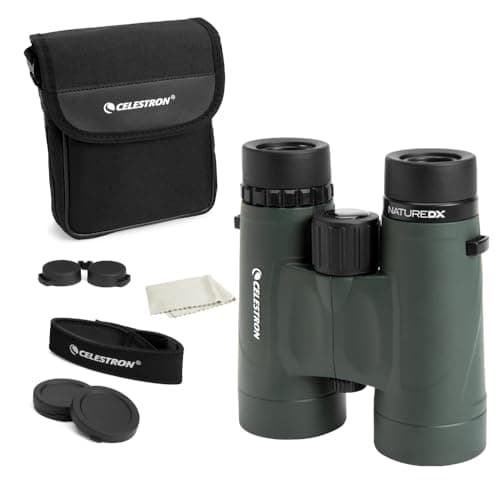
Buy binoculars, and buy them first — the Celestron Nature DX 8x42 if you want one recommendation. Binoculars give you 388 ft of field of view at 1,000 yards, focus down to 6.5 ft, weigh 22 oz and work the moment you lift them. A spotting scope gives you between 105 ft and 52 ft of field, will not focus closer than about 25 ft, weighs 55 oz and does not work at all without a tripod. A scope is a second optic for one situation: static birds a long way off, across water or mudflat. Nobody should own a scope and no binoculars.
The reason this question gets asked at all is that the two look like competing answers to "how do I see birds better". They are not. Magnification is the figure both are sold on and it is the least useful one, because what you lose going from 8x to 60x is everything else.
The figures that decide it
Published specifications, Celestron's own figures
Published specifications, Celestron's own figures
Nature DX 8x42 binoculars
TrailSeeker 80 scope
Hummingbird 56 ED micro scope
Magnification
8x fixed
20-60x zoom
9-27x zoom
Field of view at 1,000 yd
388 ft
105 ft at 20x, 52 ft at 60x
216 ft at 9x, 98 ft at 27x
Close focus
6.5 ft
24.6 ft
9.8 ft
Weight
22.2 oz
54.6 oz
20.8 oz
Length
Pocketable
19.9 in
8.2 in
Tripod
Not needed
Required
Required in practice
Eye relief
17.5 mm
18 mm at 20x, 15 mm at 60x
15 mm
Usable one-handed
Yes
No
No
Read from Celestron's own specification tables. The field-of-view row is the one to read twice: binoculars show you more than seven times as much sky as a scope at 60x.
Field of view is what you are actually buying when you buy binoculars. A bird moves, and 388 ft of field at 1,000 yards means you can follow it. At 52 ft you cannot find it in the first place, which is why scope users locate the bird with binoculars and then point the scope at it.
What each one is for
Binoculars: everything, most of the time
Woodland, garden, feeder, hedgerow, anything flying, anything moving, anything closer than about 25 ft. A 6.5 ft close focus means a bird on the other side of the window is in range; the scope cannot do that at all. Binoculars also work handheld, in one movement, which is the difference between seeing a bird and having seen a bird.
A spotting scope: water, shore, and anything standing still at distance
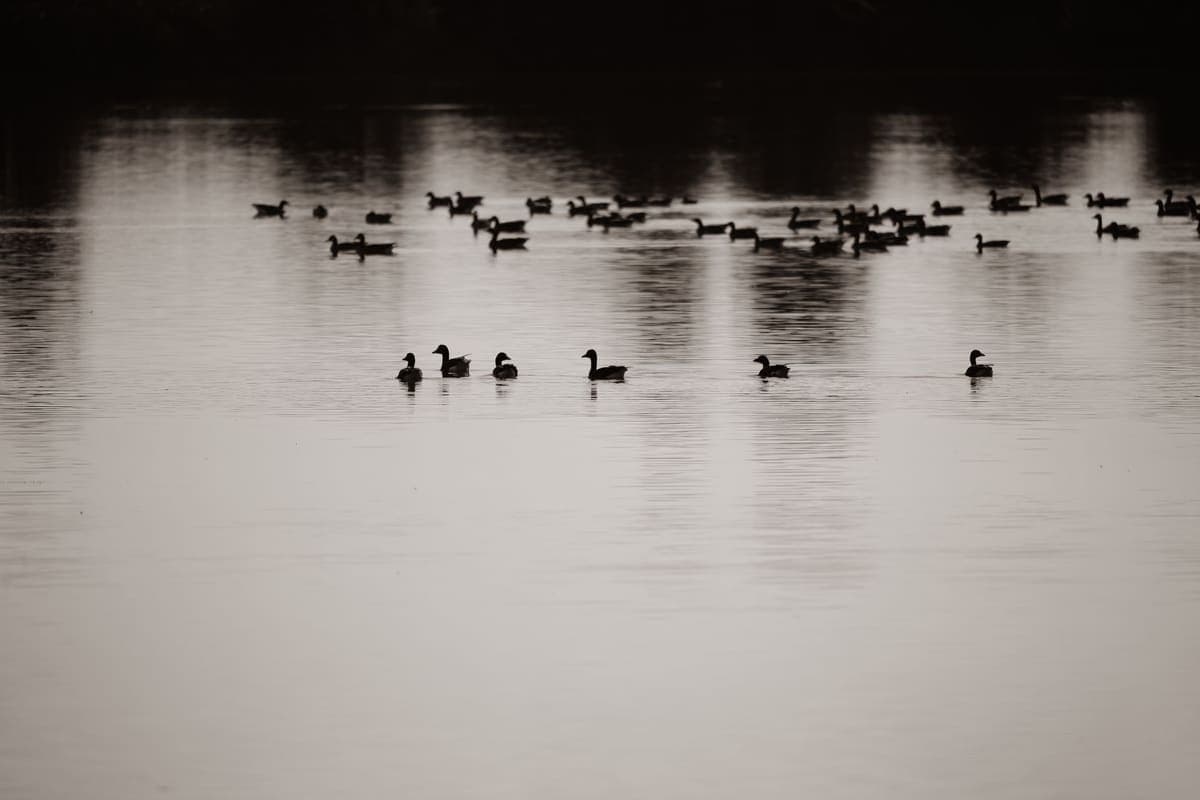
Ducks on a reservoir, waders on a mudflat, a raptor on a distant post, a gull flock you want to pick through. The common factor is that the bird is far away and not going anywhere, so 60x magnification on a tripod is both usable and the only way to identify it. On a lake, a scope is not a luxury — binoculars will not resolve a distant duck's head pattern at any price.
The picks
Ranked picks with what each is best for, our score out of ten, the budget band it falls in, and a link to check its current price on Amazon.
#
Pick
Best for
Score
Price
01
Celestron Nature DX 8x42The pair nearly every birding guide starts with, and the only one in this group that focuses down to 6.5 feet — which matters more than it sounds.Under $250
The default first pair, and the closest focus here
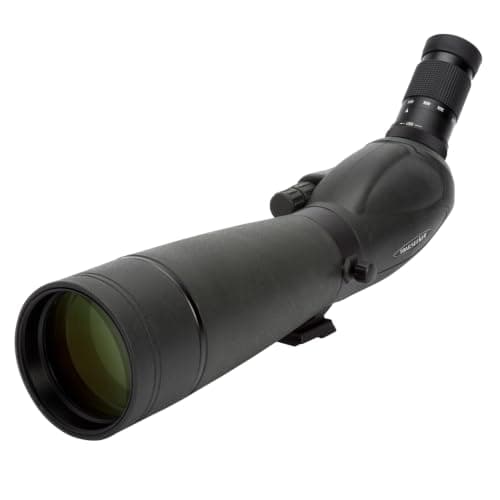
Celestron TrailSeeker 20-60x80mm Angled Zoom Spotting ScopeEverything the Ultima has plus a coarse-and-fine focus and a rotating tripod collar, two features that matter more in use than the spec sheet suggests.$250 and up
The mid-step: dual focus and a rotating mount without paying for ED glass
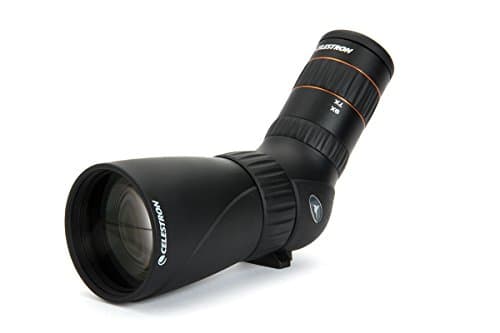
Celestron Hummingbird 9-27x56mm ED Angled Zoom Micro Spotting ScopeAt 20.8 oz it is lighter than every full-size binocular on this site, and its 9.8 ft close focus is the only scope figure here that works in a garden — the trade is a 56 mm objective and 27x at the top.$250 and up
Everything the Ultima has plus a coarse-and-fine focus and a rotating tripod collar, two features that matter more in use than the spec sheet suggests.
105 ft at 20x to 52 ft at 60x, at 1,000 yardsSource: Celestron TrailSeeker 20-60x80mm Angled Zoom Spotting Scope (item 52332) product page and specification table, celestron.com, read 2026-09-11
Eye relief
18 mm at 20x, 15 mm at 60xSource: Celestron TrailSeeker 20-60x80mm Angled Zoom Spotting Scope (item 52332) product page and specification table, celestron.com, read 2026-09-11
$369.95, in stock on celestron.com on 2026-09-11Source: Celestron TrailSeeker 20-60x80mm Angled Zoom Spotting Scope (item 52332) product page and specification table, celestron.com, read 2026-09-11
What it gets right
Dual focus is the feature that makes a zoom scope usable on a bird that is moving — coarse to find it, fine to sharpen it
Rotating collar lets the eyepiece sit at a comfortable angle on any tripod
Slightly lighter and slightly closer-focusing than the Ultima
Interchangeable eyepiece design, per the maker
What it does not
Still no ED glass, so the color fringing at 60x is the same trade as the Ultima at $100 more
Eye relief drops to 15 mm at 60x, which is tight over glasses
54.6 oz is still a car-and-tripod weight
The gap to the Regal M2 is ED glass and a magnesium body, and it is a large gap in price
Who it is for
A fixed-spot birder who will use the zoom and wants the focus to keep up with it. The right middle step if the ED models are out of reach.
Skip this if
You are choosing between this and the Regal M2 and can afford the Regal. The ED glass is the thing that changes the image; the focus and collar are conveniences.
Pick 03
The scope that weighs what binoculars weigh
Celestron Hummingbird 9-27x56mm ED Angled Zoom Micro Spotting Scope
At 20.8 oz it is lighter than every full-size binocular on this site, and its 9.8 ft close focus is the only scope figure here that works in a garden — the trade is a 56 mm objective and 27x at the top.
216 ft at 9x to 98 ft at 27x, at 1,000 yardsSource: Celestron Hummingbird 9-27x56mm ED Angled Zoom Micro Spotting Scope (item 52308) product page and specification table, celestron.com, read 2026-09-11
$369.95, in stock on celestron.com on 2026-09-11Source: Celestron Hummingbird 9-27x56mm ED Angled Zoom Micro Spotting Scope (item 52308) product page and specification table, celestron.com, read 2026-09-11
What it gets right
20.8 oz — the same as the lightest full-size binocular on this site, so it genuinely goes in a bag
9.8 ft close focus, against 21 to 26 ft for the 80 mm scopes
ED glass and phase-coated prisms at the same price as the non-ED TrailSeeker
216 ft field at 9x makes finding the bird far easier than any 20x scope
What it does not
27x maximum — this cannot do what a 60x scope does on a distant duck
56 mm objective gathers much less light than 80 mm, so dusk is a struggle
15 mm eye relief is on the short side over glasses
It is small enough to tempt hand-holding, which does not work above about 10x
Who it is for
Someone who walks to their birds, already owns binoculars, and wants a step up in reach without a tripod-sized commitment. The best gift scope here, precisely because it is the one most likely to actually leave the house.
Skip this if
The recipient birds estuaries and reservoirs where the bird is a quarter of a mile away. 27x is not enough for that job, and no amount of ED glass changes it.
Pick 04
A real pair of waterproof binoculars under $100
Celestron Outland X 8x42
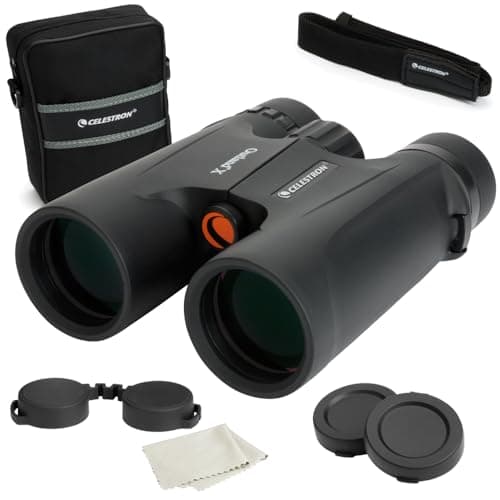
Genuinely waterproof, genuinely lifetime-warrantied, and honest about the compromise: it cannot focus close.
17.8 mm eye relief — better over glasses than binoculars costing twice as much
Nitrogen-filled and genuinely waterproof at this price, which most sub-$100 pairs are not
Limited lifetime warranty on an entry-level pair
Tripod adaptable, and ships with case, strap, cloth and rainguard
What it does not
13.1 ft close focus rules out most feeder watching from a window
Multi-coated rather than fully multi-coated, so it is dimmer at dawn and dusk than the Nature DX
Heaviest pair in this whole comparison at 23.6 oz
Who it is for
A walker or hiker on a real budget, or a spare pair to keep in the car. For feeder watching, spend up to the Nature DX instead.
Skip this if
The recipient wants to watch their own feeder. At just over 13 ft minimum focus, the feeder outside the kitchen window is inside the blind spot.
The exception: the micro scope
The Celestron Hummingbird 56 ED complicates the clean story above, and it is the most interesting product in the comparison. It weighs 20.8 oz, which is less than the Nature DX binoculars. It is 8.2 in long. Its close focus is 9.8 ft rather than 26 ft, and it has ED glass, which the two big scopes do not. At 9x the bottom of its zoom range it shows 216 ft of field — a usable, findable view.
What it gives up is aperture. 56 mm against 80 mm is considerably less light, which matters at dawn, at dusk and at the top of the zoom. It is the right scope for someone who will carry it, and the wrong one for someone who wants maximum reach from a fixed position by a lake. The honest framing is that it is a third category rather than a cheap scope.
If you are buying a gift
Binoculars, without hesitation. A scope is a bad gift even for someone who wants one: it is a system purchase involving a tripod, a head and a carrying decision, and the recipient has opinions about all three. It also only makes sense for someone with a habitat to point it at. Binoculars are useful to a birder in every garden in the country, which is why they are the whole of the optics gift answer.
The one gift-shaped exception is somebody who already owns good binoculars and lives beside water. That is a narrow enough description that if it fits, you will know.
Use them for a season. Most people discover their birding is woodland and garden, where a scope would sit in a cupboard.
If and only if you keep running into distance you cannot resolve — a reservoir, an estuary, a coastline — add a scope.
Buy the tripod at the same time, because a scope without one is an ornament.
Keep using the binoculars to find the bird. Even with a scope on the tripod, the binoculars do the searching. They never become redundant, which is the clearest sign of which is the primary optic.
FAQ
Questions people ask about this
Should I buy binoculars or a spotting scope?
Binoculars, first and always. They publish 388 ft of field of view at 1,000 yards against 52 ft for a scope at 60x, focus down to 6.5 ft against 24.6 ft, weigh 22 oz against 55 oz, and need no tripod. A scope is a second optic for static birds at distance over water or shore.
Do I need a spotting scope for birding?
Only if you regularly watch water, shore or open country where birds are hundreds of yards away and not moving. For woodland, garden and feeder birding a scope is worse than binoculars at every part of the job, because it cannot focus closer than about 25 ft and shows a fraction of the field.
Is a spotting scope better than binoculars?
At one thing: resolving detail on a distant, stationary bird. At everything else it is worse - finding the bird, following movement, close focus, weight, speed of use, and working without a tripod. That is why birders who own scopes still carry binoculars to locate the bird first.
What magnification do I need for bird watching?
8x for binoculars, which is the birding default. More magnification narrows the field of view and amplifies hand shake, which is exactly why a 60x scope has to live on a tripod. The trade-off is explained on our 8x42 vs 10x42 page.
Does a spotting scope need a tripod?
Yes, and it is not included. At 20x to 60x no one can hold a 55 oz scope steady enough to use it. Budget for a tripod sturdy enough for the scope as part of the purchase, not as an accessory.
Can you use a spotting scope for garden birds?
Poorly. The Celestron TrailSeeker 80 will not focus closer than 24.6 ft, so a feeder outside the window is inside its blind spot entirely. The Hummingbird 56 ED micro scope focuses to 9.8 ft, which is the only scope here that garden use is even arguable for.
What is a micro spotting scope?
A short, light scope with a smaller objective - the Celestron Hummingbird 56 ED is 8.2 in and 20.8 oz, less than most binoculars, with 9.8 ft close focus and ED glass. It trades aperture for portability, so it is dimmer at dawn and dusk than an 80 mm scope but it actually gets carried.