The Gift Perch earns a commission when you buy through our links, at no extra cost to you. We are an Amazon Associate. We accept no free products, no sponsored placements and no paid inclusion, and the commission rate plays no part in what we recommend. Full disclosure.
No — not to start. A feeder within sight of where you already sit gives a closer view than any pair of binoculars, and the free Merlin Bird ID app answers the question a beginner actually has, which is what the bird is rather than what it looks like magnified. Binoculars matter once you start going to the birds instead of waiting for them.
This is an awkward thing for a site that earns commission on binoculars to say, so it is worth being specific about why it is true.
The barrier for a beginner is identification, not magnification
A new birder's problem is almost never that the bird is too small to see. It is that they saw it clearly, for four seconds, and still have no idea what it was. Binoculars do nothing for that. A field guide and an app do.
There is also a skill barrier nobody mentions: finding a small moving bird through a narrow circle is learned, and the first ten attempts are all failures. Handing a beginner binoculars often teaches them that birding is frustrating, which is exactly the wrong first lesson.
What to do instead, in order
Install [Merlin Bird ID](https://merlin.allaboutbirds.org/). Free, from the Cornell Lab of Ornithology, covering more than 10,000 species worldwide, with Sound ID handling 540 species in the US and Canada. Most birds are heard before they are seen.
Put a feeder where you already sit. A suction-cup window feeder is under $25 and puts a bird inches from the glass — closer than binoculars ever get you.
Get a regional field guide. Eastern or Western. It teaches you which marks matter, which is what makes you faster.
Then buy binoculars, when you find yourself walking somewhere specifically to look at birds.
When binoculars genuinely start to matter
When the bird is more than about thirty feet away. Beyond that, detail is genuinely lost to the naked eye.
When you start walking to watch. A feeder is fixed; a footpath is not.
On water, or in open country. Ducks and raptors are distant by definition.
When you want to see plumage detail — the wingbar, the eye-ring, the exact shade of the flank. That is where identification gets interesting, and where the naked eye stops helping.
Can you use any binoculars?
Not really, and two published figures explain why. Close focus: many general-purpose and astronomy binoculars will not focus nearer than ten feet, which puts a feeder outside the window inside their blind spot. Eye relief: under about 16 mm the view is cropped into a black-ringed tunnel for anyone wearing glasses.
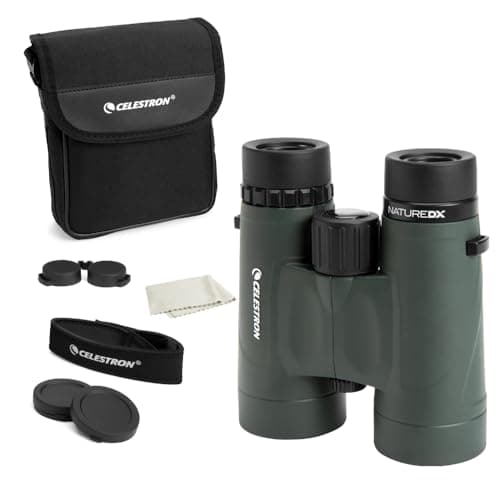
For comparison, a purpose-built birding pair like the Celestron Nature DX 8x42 publishes 6.5 ft close focus and 17.5 mm eye relief, and the Vortex Diamondback HD focuses to 5 ft. Astronomy binoculars are usually heavy, long-focusing and high magnification — the opposite of what birding wants.
When you are ready, this is what to buy
Ranked picks with what each is best for, our score out of ten, the budget band it falls in, and a link to check its current price on Amazon.
#
Pick
Best for
Score
Price
01
Nature AnywhereNo photoNature Anywhere Window Bird Feeder with Strong Suction CupsA clear acrylic tray that sticks to the glass, which turns any window into the closest view of a bird you will ever get for the money.Under $25
Cornell Lab of OrnithologyNo photoCornell Lab of Ornithology Merlin Bird ID (free app)Free, from Cornell, and better at identifying a bird by its song than any book will ever be. We earn nothing from it and it belongs at the top of the list anyway.Under $25
The thing to give before you spend any money at all
Free from Cornell Lab of Ornithology — there is nothing to buy, and this link earns us nothing.
03
Celestron Nature DX 8x42The pair nearly every birding guide starts with, and the only one in this group that focuses down to 6.5 feet — which matters more than it sounds.Under $250
The default first pair, and the closest focus here
David Allen Sibley Sibley Field Guide to Birds of Eastern / Western North AmericaHalf the continent, a fraction of the size, and the version that actually gets carried outdoors.Under $25
The Sibley artwork, in a book that fits a coat pocket
Scores are ours, from the published rubric on the how-we-pick page. They are editorial judgments about published specifications and cost arithmetic, not test results — we have not handled these products.
Pick 01
Nature AnywhereNo photo
Apartments, and anyone who cannot get to a garden
Nature Anywhere Window Bird Feeder with Strong Suction Cups
A clear acrylic tray that sticks to the glass, which turns any window into the closest view of a bird you will ever get for the money.
Clear acrylic, so the birds are visible from inside
Capacity
Not published by the manufacturer in a form we could verify
Drainage
Check the listing: a removable tray with drainage holes is the feature that decides whether seed rots after rain
Warranty
Not published by the manufacturer in a form we could verify
What it gets right
The view is unbeatable — inches away, at eye level
Works with no garden at all, which no other feeder here does
Cheap enough to be a low-risk gift for someone who has never fed birds
What it does not
Suction cups fail in cold weather and after the glass gets dirty
Small capacity means frequent refills
Birds can strike the window; it takes some care to place well
Who it is for
A city-apartment gift, a gift for someone with limited mobility, or a first feeder for a child who wants to see a bird up close.
Skip this if
The recipient's windows do not open, or are above the second floor. Refilling from the outside becomes the whole problem.
Pick 02
Cornell Lab of OrnithologyNo photo
The thing to give before you spend any money at all
Cornell Lab of Ornithology Merlin Bird ID (free app)
Free, from Cornell, and better at identifying a bird by its song than any book will ever be. We earn nothing from it and it belongs at the top of the list anyway.
Free from Cornell Lab of Ornithology — there is nothing to buy, and this link earns us nothing.
Published specifications
Price
Free. The Cornell Lab of Ornithology publishes it as part of its mission.Source: Merlin Bird ID by the Cornell Lab of Ornithology, read 2026-09-02
Species coverage
Identification support, photos, sound recordings, maps and descriptions for more than 10,000 species worldwideSource: Merlin Bird ID by the Cornell Lab of Ornithology, read 2026-09-02
Sound ID coverage
540 species in the US and Canada, 602 in Central and South America, 284 in EuropeSource: Cornell Chronicle, Merlin Bird ID sound identification coverage, news.cornell.edu, read 2026-09-02
Identification methods
Photo ID, Sound ID, and a step-by-step question flowSource: Merlin Bird ID by the Cornell Lab of Ornithology, read 2026-09-02
What it does not do
Sound ID is not yet available worldwideSource: Cornell Chronicle, Merlin Bird ID sound identification coverage, news.cornell.edu, read 2026-09-02
What it gets right
Free, from the most authoritative bird organization in North America
Sound ID answers the question a book cannot: what is singing, out of sight, in that tree
Works alongside every book on this page rather than replacing them
What it does not
Needs a phone, charged, in hand — which is the opposite of what some people want from birding
Sound ID coverage is regional, not global
It is not a gift you can wrap
Who it is for
Everyone, before they spend anything.
Skip this if
Nothing. Install it first and buy the book anyway. We do not earn a commission on this and it is still the first recommendation on the page.
Pick 03
The default first pair, and the closest focus here
Celestron Nature DX 8x42
The pair nearly every birding guide starts with, and the only one in this group that focuses down to 6.5 feet — which matters more than it sounds.
Regional field edition — buy Eastern or Western to match where the recipient lives
Illustration style
The same painted approach as the full guide, edited down to the species that occur in that half of the continent
Why regional wins outdoors
Removing the species that do not occur where you are standing removes most of the wrong answers, which is the hardest part of identification for a beginner
Page count and dimensions
Not published by the manufacturer in a form we could verify for the current printing on a publisher page we could read; the regional editions are substantially smaller than the 624-page full guideSource: Knopf / Penguin Random House listing for The Sibley Guide to Birds, Second Edition, read 2026-09-02
What it gets right
Fits in a jacket pocket, which is the difference between a guide used and a guide shelved
Regional editing removes most misidentifications before they happen
Cheaper than the full guide, so it works as a stocking gift
What it does not
You must know which half of the country the recipient lives in
A vagrant or an out-of-range bird will not be in it
Less impressive to unwrap than the big hardcover
Who it is for
Anyone who actually goes outside. This is the book to buy a beginner, and the full guide is the one to buy them later.
Skip this if
You do not know where the recipient does most of their birding. Buying the wrong half is a real risk and an awkward one to fix.
FAQ
Questions people ask about this
Do you need binoculars for bird watching?
Not to start. A feeder within sight of where you sit gives a closer view than binoculars, and the free Merlin Bird ID app answers the real beginner question. Binoculars matter once you start going to the birds rather than waiting for them.
Can you use any binoculars for bird watching?
Not comfortably. Two published figures decide it: close focus, which many general-purpose pairs set at ten feet or more, and eye relief, which is often too short for glasses wearers.
Can you use astronomy binoculars for bird watching?
Poorly. They are usually heavy, high magnification and long-focusing, which makes them hard to hold steady, narrow in the view and unable to focus on anything close.
What should a beginner buy before binoculars?
The free Merlin Bird ID app, a feeder they can see from where they already sit, and a regional field guide. Together those cost under $50 and teach more in a month than optics do.